Travellers short on drying time
If you need to dry a few summer dresses before packing, weigh up how long they may take, the effect of heat and whether you can check for any remaining dampness.


If the care label says to dry the garment flat or avoid additional heat, an unheated airer is the right choice. Heated bars are only suitable if the label allows the dress to be hung up and exposed to heat. For several dresses to be hung up, a warm-air airer may be another option, but its rated power does not guarantee a particular drying time or suitability for delicate fabrics. For mains-powered appliances in Germany, you should also check the applicable product requirements and the CE marking required for the specific model. CE marking is not proof of an independent safety test.
If you need to dry a few summer dresses before packing, weigh up how long they may take, the effect of heat and whether you can check for any remaining dampness.
The care label tells you how to dry the dress. Only consider additional heat if it is suitable for that particular garment.
If you want to put the airer away after use, check both its dimensions when open and its folded dimensions.
Suitable if: the care label says the dress can be hung up to dry and you only need to dry a few items before your trip.
Keep in mind: the contact points and heat need to be suitable for the dress; manufacturers’ claims do not guarantee a particular drying time.
Suitable if: the labels say several dresses can be hung up to dry and you have enough space for the airer.
Keep in mind: a higher rated power and stated temperature do not guarantee a shorter drying time or suitability for delicate fabrics.
Suitable if: you have enough time before departure, or the dress needs to dry flat or without additional heat.
Keep in mind: there is no additional electric heat. When drying clothes indoors, you need to remove moisture by ventilating the room appropriately.
| What matters when buying | What to check | Who is this important to? |
|---|---|---|
| Drying time before packing | Check the heating method and timer; before packing, check seams and thicker, layered areas for any remaining dampness. | If I have to pack shortly before leaving, I want to know whether I can check for any remaining dampness in time. Around 40% of consumers put the time available before packing first. |
| Fabric care and drying position | Check that the care label’s instructions match the hanging position, contact areas and intended heat treatment. | For a delicate dress, I follow its specified drying position first. Around 30% of consumers prioritise choosing the right treatment for the fabric. |
| Space and storage | Compare the open and folded dimensions, as well as the height needed for your dresses. | If I have limited space at home, the airer needs to fit while drying and be easy to put away afterwards. Around 20% of consumers prioritise space and storage. |
| Power use and running costs | Compare the rated power and timer; calculate energy use from kW and operating hours. | If I want to avoid extra electricity costs, I want to know how much power the airer uses during actual operation. Around 10% of consumers prioritise running costs. |
GINETEX distinguishes, among other things, between natural line drying and flat drying. An instruction about tumble drying does not automatically tell you whether direct heat from an airer is suitable for the dress.
Check the care label on the dress itself, and consider its drying position and the use of additional heat separately.
An unsuitable drying position or use of heat could damage the dress.
The stated rated power of different appliances is no substitute for a like-for-like drying test using summer dresses. You cannot work out when to pack from the wattage alone.
Only compare power ratings on the same basis, and check the dress for any remaining dampness before packing it.
Your actual electricity costs also depend on how long the appliance runs and your electricity tariff.
When drying clothes indoors, you need to remove the moisture they release. The Verbraucherzentrale warns that moisture which is not regularly ventilated out can encourage mould.
Ventilate the room appropriately, and only pack the dresses once they are completely dry.
Moisture that is not removed can affect the air quality in your home.
The AD 7821 is a folding airer with heated bars. Adler says it can also be used without electricity.
The BH16 is a folding heated indoor airer with a timer.
DOMO says its heated airer, the DO7117DR, can also be used for bath towels and in the bathroom.
Dupledry Blue is a warm-air airer with a cover and hanging rails, rather than a flat airer with heated bars.
The products below include a folding heated airer and a portable warm-air dryer. Whether the heat and hanging position are suitable for your summer dress depends on its care label.
 No image available
A folding heated airer for dresses whose care labels allow them to be hung up and dried with additional heat.
The product details list 45–55 °C and 230 W, with dimensions of 144 × 53 × 96 cm. This temperature range does not mean the airer is suitable for delicate dresses.
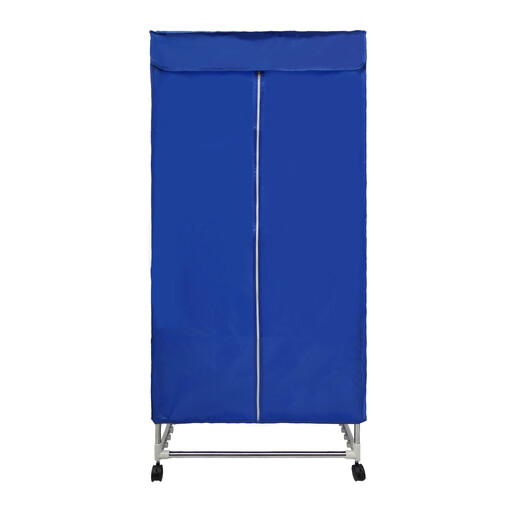 No image available
Hanging the dress to dry may be an option if its care label allows this drying position and the use of additional heat.
The product details list PTC warm air, an adjustable one- or two-tier hanging system and a timer with four settings. Its rated power of 1200–1500 W does not guarantee a particular drying time for a summer dress.
It depends on the drying position and heat treatment allowed by the care label. GINETEX distinguishes, among other things, between line drying and flat drying; a garment’s suitability for a tumble dryer does not automatically mean it can be dried using any heat source. For delicate dresses, also check whether the specific appliance is suitable.
Yes. You need to remove the moisture released as the clothes dry. The Verbraucherzentrale recommends regular short bursts of ventilation or cross-ventilation, and warns that moisture left in the room can encourage mould.
Multiply the rated power in kilowatts by the operating hours, then multiply the kilowatt-hours by your price per kilowatt-hour. Actual power use and drying results may differ from this calculation based on the rated power.
No. By applying the required CE marking, the manufacturer declares that the specific product meets the applicable EU requirements; it is not proof of an independent safety test. For mains-powered appliances in Germany, the applicable product requirements and marking for the specific model are what matter.
Electrical and electronic waste must not go in household rubbish. The Umweltbundesamt lists municipal recycling centres and options for returning items to retailers; you may want to check first whether the appliance can be repaired.