Limited floor space
If you want to hang T-shirts indoors and put the airer away afterwards, consider how much space it takes up both open and folded.


Measure the available floor space with T-shirts hanging on the airer. A heated winged model needs room widthways, while a tower may be a better fit if floor space is tight, provided its tiers have enough room for hanging clothes. If drying time is less important, a folding airer without a heating function is another option. Ventilation is still important when drying clothes indoors. Before buying, also check that the specific electrical model complies with EU requirements.
If you want to hang T-shirts indoors and put the airer away afterwards, consider how much space it takes up both open and folded.
If T-shirts often take a long time to dry indoors, heated rails may be worth considering. Don’t rely on a specific drying time unless it has been verified for the particular model.
If you dry laundry in your living space, think about how you’ll ventilate the room and keep an eye on humidity.
A good fit if: there’s enough floor space for the airer when open, with T-shirts hanging on it.
Consider: it takes up floor space and uses electricity; you can’t assume it will save a set amount of time.
A good fit if: floor space is limited and the tiers have enough room for your T-shirts.
Consider: the height and arrangement of the tiers need to suit both your laundry and the available space.
A good fit if: drying time isn’t a priority and you want to avoid using extra energy for heating.
Consider: this airer still needs floor space, and drying may take longer in a poorly ventilated room.
| Buying priority | What to check | Who is this particularly important to? |
|---|---|---|
| Floor space and storage | Compare the open dimensions, usable height and folded dimensions with the space where you’ll use and store the airer. | If I’m hanging T-shirts in a small flat, I want to keep walkways clear and be able to put the airer away afterwards. Around 36% of consumers prioritise floor space and storage. |
| Drying speed | Check the heating function, spacing between rails and, where applicable, the timer on the specific model; don’t assume a set drying time. | If my cotton T-shirts often take a long time to dry indoors, I’m interested in a heating function, without assuming it will save a particular amount of time. Around 29% of consumers prioritise drying speed. |
| Room humidity | Choose a spot where you can ventilate the room, and use a hygrometer to monitor humidity if needed. | If I dry laundry in my living space, I want to clear moisture by ventilating the room and be able to assess the humidity. Around 21% of consumers put monitoring room humidity first. |
| Electricity use | Consider the rated power together with the actual running time; the wattage alone doesn’t tell you the energy used per drying cycle. | If I want to avoid using extra electricity where possible, I’ll consider an unheated airer. Around 14% of consumers prioritise electricity use. |
When laundry dries indoors, moisture from the clothes enters the room air. A heating function or cover doesn’t replace ventilation.
Choose a spot where you can ventilate the room. The German Environment Agency recommends regular ventilation when there are extra sources of moisture, such as wet laundry. Consumer advice centres recommend checking room humidity with a thermo-hygrometer if needed.
The rated power alone doesn’t tell you how much energy is needed to dry a full load completely.
To calculate energy use, multiply the power in kilowatts by the running time in hours. Only compare figures calculated on the same basis.
In everyday use, hanging T-shirts and opening the wings or accessing the tiers also take up space.
Measure the actual space where you’ll use the airer, allowing enough room to hang clothes, and check where you can store it when folded.
Silvergear describes heated winged and tower-style models with a heated cover. Their designs are worth considering when comparing options for smaller rooms.
Todeco describes a folding, three-tier heated airer for indoor use.
The products below include a heated folding airer, as well as folding and extendable options for air-drying laundry. Above all, compare the space each one needs with your available room and decide whether a heating function matters to you.
 No image available
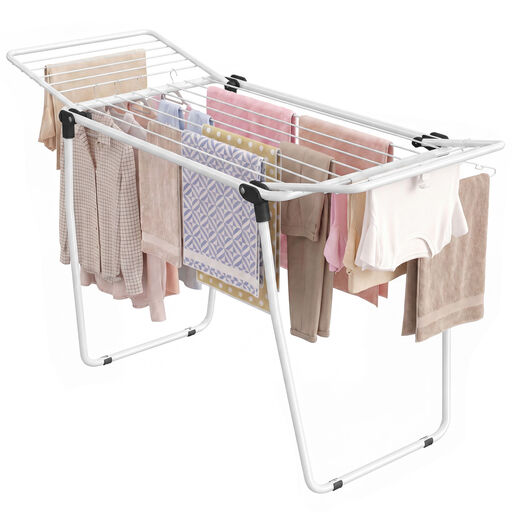
A heated winged design for anyone who wants to check whether the airer and hanging T-shirts will fit in their available space before buying.
The product details list 230 W, 45–55 °C and dimensions of 144 × 53 × 96 cm.
Before buying, check the rated voltage and EU compliance requirements that apply to this specific electrical model.
 No image available
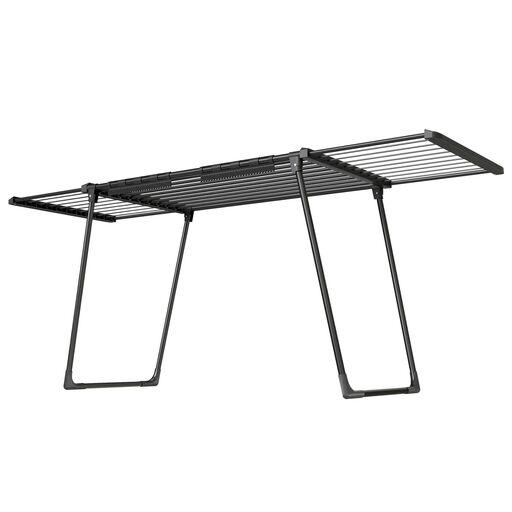
An unheated option for natural air-drying if you’d rather avoid an additional heating function.
The product details list dimensions of 158 × 53 × 93 cm when open, a folding design and 18 m of drying space.
 No image available
A folding air-drying option with adjustable width, so you can make the most of the space available.
The product details list dimensions of 62.5 × (113.5–200) × 90 cm and 18 m of drying space.
 No image available
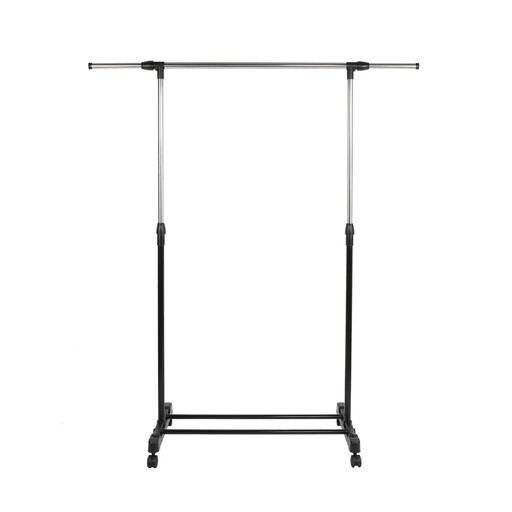
A single rail for T-shirts if you’re looking for an adjustable-height hanging option that you can move or fold away.
The product details list a width of 80–145 cm, a height-adjustable rail from 90–158 cm, wheels and a folding design.
 No image available
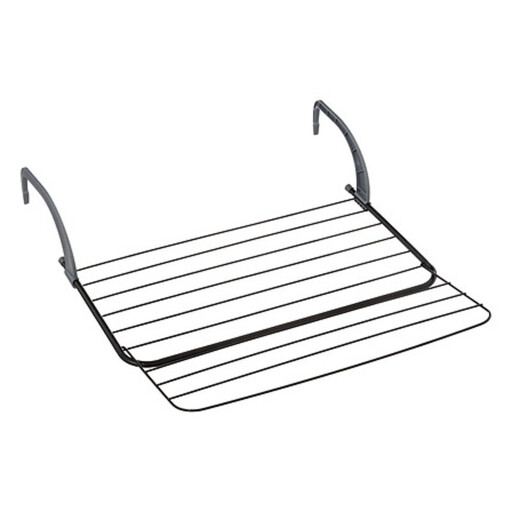
A compact air-drying solution which, according to the product description, must be attached to a suitable, sturdy surface.
The product details list dimensions of 60 × 55 × 13 cm, retractable arms and 7 m of drying space.
No. When drying laundry indoors, the German Environment Agency recommends ventilating the room regularly. Consumer advice centres recommend checking room humidity with a thermo-hygrometer if needed.
Follow the instructions for the specific model. For its Airer Heater, Todeco specifies a flat, dry surface, at least 1.5 m from sources of heat or water, and a maximum load of 5 kg per tier. These figures don’t automatically apply to other models.
Multiply the power in kilowatts by the running time in hours to calculate an estimated kWh figure. Silvergear lists 300 W for its premium tower. Assuming it runs for four hours, that works out at 1.2 kWh (0.3 kW × 4 h); this isn’t a measured figure for a drying cycle.
For electrical equipment with a rated voltage of 50 to 1,000 V AC, EUR-Lex sets out the requirements of the Low Voltage Directive, including CE marking. The CE mark is the manufacturer’s declaration of conformity, not approval by a central EU testing body. Check the rated voltage and applicable requirements for the specific model.