House shares with limited drying space
If you want to keep the hallway or communal room clear, consider the airer’s footprint, the number of usable hanging spaces and how easily it can be put away after use.


For a few pairs of cotton socks, an unheated clothes airer with a suitable small-items holder is the obvious place to start, provided you have enough time for them to dry. A heated model could be a good fit if you regularly need to dry small loads more quickly. Consider the usable space for socks, the floor and storage space it needs, and its electricity consumption. Heat is no substitute for ventilation or for checking care labels and the product’s electrical specifications.
If you want to keep the hallway or communal room clear, consider the airer’s footprint, the number of usable hanging spaces and how easily it can be put away after use.
If you dry damp clothes indoors, consider how well the drying area can be ventilated. The Federal Environment Agency and the consumer advice centre recommend regular ventilation to remove moisture.
If you’re considering extra electric heat, weigh it up against an unheated clothes airer. The Federal Environment Agency recommends clothes airers or washing lines as an energy-efficient way to dry clothes.
A good fit if: You’re drying a few pairs, have plenty of time and want to avoid using extra electricity.
Keep in mind: Drying may take longer. You’ll also need to remove moisture from the room with this option.
A good fit if: You regularly hang up small loads and want to store the airer away in a small space after use.
Keep in mind: Check that there’s enough usable space for your socks. Extra electric heat uses electricity.
A good fit if: Several people want to hang up small items at the same time and you can fold the airer away after use.
Keep in mind: A larger airer takes up more shared space when it’s unfolded.
A good fit if: Your house share wants to keep the floor clear permanently and there’s a suitable place to install it.
Keep in mind: Installation and power requirements may be excessive for just a few pairs of socks.
| What matters | What to check before buying | Who should pay particular attention? |
|---|---|---|
| Drying time and space for socks | Check how many spaces you’ll need at once and the gaps between the bars or on the small-items holder; follow care labels. | If I need my socks to be dry before I wear them again, I need enough suitable hanging spaces and want to treat the fabric in line with its care label. Around 33% of consumers put drying clothes in time first. |
| Moisture in the room | Decide in advance where the airer can go and how you’ll ventilate the room while clothes are drying. | If clothes are drying in a shared room, I want a well-ventilated spot so moisture can be removed. Around 27% of consumers prioritise room humidity. |
| Space and storage | Check the space needed when set up, that walkways will remain clear and, for foldable models, the dimensions when folded. | If the drying space only needs to be available temporarily, I need an airer that can be put away after use without blocking walkways. Around 20% of consumers pay particular attention to the space it takes up. |
| Electricity consumption | Use the rated power in watts and your planned running time to make a rough calculation; also consider an unheated airer. | If I plan to use extra heat regularly, I want to factor in the likely running time and my electricity tariff. Around 20% of consumers put electricity costs first. |
Damp clothes release moisture into the room, even when the clothes airer has heated bars. The Federal Environment Agency and the consumer advice centre recommend ventilating regularly.
Plan the drying area so you can ventilate the room, and keep shared walkways clear.
In a house share, you may also need to agree on where to dry clothes and when to ventilate so it works for everyone day to day.
The number of heated bars doesn’t tell you how many pairs of socks you can hang at once with enough space between them.
Count how many spaces you need and check the gaps between bars, the design and whether a small-items holder will fit the specific airer.
The wattage alone won’t tell you the electricity cost of a session or how long your clothes will take to dry.
For a rough calculation, divide the wattage by 1,000, then multiply by the running time in hours and your price per kWh. Base your estimate on how you’ll actually use it, and consider unheated options for small loads too.
Using the heating function means extra electricity consumption.
Compact and two-tier heated airers are worth considering for comparison. Check the exact model rather than assuming features are the same across different versions.
Adler describes the AD 7821 as a foldable heated clothes airer.
Clarsen is a brand to consider for heated clothes airers. The specifications for the particular model are what matter.
Foxydry describes Pro as a permanently installed solution, fitted to the ceiling or wall and featuring a warm-air function.
According to the manufacturer, Leifheit offers a small-items holder that can be attached to certain Pegasus clothes airers.
The product cards below include heated and foldable unheated clothes airers for drying socks in a house share.
 No image available
An option if you want to dry socks with heat and fold the airer away after use.
The product name lists 45–55 °C, 230 W and dimensions of 144L × 53W × 96H cm. Before buying, check the mains voltage and CE information on the specific appliance, as well as the care labels on your socks.
If you’re drying clothes indoors, you’ll still need to remove moisture by ventilating regularly.
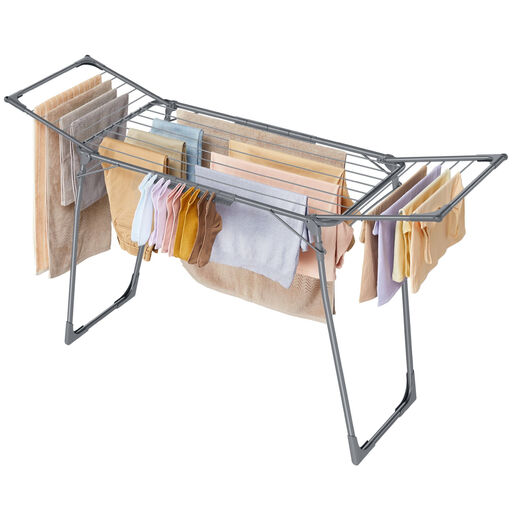 No image available
A foldable, unheated airer with a sock holder if you want to dry clothes without extra electric heat.
The stated dimensions when unfolded are 52,5 × 173 × 96,5 cm. If you’re drying clothes indoors, remember to ventilate regularly.
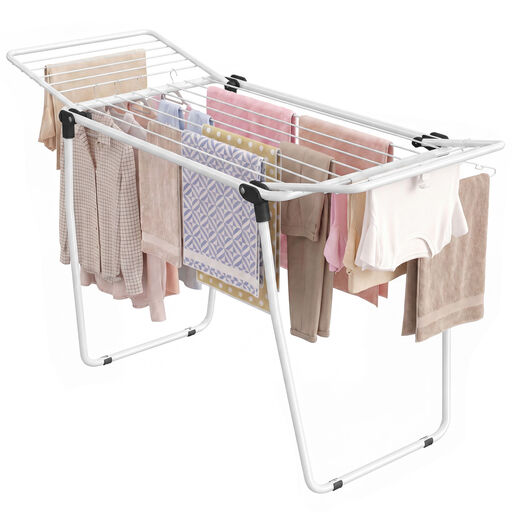 No image available
A foldable, unheated airer with a sock holder for anyone who wants to avoid extra electric heat.
The stated dimensions when unfolded are 158 × 53 × 93 cm. If you’re drying clothes indoors, remove moisture by ventilating regularly.
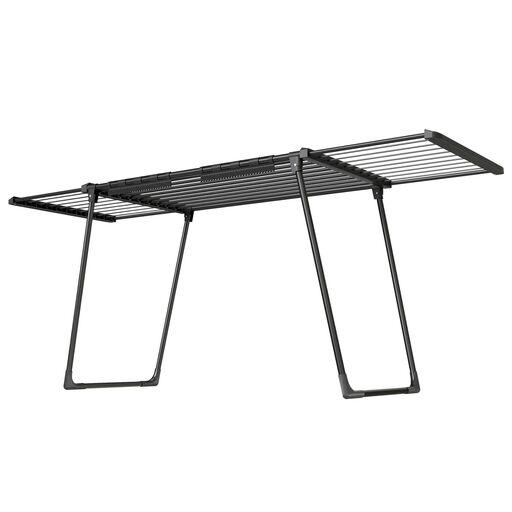 No image available
A foldable, unheated airer with a sock holder if you want to dry socks without extra electric heat.
The product name lists dimensions of 62,5 × 113,5–200 × 90 cm. Make sure you have enough space when setting it up, and ventilate regularly if you’re drying clothes indoors.
No. The Federal Environment Agency recommends ventilating regularly when drying clothes indoors to remove moisture. The airer’s heating function doesn’t replace this.
Read the socks’ care label and the instructions for the specific appliance. The care label tells you which treatments are suitable for that particular fabric; the cotton content alone isn’t enough to go on.
Divide the rated power in watts by 1,000, then multiply the result by the running time in hours and your price per kWh. The calculation is only as accurate as the running time you use; without your tariff, you can’t work out a specific cost in euros.
The consumer advice centre says that online orders generally come with a 14-day right to cancel, starting from delivery. Claims relating to faulty goods are separate from this. A voluntary manufacturer’s guarantee is also different from your statutory consumer rights against the retailer.
Electrical equipment covered by the EU Low Voltage Directive must meet certain requirements to be placed on the market, including CE marking. EUR-Lex and the EU’s information on CE marking describe the relevant scope; check the details for the specific product. A CE marking alone doesn’t prove a particular drying performance or that the product has been independently tested.