People who want to dry swimwear gently
If you mainly dry stretchy swimwear and want to avoid direct heat, follow the care label. GINETEX GERMANY lists natural drying as an option when tumble drying is not permitted.


If you mainly dry swimwear, a small, unheated clothes airer is the obvious choice: GINETEX GERMANY lists natural drying as an option when the care label rules out tumble drying. A heated model is better suited to extra laundry that the care instructions say can be exposed to heat. Either way, consider the space available, ventilation and the appliance’s guidance on where it can be used safely.
If you mainly dry stretchy swimwear and want to avoid direct heat, follow the care label. GINETEX GERMANY lists natural drying as an option when tumble drying is not permitted.
If you share your living space and want to put the airer away after use, compare its dimensions when open and folded.
When drying laundry in shared indoor spaces, good ventilation and a suitable spot for the appliance are important. The Verbraucherzentrale points out that moisture needs to be removed regularly.
A good fit if: you mainly dry swimwear and want to avoid direct contact with heat.
Worth bearing in mind: The airer does not heat up; air circulation and indoor humidity still matter when drying clothes indoors.
A good fit if: you also regularly have laundry that the care instructions say can be exposed to the heat provided.
Worth bearing in mind: A heating function does not mean it is suitable for swimwear; you still need to ventilate the room to remove moisture.
| Priority | What to check when buying | Who is this important to? |
|---|---|---|
| Protecting fabrics | The care label on each item and the appliance instructions; only use a heating function if the care instructions allow it. | If you dry swimsuits, bikinis or swimming trunks, following the care instructions is your main concern. Around 36% of consumers put protecting delicate fabrics first. |
| Space and storage | Dimensions when open and folded, as well as space for walkways and access to a socket. | If you share a room, you’ll want to be able to put the airer away once the laundry is dry. Around 29% of consumers prioritise the space it takes up and how easy it is to store. |
| Room humidity and positioning | Ventilation and indoor humidity; for electrical appliances, also check the instructions and the permitted location. | If you dry clothes indoors or use an electrical appliance, good air circulation and keeping it away from water are essential. Around 21% of consumers prioritise room humidity and a safe location. |
| Energy use and running time | The rated power of the specific model and the intended operating time; calculate energy use in kWh using watts × hours ÷ 1,000. | If you only want to switch on the heater for suitable laundry, energy use during actual operation is what matters to you. Around 14% of consumers say this is their main purchasing priority. |
The temperature of a rail does not tell you what treatment is suitable for a particular swimsuit or bikini.
Check the care label before exposing an item to direct heat. If it does not specifically allow this, dry it without heat.
Drying clothes indoors creates moisture, which heat alone will not remove from the room. The Verbraucherzentrale recommends regular ventilation and suggests using a thermo-hygrometer to monitor humidity.
Make sure you can ventilate the room while the laundry is drying, and keep an eye on indoor humidity.
Rated power alone does not show how much energy a complete drying cycle uses; the running time matters too.
Compare power and actual running time on a like-for-like basis, and consider hanging laundry to dry without heat as an alternative.
The term “towel rail” does not mean the appliance can be placed near a shower or bath. The VDE advises keeping electrical appliances away from showers and baths.
Check the appliance instructions and its intended location before using it.
Models 850-048 and 850-032 offer different designs: a two-tier airer and a towel rail with five bars.
The range includes heated clothes airers with covers, as well as a separate tower-style model.
This heated, folding model is an example of a classic wing-style design.
Model 10051099 is an unheated, folding option for comparison, designed for natural air drying.
This selection includes folding airers for natural air drying and a heated model for extra laundry that the care instructions say can be exposed to heat. Always check the care label on swimwear.
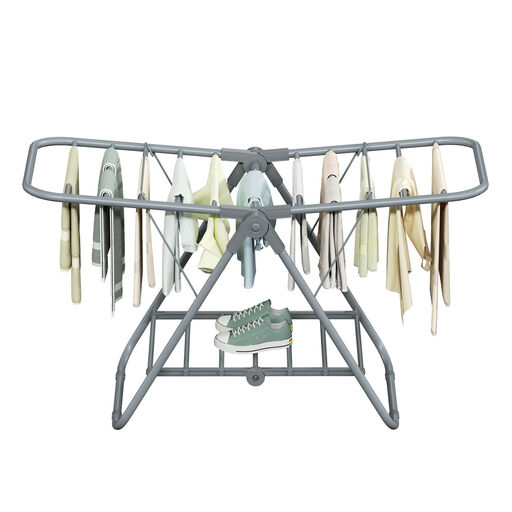 No image available
The folding design is an option for natural air drying if you want to put the airer away after use.
Two height-adjustable wings; stated dimensions: 101 × 44 × 50 cm; supports up to 10 kg.
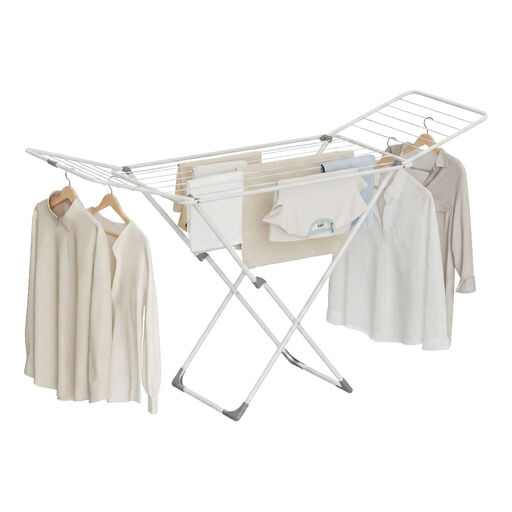 No image available
If you’re looking for a folding airer for natural air drying, this model folds flat, according to the product description.
17 bars; 18 m of drying space; supports up to 15 kg when the weight is evenly distributed.
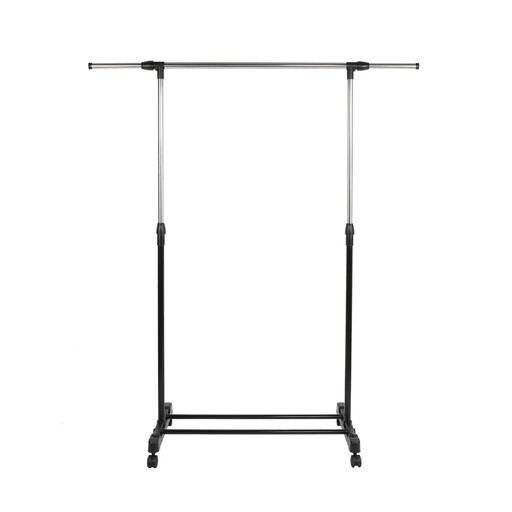 No image available
The single height- and width-adjustable rail may suit you if you want to hang individual items of clothing and move the rail around the room.
Height 90–158 cm; width 80–145 cm; folds away and has four wheels.
 No image available
This heated model may be suitable for extra laundry if its care instructions allow the heat provided; it is not approved for direct heat contact with swimwear.
Two fold-out side wings; 230 W; stated heating temperature 45–55 °C. Before buying, check that the specific appliance has the required CE marking, German-language instructions and safety information.
Not in every case: the care label on the specific item is what matters. The stated temperature of a clothes airer does not mean the fabric is approved for heat; if the care instructions do not allow direct heat, dry it without heat.
No. Moisture still needs to be removed when drying clothes indoors. The Verbraucherzentrale recommends regular airing or cross-ventilation and suggests using a thermo-hygrometer to monitor humidity.
Don’t assume the appliance’s name means it is safe to use in this location. The VDE advises keeping electrical appliances away from showers and baths; also check the instructions and the location specified for the particular appliance.
The EU Low Voltage Directive applies to mains-powered electrical appliances within the relevant voltage range of 50 to 1,000 V AC. The Bundesnetzagentur lists CE marking and any required instructions and safety information in German as points to check. CE marking is a manufacturer’s declaration, not an independent product test.
Multiply the rated power in watts by the actual running time in hours, then divide the result by 1,000 to calculate an estimated energy use in kilowatt-hours. This is a guide; actual energy use and running time may vary.