Households with lots of bath towels
If you regularly dry several thick towels, check that they fit on the fully opened airer with enough space between them.


If you regularly dry several thick bath towels, usable spacing, footprint and load capacity matter more than the number of heated rails. For outdoor clothing, follow the care instructions for each item. Heat from the airer does not replace checking the care label or ventilating your home regularly. Before deciding on a specific purchase, you should also check the conformity documents for the electrical model in question.
If you regularly dry several thick towels, check that they fit on the fully opened airer with enough space between them.
For bath towels and muddy waterproofs or technical clothing, follow the care instructions for each fabric when washing and drying.
If you dry laundry indoors, you’ll need a suitable spot for the airer and should plan to ventilate the room regularly.
A good fit if: You can hang several towels on the open airer with enough space between them.
Consider: The footprint and rail layout are key. Heat does not remove moisture from the room.
A good fit if: You mainly need a permanent freestanding or wall-mounted spot for individual towels.
Consider: A slim design won’t necessarily have room for several large outdoor layers.
A good fit if: You’re more likely to dry hanging clothes than wide bath towels, and their care instructions allow the heat used.
Consider: InnovaGoods states that the Dupledry’s warm-air generator has a power rating of 1,200 W. This does not indicate a general drying time or prove that it is suitable for every outdoor fabric membrane.
A good fit if: Drying space and room between items matter more than extra heat from the airer.
Consider: When drying laundry indoors without power, you still need to ventilate the room to remove moisture.
| What matters | What to look for when buying | Who should pay particular attention? |
|---|---|---|
| Room for thick towels | Compare the open dimensions, rail layout and stated load capacity with the towels you actually need to dry. | If I want to hang several large bath towels with space between them, usable hanging space matters more than the number of rails. That’s why around 36% of consumers prioritise room for thick towels. |
| Outdoor fabrics | Check the care label and manufacturer’s instructions. Don’t assume that permission to use heat means the item can touch a heated rail directly. | If I’m drying muddy technical clothing, I first want to know how it can be cleaned and whether direct contact with heat is suitable. Around 29% of consumers prioritise fabric care. |
| Room humidity | Check whether you can ventilate the intended drying spot regularly and whether there are other sources of moisture in the room. | If I’m drying laundry indoors, I need a spot where regular air circulation is possible. Around 21% of consumers prioritise managing room humidity. |
| Electricity and storage | Use the rated power, your expected usage time and your electricity tariff to estimate costs. Compare the open and folded dimensions separately. | If I want to keep running costs down and put the airer away after drying, energy use and folded size are equally important. Around 14% of consumers prioritise running costs and storage space. |
Even when drying laundry with heat, moisture from the clothes enters the room. The German Environment Agency recommends taking particular care to ventilate regularly when drying damp laundry indoors.
Check that the intended spot can be ventilated as carefully as you check the airer’s dimensions.
Wide, thick towels need room between them. Rail layouts and the footprint when open vary depending on the design.
Plan where your actual towels will go on the fully opened airer instead of simply counting the rails.
Care instructions can vary from one garment to another. GORE-TEX refers customers to the garment manufacturer’s instructions for its outerwear. Permission to tumble-dry an item on a warm setting does not automatically mean it can touch a heated rail directly.
Check the label and manufacturer’s instructions for each delicate item individually.
The German Environment Agency recommends an unheated clothes airer as a particularly energy-efficient drying method. By comparison, InnovaGoods states that the Dupledry’s warm-air generator has a power rating of 1,200 W.
Compare the designs and how long you’ll use them, and calculate potential costs using your electricity tariff. Don’t try to compare running costs using isolated power ratings alone.
An electric model uses electricity; the actual cost depends on how long you use it and your individual tariff.
The foldable AD 7821 is one example of an airer with heated rails.
The DO7117DR is a slim heated towel rail that the manufacturer says can be used freestanding or wall-mounted.
The Warmmat and Dupledry represent two different types of electric dryer: one with heated rails and one with an enclosed warm-air system.
The Classic 250 Flex Black is an unheated option to consider if drying space matters more than extra heat.
This selection includes a folding heated airer and towel radiators as a space-specific alternative for individual towels. For outdoor clothing, always follow the care instructions for the garment in question.
 No image available
Could suit households looking for a folding heated airer for damp laundry. For outdoor clothing, check that the care instructions for the specific fabric allow it.
Listed dimensions are 144 × 53 × 96 cm, with a maximum load capacity of 10 kg.
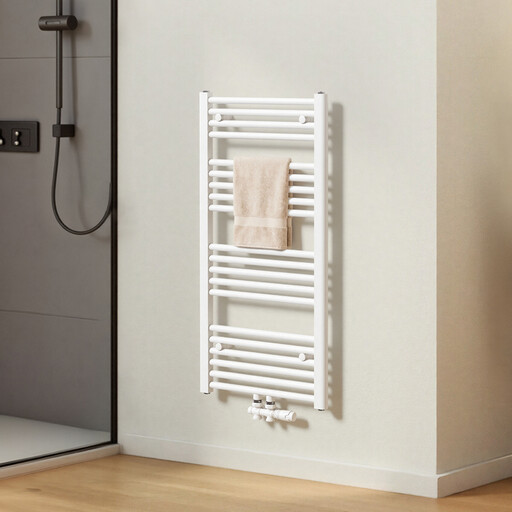 No image available
Could suit individual towels if it can be connected to an existing central heating system; this model is not a folding clothes airer.
The description lists 427 W and a G1/2 connection.
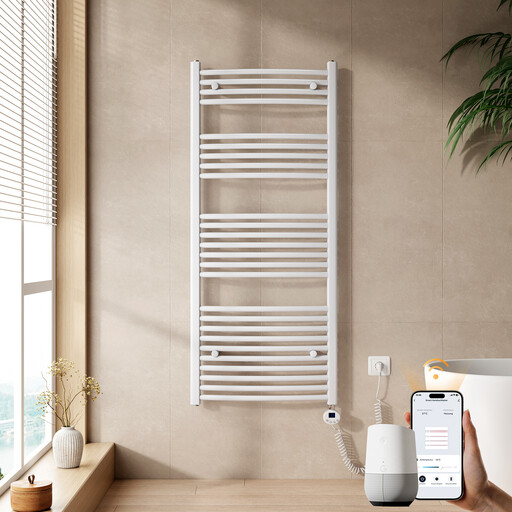 No image available
Could suit towels in a wall-mounted bathroom radiator; it is not a freestanding or folding clothes airer.
Listed dimensions are 1400 × 600 mm, with a power rating of 600 W, 220–240 V and IP44.
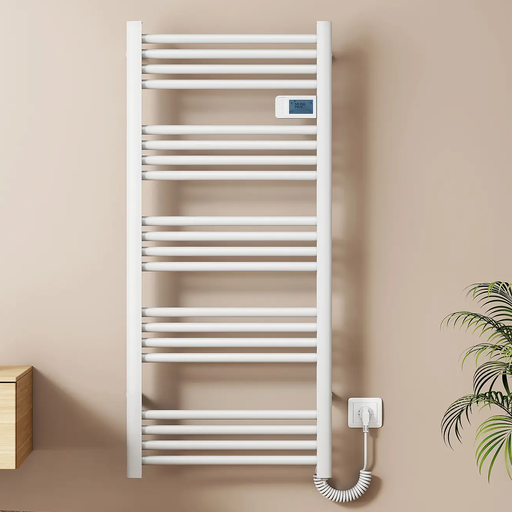 No image available
Could suit towels on an electric bathroom radiator; its design is not a substitute for a folding airer for several large items.
The description lists dimensions of 1200 × 540 mm, a power rating of 600 W, touch controls and a timer.
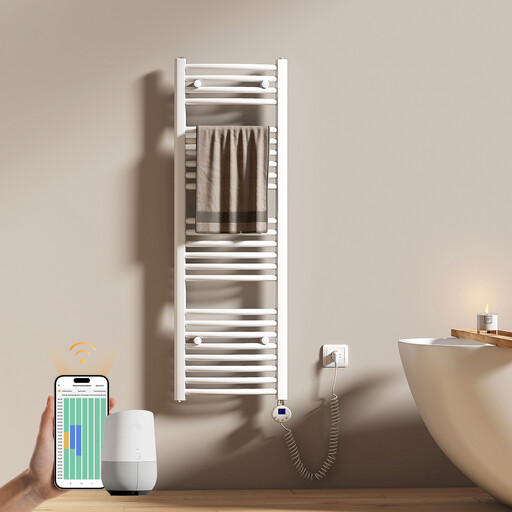 No image available
Could suit towels on a wall-mounted electric bathroom radiator; it is not a folding clothes airer for several large outdoor layers.
Listed dimensions are 1200 × 400 mm, with WiFi control and IP44.
Not without checking the care instructions for the specific garment. The airer won’t remove dirt. GORE-TEX recommends following the garment manufacturer’s instructions for its outerwear and not washing it with heavily soiled items. Permission to tumble-dry on a warm setting does not automatically mean direct contact with a heated rail is suitable.
Yes, if you’re drying laundry indoors. Damp laundry releases moisture into the air, so the German Environment Agency recommends taking particular care to ventilate regularly when drying wet laundry in your home.
No. You can’t tell from the type of appliance alone. DOMO lists an IPX4 rating for the DO7117DR and markets it for bathroom use, but you should still check the complete appliance instructions, the specific location and the electrical installation.
For electrical equipment covered by the Low Voltage Directive, which applies to voltages from 50 to 1,000 V AC, manufacturers must carry out a conformity assessment, draw up an EU Declaration of Conformity and apply the CE marking. The European Commission explains these manufacturer obligations; check the documents for the specific model. According to the German Federal Institute for Occupational Safety and Health, the GS mark is not a comprehensive assessment of a product’s quality or performance, nor a general substitute for these requirements.
Multiply the rated power in kilowatts by the assumed operating time in hours. To estimate the cost, multiply the result by your price per kilowatt-hour. For the Adler AD 7821, rated at 220 W, five assumed hours running continuously at its rated power would work out to 1.1 kWh. This is a calculation based on the rated power, not a measurement of actual consumption.