Households short on space
If you plan to keep the airer in a small laundry nook, compare its dimensions when open with the space available, and its folded dimensions with the storage space you have in mind.


If you regularly hang towels indoors and want them to rest on heated bars, start by comparing the airer’s footprint when open with its usable towel space. If floor space is tight, or you’d rather not use extra electricity, a slim, unheated airer could be a better fit. The German Environment Agency recommends ventilating regularly when drying damp laundry indoors; heated bars don’t remove moisture from the room.
If you plan to keep the airer in a small laundry nook, compare its dimensions when open with the space available, and its folded dimensions with the storage space you have in mind.
If you hang towels indoors, weigh the benefit of heated bars against the extra electricity they use, and check how much of the airer’s surface you can actually use.
If towels can only be dried indoors, choose a spot where you can ventilate to remove the moisture they release.
A good fit if: You have room for a few towels on an airer with its wings open and want heated bars. Adler lists the open dimensions of the AD 7821 as 148 × 52,5 × 90 cm.
Keep in mind: It folds flat for storage, but still takes up its full footprint when you’re drying laundry.
A good fit if: You have less floor space but enough height. According to the manufacturer, the Adler AD 7831 measures 73 × 58 × 139 cm when open.
Keep in mind: Check that your wider towels will fit on each tier and can hang with enough space between them.
A good fit if: You don’t need heated bars and want drying space without using electricity. Leifheit lists the Pegasus 150 Solid Slim as offering 15 m of drying length with a width of 55 cm.
Keep in mind: Even without a heating function, the airer still takes up space. Drying length and the number of heated bars are different measurements.
| Buying criterion | What to check before buying | Who is it important for? |
|---|---|---|
| Floor and storage space | Compare the open dimensions with the space where you’ll dry laundry, and check the folded dimensions against your storage space separately. | If I’m putting the airer in a tight laundry nook, I want to know whether it will block the way when in use and where I can put it afterwards. Around 36% of consumers would prioritise the airer’s footprint and storage space. |
| Towel space and heat | Check the layout of the bars and usable surface against the number and width of your towels. | If I want to hang towels as spread out as possible while making use of heated bars, the usable surface is what matters. Around 29% of consumers would prioritise towel space and heat. |
| Room humidity | Check that you can ventilate the room regularly where you plan to dry your laundry. | If I can only dry laundry indoors, I need to consider the moisture in the room where I put the airer. Around 21% of consumers would prioritise managing room humidity. |
| Electricity use | Compare the rated power and planned running time on the same basis, or choose a design that can be used without electricity. | If I want to avoid using extra electricity, a heated airer is only worth considering if the warmth justifies the electricity it uses. Around 14% of consumers would prioritise electricity costs. |
An airer may fold flat and still take up a lot of space when you’re drying laundry. For the Adler AD 7821, the manufacturer lists dimensions of 148 × 52,5 × 90 cm when open and 113 × 52,5 × 8 cm when folded.
Measure the available space with the airer open and towels hanging on it; check your storage space separately.
A poorly chosen spot could block your way while laundry is drying.
Heated bars don’t remove moisture from the room. The German Environment Agency recommends ventilating regularly when drying laundry indoors.
Choose a drying spot where you can remove the moisture, whether or not the airer is heated.
Remember to allow for the extra ventilation needed when using an airer indoors.
The number of heated bars and the drying length in metres describe different features; neither tells you how many towels you can spread out comfortably.
Compare the layout of the bars and the usable surface with the size of your towels, rather than relying on a single figure.
The AD 7821 and AD 7831 are heated airers in winged and tiered designs respectively.
The 7080400 heated folding airer is another winged design, and one worth comparing with other heated airers.
The Pegasus 150 Solid Slim is an unheated alternative to consider if drying space and a slim width matter more to you than heated bars.
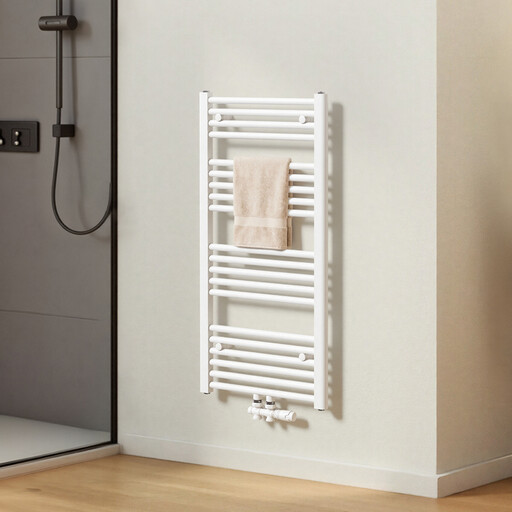
The following Joybuy picks are a bathroom radiator and a wall-mounted towel rail, not freestanding clothes airers. They’re only worth considering if a radiator or wall-mounted solution suits your drying space.
 No image available
This may suit you if you’re looking for a bathroom radiator with a towel rail function, rather than a freestanding clothes airer.
The product name lists dimensions of 1000 × 500 mm, a power rating of 427 W and a central connection. Before buying, check that the radiator type is right for your intended installation location.
 No image available
This could suit your needs if you’re looking for a heated towel rail on the wall rather than a freestanding clothes airer.
The product description lists dimensions of 58,5 × 55 cm, a top shelf and wall mounting. Check that the installation method is suitable for your bathroom.
Measure the available floor space and height with the airer open, as well as the space where you plan to store it. Also compare the dimensions with your towels when spread out; Adler lists quite different dimensions for the AD 7821 when open and folded.
Yes. The German Environment Agency recommends ventilating regularly when drying laundry indoors. A heated airer doesn’t remove moisture from the room.
Multiply the rated power in kilowatts by the planned running time in hours. The result is a calculated amount of energy in kilowatt-hours, not a measured consumption figure. To estimate the cost, multiply this figure by your own price per kilowatt-hour.
The EU Low Voltage Directive applies to mains-powered equipment rated at 50 to 1.000 V AC, provided the equipment falls within its scope. According to the European Union, the manufacturer is responsible for meeting the relevant requirements and applying the CE marking. Germany’s Federal Network Agency also recommends checking the product identity, manufacturer information and whether a German-language instruction manual with usage and warning information is included. The CE marking isn’t an independent performance test.