What should you look for when buying?
First work out how many shirts need to hang freely and how much floor space you have. Then compare heating duration, care instructions and ventilation options.
| What matters when buying |
What to check |
Who is it important to? |
| Drying time |
Compare the number of shirts, usable rails and timer settings. The rated power alone won’t tell you how long a load will take to dry. |
If I only have a set amount of time between washes, usable hanging space matters most to me; around 26% of consumers put drying time first. |
| Floor space and storage |
Check the open and folded dimensions, doorways and available hanging height against the space you plan to use. |
If I need to clear the shared space after drying, I pay attention to the footprint and storage size; around 21% of consumers prioritise space requirements. |
| Shirt care and hanging |
Check the care label and appliance instructions. Find out whether shirts can hang freely on hangers or will touch the heated rails. |
If I want to dry cotton shirts in line with their care instructions, how they hang is crucial; around 16% of consumers prioritise shirt care. |
| Electricity use |
Multiply the rated power by the actual running time. The manufacturer gives the Adler AD 7821 a rated power of 220 W; four hours would use 0.88 kWh based on this calculation. |
If I want to weigh the extra energy used for heating against the drying time available, I want to be able to work out the consumption; around 16% of consumers prioritise electricity use. |
| Room humidity |
Plan where to dry your clothes and how you’ll ventilate the room. The German Environment Agency recommends airing rooms regularly when drying wet laundry indoors. |
If I dry clothes indoors, I want to let the moisture out of the room; around 21% of consumers pay particular attention to room humidity. |
Joybuy products
The options below include a heated wing airer and a warm-air dryer. Check which drying method suits your shirts and the time you have between washes.
 No image available
Foldable heated clothes airer, 45–55 °C
The wing design could suit you if you want to spread several shirts across an extendable drying area.
The product details list a temperature range of 45–55 °C, a maximum load of 10 kg and dimensions of 144 × 53 × 96 cm. Check that the hanging space and intended use are suitable for your shirts.
For a mains-powered appliance, check the markings and the EU Declaration of Conformity for the specific German model before buying.
View at Joybuy
 No image available
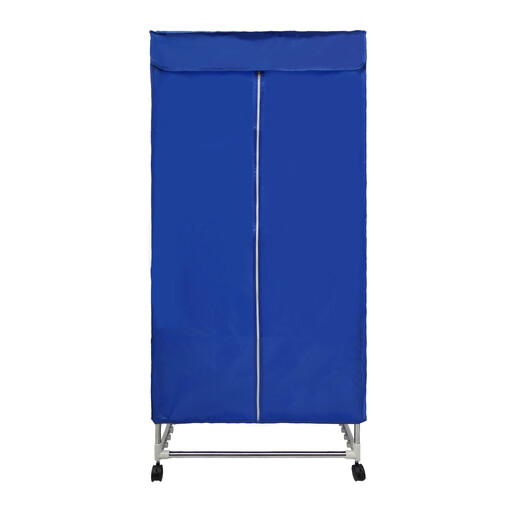
Electric warm-air dryer with timer, Blue
This option uses circulating warm air rather than heated clothes-airer rails. It may suit people who want to hang shirts under a cover.
The product description lists a power rating of 1,200–1,500 W, four timer settings from 60 to 240 minutes and adjustable shelves. Its drying method and intended use differ from those of a traditional clothes airer.
Before buying, check that the dimensions and shelves are suitable for your shirts. For a mains-powered appliance, you should also check the markings and the EU Declaration of Conformity for the specific German model.
View at Joybuy
Frequently asked questions about drying cotton shirts
Does a timer guarantee my shirts will be dry before my next planned wash?
No. For the InnovaGoods Warmmat, the timer specified by the manufacturer sets the heating time, up to 12 hours; it doesn’t indicate how long a particular load of shirts will take to dry. Allow for space between shirts, the time available and the care instructions.
Do I need to air the room when using a heated clothes airer indoors?
Yes. The German Environment Agency identifies wet laundry as a source of moisture indoors and recommends paying particular attention to regular ventilation when drying clothes inside. The heating function doesn’t remove moisture from the room.
How can I work out the extra electricity use?
Multiply the rated power in kilowatts by the number of hours the appliance runs. Based on the manufacturer’s 220 W rating for the Adler AD 7821, four hours would use 0.88 kWh; you can then apply your own electricity rate per kilowatt-hour. This is a calculation, not a measurement of the energy used to dry a load of shirts.
What should I do if the appliance breaks or needs disposing of in Germany?
When you buy from a business seller in the EU, you generally have a legal guarantee of at least two years from the date you receive the goods, as explained by Your Europe. This is separate from any voluntary manufacturer’s warranty. You can take end-of-life electrical appliances to municipal collection points; the Verbraucherzentrale notes that they accept them free of charge.
What markings should a new mains-powered heated airer have?
For new electrical equipment covered by Germany’s 1. ProdSV, including appliances rated at 50 to 1.000 V AC, the manufacturer must issue an EU Declaration of Conformity after a successful conformity assessment and affix the CE marking. The CE mark doesn’t guarantee a particular drying performance.


