If you regularly need your shorts again quickly
If you often dry cotton shorts in your utility room, consider whether a heated airer would fit into your routine. This alone doesn’t tell you how long drying will take.


A heated clothes airer can be useful if you regularly need your cotton shorts again quickly and the design you choose suits the space available. A compact airer may be enough for a few pairs of shorts, while a winged airer offers more hanging space for several items; a warm-air dryer works in a different way. None of these options removes the moisture released during drying from the room, so check the labelling and documentation for the specific product before you buy.
If you often dry cotton shorts in your utility room, consider whether a heated airer would fit into your routine. This alone doesn’t tell you how long drying will take.
A slim freestanding airer, a fold-out winged airer and a wall-mounted option all take up space differently. The key is whether the appliance will fit when in use and can be stored away afterwards.
When drying damp laundry indoors, air circulation matters just as much as the size of the appliance. The German Environment Agency recommends paying particular attention to regular ventilation when there are additional sources of moisture, such as damp laundry.
First, consider whether the extra heat would make a practical difference to your laundry routine. Then compare the space it takes up, its electricity consumption, the care instructions for your shorts and whether you can remove moisture from the room.
The table compares the key things to consider, based on what matters most to people drying cotton shorts in a utility room.
| What matters | What to check before buying | Who should pay particular attention? |
|---|---|---|
| Room humidity | A hygrometer to monitor humidity; ventilation options in the room. | If I dry shorts indoors, I want to be able to ventilate the room rather than mistake a heating function for dehumidification. Around 26% of consumers put room humidity first. |
| Drying time | Enough space to hang the shorts with room around them; comparable conditions when comparing performance. | If I regularly need my shorts again soon, I want to know whether extra heat will suit my routine. Around 26% of consumers pay particular attention to drying time. |
| Space required | Dimensions when fully opened and storage space; for wall-mounted appliances, the fixing requirements and position of the socket. | If there’s little free space in my utility room, the appliance needs to fit when in use and be easy to store or securely mount afterwards. Around 21% of consumers put available space first. |
| Electricity consumption | Consider the power rating and actual running time together; watts alone don’t show the energy used per dry pair of shorts. | If I want to limit the extra electricity used, I don’t want to judge consumption per drying cycle by the wattage alone. Around 16% of consumers prioritise electricity consumption. |
| Fabric care | The care label on each pair of shorts and the appliance’s instruction manual. | If I want to look after my particular cotton shorts, I need to know which treatments the care label allows. Around 11% of consumers prioritise fabric care. |
Even warmed-up laundry releases moisture into the room. A heating function therefore doesn’t replace monitoring room humidity or providing the necessary air circulation.
Check how you can ventilate the room and, if needed, monitor the relative humidity with a hygrometer.
Heated-bar and warm-air appliances have different power ratings. On their own, these figures don’t tell you how long drying will take or how much energy is needed to dry a pair of shorts.
Only compare appliances using measurements taken under similar conditions, such as a similar amount of laundry, room humidity and running time.
A winged airer needs more space when fully opened, while a wall-mounted option requires a suitable place to install it.
First measure the space available when the appliance is in use, then check your storage space or, for a wall-mounted model, the fixing requirements and socket position.
Manufacturer information about a model’s features doesn’t automatically confirm that the specific product on offer has the required labelling and documentation.
Before you buy, check the identity of the model on offer, the required labelling and the accompanying safety information in German.
The AD 7821 is a foldable heated-bar airer designed as a compact freestanding option.
According to the manufacturer, the DO7117DR can be used as a slim freestanding or wall-mounted option.
Warmmat is a heated winged airer, while Dupledry uses a separate warm-air blower with a cover.
The Foxydry Pro is a permanently installed warm-air option for households that dry larger loads as well as shorts.
The products below include a foldable heated clothes airer and a portable electric warm-air dryer. Before buying, check the identity of the specific product on offer, the required labelling and the instruction manual and safety information in German.
 No image available
A good fit if you’re looking for a heated freestanding airer that folds away; extra heat doesn’t remove the need to ventilate the room.
Product name includes: temperature range of 45–55 °C and dimensions of 144L × 53W × 96H cm.
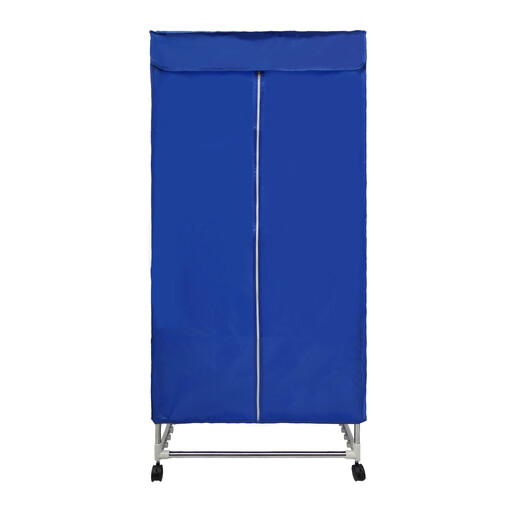 No image available
A warm-air alternative to heated hanging bars; bear in mind that warm air doesn’t remove the moisture released into the room either.
Yes. Air circulation is still important when you use a heated clothes airer, as the laundry releases moisture into the room. The German consumer advice centre recommends monitoring relative humidity with a hygrometer; how you ventilate will depend on the conditions in the room.
Not necessarily. Check the care label on the specific pair of shorts and the appliance’s instruction manual. GINETEX distinguishes between symbols for natural drying and tumble drying; these symbols alone don’t indicate that a garment is approved for use with a particular appliance.
Consider the power rating in kilowatts together with the running time in hours; multiplying the two gives the calculated energy use in kilowatt-hours. This still doesn’t tell you how much energy it takes to dry a pair of shorts, as that would require measurements taken under comparable conditions.
Check the dimensions when the appliance is ready to use, as well as the space available for storage. For a wall-mounted model, you’ll also need a suitable installation location, appropriate fixings and a conveniently positioned socket.
The relevant requirements for electrical equipment apply to electric clothes airers placed on the market in Germany and designed for 50–1,000 V alternating current. The European Commission explains that CE marking is a declaration by the manufacturer; the German Federal Network Agency also lists product identification and the required instructions and safety information in German as points to check. CE marking isn’t an independent test mark.