Households drying socks and outdoor layers
You need easy-to-reach spots for smaller items as well as room for larger layers that are still damp after washing.


If you regularly need to dry cotton socks and larger outdoor layers at the same time, the key factors are usable rails, enough space between items and the amount of floor space available. A switchable heating function could suit you if you often dry clothes indoors and don’t have a suitable outdoor space. If you only dry clothes occasionally and aren’t in a hurry, an unheated airer may also be an option. The German Environment Agency recommends clothes airers and washing lines as energy-efficient ways to dry laundry. It’s still important to follow garment care instructions and air the room regularly.
You need easy-to-reach spots for smaller items as well as room for larger layers that are still damp after washing.
You’re comparing the footprint of an opened winged airer with the height and accessibility of a multi-tier or compact model.
You want to use the heating function only when needed and check whether your outdoor clothing can come into direct contact with heat.
The figures show the share of consumers who prioritise each factor when drying cotton socks and larger outdoor layers.
| Priority | What to look for when buying | Who it matters most to |
|---|---|---|
| Space for mixed loads | Compare the dimensions when opened, along with the accessibility of the rails, the space between tiers and any small-item holders, against the laundry you need to dry. | If I’m hanging socks and larger layers at the same time, I need enough space and room between items for both; around 31% of consumers prioritise space for mixed loads. |
| Fabric care and contact with heat | Check the care label and appliance instructions, and remove dirt using a method suitable for the fabric before drying. | If caring for my outdoor layers matters more than extra heat, I follow the care instructions; around 25% of consumers make fabric care their top priority. |
| Where to put it and room humidity | Check the available floor space or installation location, and make sure there’s good airflow when drying clothes indoors. | If I’m drying clothes indoors, the airer needs to fit in a suitable spot and I need to consider the humidity in the room; around 25% of consumers prioritise location and room humidity. |
| Energy use | Consider the rated power and how long you plan to use it for, and also think about an unheated alternative. | If I only need the heating function occasionally, I want to weigh up its energy use against an unheated airer; around 19% of consumers prioritise energy use and cost. |
A good fit if: you regularly dry socks and longer items at the same time, and have enough room for the airer when it’s open.
What to consider: It uses electricity and takes up space; the heating function alone doesn’t tell you how long thicker layers will take to dry.
A good fit if: you want to hang smaller items separately from larger ones and have less floor space available.
What to consider: The tiers won’t necessarily provide enough height or space for every outdoor layer.
A good fit if: you mainly dry a few smaller items and have a suitable place to position or install it.
What to consider: A compact design doesn’t guarantee enough capacity for lots of socks and large layers at the same time.
A good fit if: you have plenty of time and a suitable place to dry your clothes, and don’t need a heating function.
What to consider: It doesn’t have heated rails; if you dry clothes indoors, airing the room is still important.
Heat doesn’t remove mud or replace washing according to the care instructions. Dried-in stains can be harder to treat, so the Consumer Advice Centre recommends dealing with stains before they dry in, wherever possible.
Clean outdoor layers using a suitable method first, then follow the care label and drying instructions.
The stated rail or line length doesn’t tell you whether thicker items can be hung with enough space between them.
Picture how your larger items and socks will fit on the actual rails or tiers, and check the dimensions when the airer is open.
If you can’t hang your laundry with enough space between items, you may need an extra place to dry it.
The rated power alone doesn’t tell you how long the airer will run or how much electricity a full drying cycle will use.
For a rough estimate, multiply the power in kilowatts by the planned operating hours, then take your actual usage and electricity tariff into account.
Damp laundry adds moisture to a room, even when it’s hanging on a heated airer. The German Environment Agency recommends airing rooms regularly when drying damp laundry indoors.
Plan for a suitable drying spot and good airflow. If you’re putting the airer in a bathroom, also check the instructions for the specific electrical appliance.
The AD 7821 is a foldable heated winged airer.
The 850-048 is described as a heated airer with two tiers.
According to the manufacturer, the DO7117DR is designed as a compact freestanding or wall-mounted airer.
The Classic 200 Easy Black is an unheated alternative if you need space for smaller items and longer garments.
The selection below includes a foldable heated clothes airer and a retractable indoor washing line.
 No image available
Its foldable design has a central section and two folding side wings, offering several areas for hanging laundry.
The product name lists a temperature of 45–55 °C and dimensions of 144 × 53 × 96 cm; the product details also state 230 W. Check that the dimensions when open suit your space and that your garments’ care instructions allow contact with heat.
 No image available
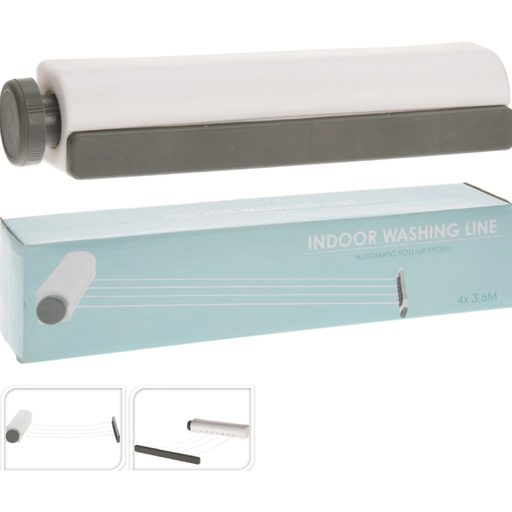
This washing line is designed for wall mounting and could be an option if you want to hang laundry indoors without using a freestanding airer.
The product details list four lines with a total drying length of 14.4 m, for installation between two walls no more than 360 cm apart. Check beforehand that you have suitable walls and enough space for installation.
No. The heating function doesn’t replace washing. Remove dirt in a way that’s suitable for the garment, following its care label, and check whether it can come into direct contact with heat. There’s no single answer that applies to all outdoor fabrics.
Yes. The German Environment Agency recommends airing rooms regularly when drying damp laundry indoors; the heating function doesn’t remove the moisture from the room.
Check the details for the specific model, its labelling, the manufacturer’s information and an instruction manual in German. The Federal Network Agency lists these as relevant checks when monitoring electrical products on the market; a CE mark alone isn’t an independent performance test.
Your statutory rights against the seller are separate from any voluntary guarantee. Many online purchases also generally come with a 14-day right to cancel; the Consumer Advice Centre says the period starts when the contract is made or when you receive the goods you ordered. The requirements that apply in your case depend on the specific purchase.
For a rough estimate, multiply the power in kilowatts by the number of operating hours. For example, running continuously at 0.230 kW would use 0.92 kWh over four hours. This is a calculation based on the rated power, not a measured figure for a drying cycle.