Regular swimmers with delicate swimwear
If you wear a swimming costume or bikini often, check the care label first. SCHIESSER Magazine and LASCANA recommend air-drying swimwear in the shade and advise against heat.


For swimwear, air-drying according to the care label is the gentler option: SCHIESSER Magazine and LASCANA recommend drying it in the shade and advise against heat. A heated clothes airer may suit frequent small loads of other items, provided their care instructions allow contact with heated surfaces. When drying laundry indoors, you also need to remove the moisture; the German Environment Agency recommends airing rooms regularly.
If you wear a swimming costume or bikini often, check the care label first. SCHIESSER Magazine and LASCANA recommend air-drying swimwear in the shade and advise against heat.
If you regularly need to dry a few other items as well as swimwear, consider whether those fabrics can tolerate contact with heated surfaces and how much drying space you actually need.
If space is tight, consider both how much room the airer takes up when open and where you’ll store it. When drying damp laundry indoors, the German Environment Agency recommends airing rooms regularly.
A good fit if: you mainly need to dry swimwear, or the care label rules out heat.
Keep in mind: indoors, you need to remove the moisture; the German Environment Agency recommends airing rooms regularly.
A good fit if: you also have small loads of other items whose care instructions allow contact with heated surfaces.
Keep in mind: using electricity and having warm contact surfaces don’t automatically make it suitable for swimwear; SCHIESSER Magazine and LASCANA advise against exposing swimwear to heat.
A good fit if: you often have more suitable items to dry and have enough room for the airer when it’s open.
Keep in mind: more drying space takes up more room and doesn’t mean the heated surfaces are suitable for swimwear.
| Priority | What to check when buying | Who it matters most to |
|---|---|---|
| Protecting fabrics | Care label and whether the item can be dried flat without heat | If I’m drying stretchy swimwear, I want to avoid heat on the fibres. Around 33 % of consumers put protecting delicate fabrics first. |
| Space for small loads | Usable rails and dimensions when assembled | If I regularly only have a few suitable items to dry, I want an airer that suits the size of the load. Around 27 % of consumers prioritise frequent small loads. |
| Floor space and storage | Dimensions when set up, socket location if using heat, and folded dimensions | When space is limited, the airer needs to fit where you’ll use it and be easy to put away afterwards. Around 20 % of consumers prioritise the available floor space. |
| Energy use and room humidity | Rated power, planned running time and ventilation options | If I use heat often or dry laundry indoors, I want to keep an eye on energy use and moisture in the room. Around 20 % of consumers put this first. |
SCHiESSER Magazine and LASCANA’s care advice recommends air-drying swimwear in the shade and advises against heat. So a heated airer isn’t automatically suitable for placing a swimming costume or bikini directly on it.
Check the care label for the specific item. If it doesn’t explicitly allow contact with heated surfaces, use an unheated drying surface, preferably one that lets you lay the item flat.
Wattage alone won’t tell you when a particular load is dry. Residual moisture, the fabrics and the room conditions all affect how long it takes.
Take the actual running time into account, and consider unheated air-drying for swimwear too.
Even when laundry is drying on a heated airer, moisture from it enters the room air.
Adjust ventilation when drying laundry indoors. The German Environment Agency recommends airing rooms regularly when drying damp laundry.
The range includes compact and multi-tier heated airers, including models 850-032 and 850-048.
The foldable electric airer AD 7821 needs a suitably large space when opened out.
Electric towel warmers are a related product category, but they aren’t automatically suitable drying surfaces for delicate swimwear.
Duronic describes the CA20 BK as a multi-tier heated airer. The manufacturer lists 202 W and three tiers.
The products below include options for unheated air-drying, as well as a heated airer for fabrics whose care instructions allow contact with heated surfaces. Dry swimwear according to its care label and avoid direct contact with heated surfaces unless this is explicitly suitable.
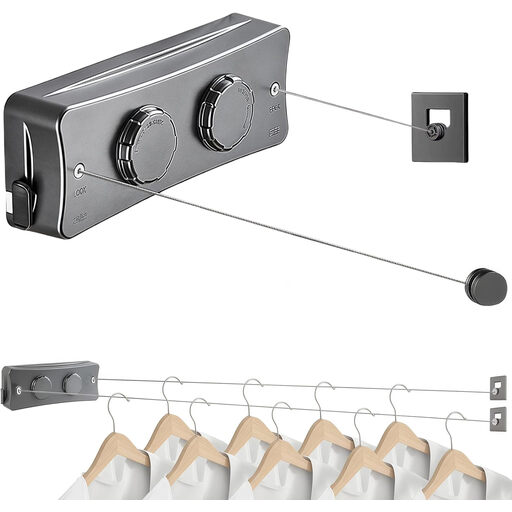 No image available
A good choice if wall-mounting is possible and you only need drying space occasionally; the lines retract when not in use.
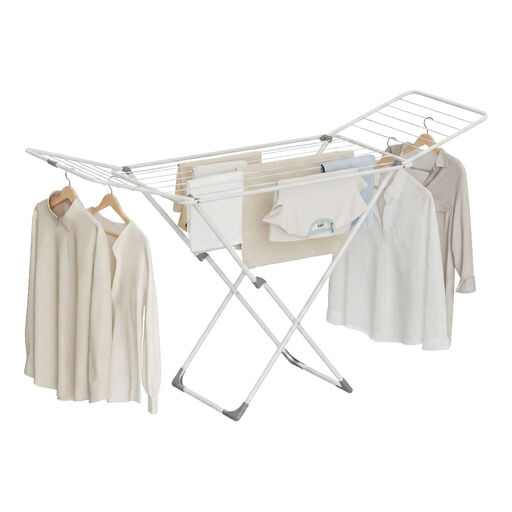 No image available
For natural air-drying and regular small loads; the product name specifies two wings and a foldable design.
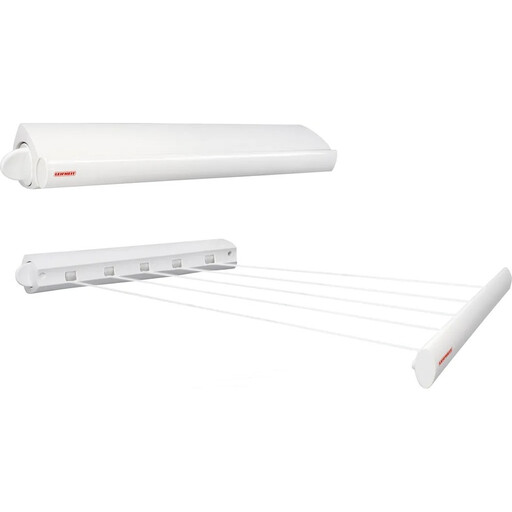 No image available
A good choice if secure wall-mounting is possible and you want to keep the drying lines out of the way after use; they retract automatically when not in use.
 No image available
For small loads of other fabrics whose care instructions allow contact with heated surfaces; there’s no confirmation that this model is suitable as a directly heated drying surface for swimwear.
The product name lists a temperature of 45–55 °C and dimensions of 144 × 53 × 96 cm.
Before buying a mains-powered appliance, check that the electrical version is suitable and that it has the required conformity information for use in Germany.
Not as a general rule. SCHIESSER Magazine and LASCANA recommend air-drying swimwear in the shade and advise against heat. Check the care label for your specific item. If it doesn’t explicitly allow contact with heated surfaces, an unheated drying surface that lets you lay it as flat as possible is the gentler option.
Rinse your swimwear in clean water after wearing it, and don’t leave it wet and scrunched up. Then wash and dry it according to the care label, somewhere airy and preferably in the shade.
No. Moisture from the laundry still evaporates into the room, even on a heated airer. The German Environment Agency recommends airing rooms regularly when drying damp laundry indoors.
No. For products covered by the relevant rules, the manufacturer uses the CE marking to declare that the product complies with applicable EU requirements; it isn’t an independent test of the individual appliance. The Low Voltage Directive covers electrical equipment rated at 50 to 1.000 V AC. The European Commission sets out the applicable electrical safety requirements.
For consumer purchases in the EU, goods come with a minimum legal guarantee of two years from receipt, as explained by Your Europe. This rule covers your statutory rights when goods are faulty.