Families with lots of towels
If you need to dry several towels at once, separate hanging spaces and a practical rail layout are key. Check the footprint too, and make sure the specific airer can support the weight of heavy, wet towels.


If you need to dry several family towels at once, the number of usable, separate hanging spaces and the available floor space matter more than the advertised number of tiers. A compact towel warmer may suit a few towels. If you have enough time and want to avoid using electricity for heat, an unheated clothes airer is another option – Germany’s Federal Environment Agency recommends clothes airers or washing lines as an energy-efficient way to dry laundry. In the bathroom, check the appliance instructions and the specific location where you plan to use it; the VDE advises keeping electrical appliances away from showers and baths.
If you need to dry several towels at once, separate hanging spaces and a practical rail layout are key. Check the footprint too, and make sure the specific airer can support the weight of heavy, wet towels.
If space is tight or the airer will be moved between locations, check its dimensions when open, the cable route and whether there’s a suitable place to use it. A folding design can make it easier to put away after use.
If you have enough drying time and a well-ventilated space, an unheated clothes airer could be a good option. For heated models, consider the rated power and how long you plan to use them.
A good fit if: You regularly need to hang several towels separately and want to put the airer away once they’re dry.
The trade-off: The airer takes up space while in use, and its heating function uses electricity.
A good fit if: You mainly need to hang a few towels rather than a full load of laundry, and a narrow footprint or suitable wall mounting is important.
The trade-off: A small number of rails limits how many towels you can hang separately at once; wall mounting requires a suitable installation.
A good fit if: You have enough time and a well-ventilated place to dry laundry, and want to avoid using electricity for heat.
The trade-off: Moisture still needs to be removed from the room, and a large airer needs space both for use and storage.
A good fit if: You’re looking for a permanent bathroom solution and can plan for suitable installation and an electrical connection.
The trade-off: Installation and electrical requirements differ from those of a portable clothes airer; a protection rating alone doesn’t confirm that a location is suitable.
| Priority | What to check when buying | Who is it important to? |
|---|---|---|
| Separate drying space | Check the rail layout, spacing, dimensions when open and load capacity against the towels you plan to use. | If I’m drying several towels at once, I want to hang them separately without overlapping them. Around 33% of shoppers put this drying space first. |
| Energy use | Consider the rated power and how long you plan to use the heater; the wattage alone doesn’t tell you how long drying will take. | If the airer will be used often, I want to weigh up the electricity used by its heating function against drying without heat. Around 27% of shoppers put energy use first. |
| Floor space and storage | Check the dimensions when open and folded, as well as the socket location and cable route. | If I can’t keep space free for an airer all the time, I want to be able to put it away once the laundry is dry. Around 20% of shoppers put space concerns first. |
| Bathroom location and humidity | Check the instructions and intended location, keep appliances away from showers and baths, and plan how to ventilate the room. | If the appliance is going in the bathroom, I want to know whether the specific location is suitable and how to remove moisture from the air. Around 20% of shoppers prioritise location safety and room humidity. |
The rated power alone doesn’t show how much energy is needed to achieve the same level of dryness. The time in use and the amount of laundry also make a difference.
Compare the rated power and how you plan to use the airer separately. Don’t assume that its wattage and running time give it a general advantage over other drying methods.
A stated protection rating doesn’t mean the appliance is suitable for every area of the bathroom. The VDE advises keeping electrical appliances away from showers and baths.
Check the instructions for the specific model and its intended location. Ask a qualified professional to clarify any questions about a permanent electrical connection.
Drying laundry releases moisture into the air. Germany’s Federal Environment Agency recommends regular ventilation when drying damp laundry indoors.
Leave space around towels as you hang them, and remove moisture from the room by ventilating it appropriately.
The models listed include compact towel warmers and folding, multi-tier airers.
Another type of heated airer to consider if you want more hanging points and adjustable settings.
An unheated alternative for households looking for drying space without an electric heating function.
This selection includes compact wall-mounted towel warmers, folding heated clothes airers and electric heated towel rails. Check whether a permanent installation or a freestanding airer is better suited to your room and intended location.
 No image available
A wall-mounted design may suit you if you don’t want a freestanding airer.
Dimensions: 58,5 × 55 cm. The product description lists touch controls, a temperature display and IP24.
If using it in the bathroom, check the instructions and the specific location; keep electrical appliances away from showers and baths.
 No image available
The central drying area and two fold-out side wings make this a useful option for households that want to hang several items of laundry.
Listed specifications: 45–55 °C, 230 W and a load capacity of up to 10 kg. Dimensions: 144 × 53 × 96 cm.
Check that the airer fits in the intended space when fully open. If using it in the bathroom, check the location and instructions.
 No image available
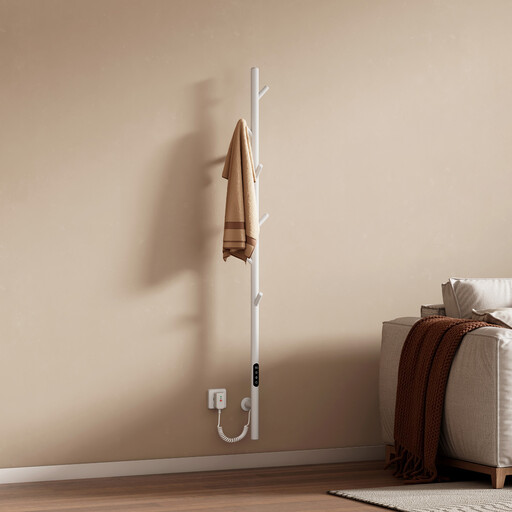
A single heated rail with six hooks gives you separate places to hang towels.
Listed specifications: 100 W, temperature control and a 1–9-hour timer. Height: 150 cm.
Check that the height and location suit the room you have in mind; if using it in the bathroom, follow the instructions.
 No image available
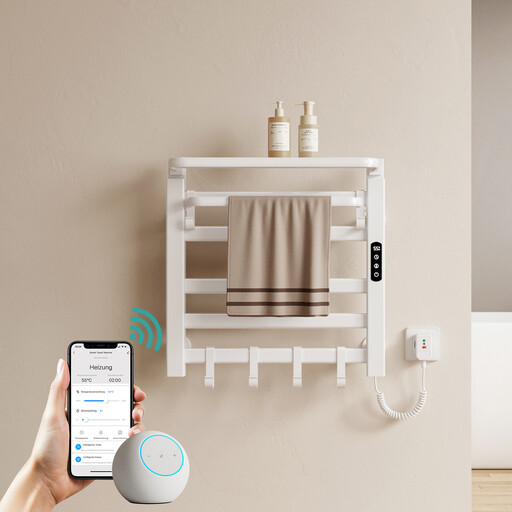
Its stated compact size, six hooks and a towel rail offer separate places to hang towels.
Listed specifications: foldable top shelf and a 1–9-hour timer. The product is also rated IPX5.
A protection rating alone doesn’t confirm that a bathroom location is suitable; check the instructions and the specific position.
 No image available
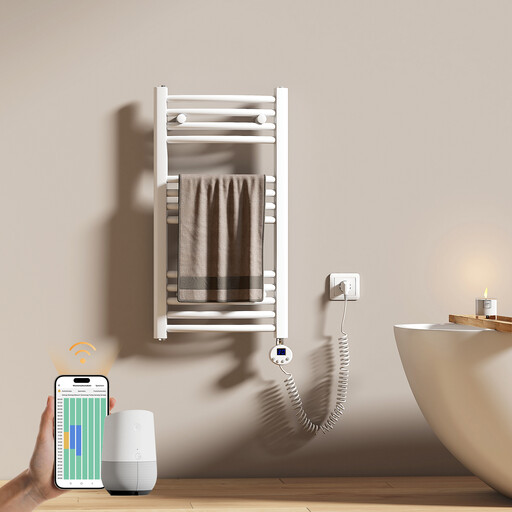
This design is intended as a planned, permanent bathroom solution with a towel-warming function.
Listed specifications: Wi-Fi version with temperature control, a timer and weekly programmes.
Check the installation requirements and suitable location before choosing; keep electrical appliances away from showers and baths.
No. An IP rating alone doesn’t mean the appliance can be used anywhere in the bathroom. The VDE advises keeping electrical appliances away from showers and baths. Check the instructions for the specific model, and ask a qualified professional to clarify any questions about a permanent connection.
Yes. Germany’s Federal Environment Agency recommends regular ventilation when drying damp laundry indoors; the heating function doesn’t replace air circulation. If possible, remove moisture from the bathroom promptly.
Multiply the rated power in kilowatts by the actual running time in hours to calculate the theoretical consumption in kilowatt-hours at full rated power. 100 W used for one hour equals 0,1 kWh; this doesn’t tell you how long a towel will take to dry.
No. The European Commission describes the CE marking as the manufacturer’s declaration that the relevant EU requirements have been met. There is no central EU body that issues a general CE certificate.
Statutory rights when a product is faulty are generally against the seller and are separate from any voluntary guarantee. Electrical appliances that have reached the end of their life must not be put in household waste; local collection points accept electrical and electronic waste. Additional conditions apply to retailer take-back schemes.