If you only have a few face flannels to dry, extra heat isn’t automatically necessary. If they dry in good time on an unheated rack with enough space between them, you can avoid using additional heating. Choose a design to suit the space available when it’s in use and where you can store it: folding racks can be put away, while ceiling- or wall-mounted options free up floor space but need to be installed and connected to the mains. Before using one in the bathroom, check the specific location, and check the compliance information for the particular electrical model before buying.
Who is a heated drying rack suitable for?
People with limited floor space
If there’s hardly any room, you’ll need to weigh up the rack’s dimensions when assembled against the space available for storage. A folding rack still takes up floor space while it’s in use; a fixed solution requires suitable mounting points.
Households with flannels that are often wet
If you need to dry several small towels at once, separate hanging spaces and a suitable running time are important things to consider. However, an adjustable temperature or timer doesn’t mean the towels will be disinfected.
People with a drying area in the bathroom
As well as the design, you’ll need to consider whether the appliance, power supply and specific location are suitable together. The VDE expressly advises keeping electrical appliances away from showers and baths.
What should you look for when buying?
First, measure the space needed while drying and the storage space available afterwards. Then consider how many towels you’ll dry, where you’ll put the rack and which operating mode you actually need.
| What matters |
What to check before buying |
Who is this important to? |
| Floor space and storage |
Measure the available floor space while the rack is in use and the storage space needed when it’s folded. For a mounted option, check the mounting surface and power connection. |
If a rack needs to stay up while it dries clothes in a small room, its assembled size matters most to me. Around 36 % of consumers have floor space as their main concern. |
| Room for several towels |
Count the towels you’ll dry at the same time and check that there are enough separate hanging spaces. Temperature settings and a timer are only relevant if you plan to use them. |
If I regularly dry several flannels, I need enough space between them and a drying cycle that suits me. Around 29 % of consumers say their main concern is frequently drying several towels. |
| Bathroom location |
Check the instructions, the specific installation location, the IP rating and the power connection. Keep the appliance away from showers and baths; consult a qualified professional about any fixed electrical connection. |
If my drying area is in the bathroom, I want to know whether the electrical appliance is suitable for the specific location and connection. Around 21 % of consumers say their main concern is using it in the bathroom. |
| Power consumption |
Compare the rated power and planned running time for the same operating mode. A manufacturer’s wattage figure isn’t a measured energy consumption per drying cycle. |
If I only have a few towels to dry, I want to weigh up whether I need the extra heat for my drying routine at all. Around 14 % of consumers first consider power consumption against drying without heat. |
Common buying and usage mistakes
-
Comparing only the folded dimensions
A folding rack takes up floor space while it’s being used. A ceiling- or wall-mounted option can free up that space, but it needs suitable mounting points and a power connection.
Measure the space needed both in use and for storage. If you’re mounting it, also check that the surface and connection are suitable for the intended installation.
-
Assuming heating also dehumidifies or disinfects
Drying releases moisture into the air, and a heating temperature doesn’t prove that an appliance has a cleaning or disinfecting effect. The Verbraucherzentrale notes that moisture which isn’t removed can encourage mould growth.
Ventilate in line with the room’s humidity, and wash or change the towels regardless of the appliance.
-
Directly comparing rated power across different operating modes
An appliance may have separate power ratings for cool and warm air, while a heated-bar rack is a different design altogether. The wattage alone therefore doesn’t tell you how much electricity a particular drying cycle will use.
Compare the power rating and planned running time for the exact mode you expect to use.
Brands to consider
Adler
The Adler AD 7821 is a folding rack with heated bars, designed for households that only need a drying rack from time to time.
- Adler says the model has 18 heating elements, 220 W and an IP22 rating. The manufacturer’s dimensions are 148 × 52.5 × 90 cm when assembled and 113 × 52.5 × 8 cm when folded.
- The manufacturer’s specifications don’t confirm a particular drying time for face flannels. The IP rating alone doesn’t mean the rack is suitable for every bathroom location.
InnovaGoods
Warmmat is a folding, winged airer with temperature settings and a timer, for buyers who want to control the heat and how long it runs.
- InnovaGoods lists 20 heated bars, 230 W, six temperature settings from 35–60 °C and a timer of up to 12 hours.
- The wings take up floor space when the airer is in use. The temperature setting doesn’t demonstrate a disinfecting effect.
Foxydry
According to the manufacturer, Foxydry Pro is a ceiling- or wall-mounted solution with ventilation and optional warm air. It’s better suited to regularly drying larger loads of laundry than individual towels.
- Mounting it can free up floor space. Foxydry lists 44 W for cool-air ventilation and 750 W for warm-air ventilation.
- It needs to be mounted and connected to the mains. The different power ratings relate to different operating modes and aren’t directly comparable.
Product options at Joybuy
The product options below include electric towel warmers and a folding heated clothes airer. Before buying a mains-powered appliance, check the compliance information that applies to the specific model. Before using it in the bathroom, check the actual installation location. The VDE advises keeping electrical appliances away from showers and baths.
 No image available
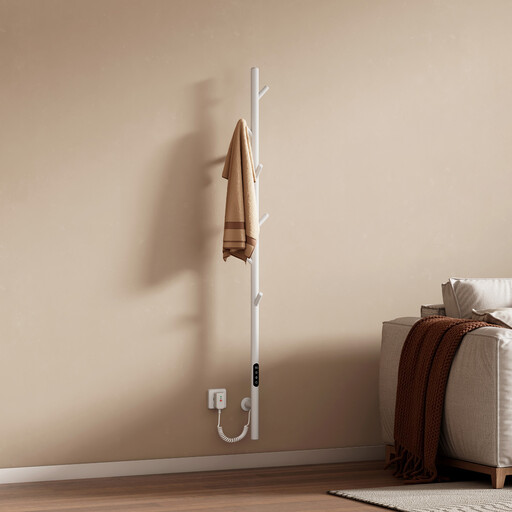
EMKE towel warmer with six hooks, 150 cm, 100 W
Could be worth considering if you want to hang several small towels from a heated bar with hooks.
Specifications include 100 W, six hooks, a height of 150 cm and a temperature setting of 30–70 °C. A timer is listed, but no running-time range is given.
Before using it in the bathroom, check that the specific location is suitable for this electrical appliance.
View at Joybuy
 No image available
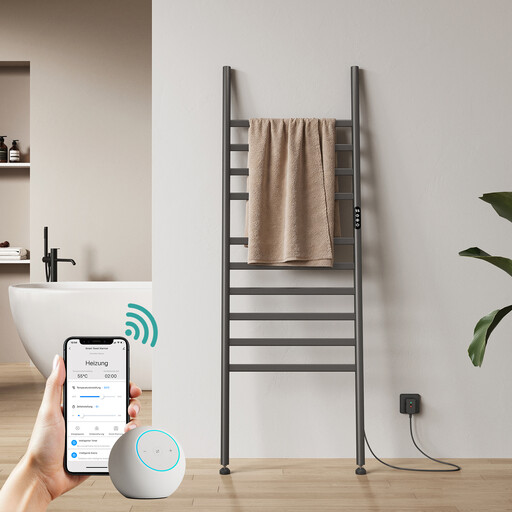
EMKE freestanding Wi-Fi towel warmer, no drilling required, anthracite, 385 W
Could be a good fit if you’re looking for a freestanding towel warmer that doesn’t need drilling and has an adjustable running time.
The listing specifies 385 W, a temperature setting of 30–70 °C, a timer from 1–24 hours, and app and voice control.
Freestanding doesn’t mean it’s suitable for every bathroom location, so check the specific spot before using it.
View at Joybuy
 No image available
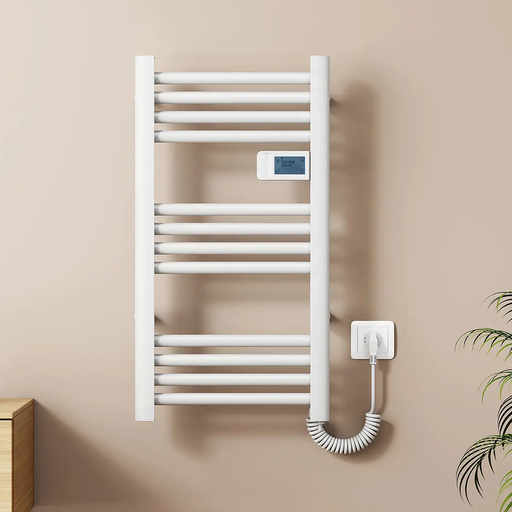
EMKE towel radiator, 180 W, 750 × 400 mm, white
This design could be a good option if a towel radiator with a holder and timer is a better fit for the space than a freestanding rack.
The listing specifies 180 W, dimensions of 750 × 400 mm, a timer and a temperature setting of 7–30 °C.
Before using it in the bathroom, check that the specific location and power connection are suitable.
View at Joybuy
 No image available
Folding heated clothes airer, 45–55 °C, 230 W
Could be a good fit if you want to dry several towels on a folding rack and have somewhere to store it when you’re done.
Specifications include 230 W, a temperature of 45–55 °C and dimensions of 144 × 53 × 96 cm. The rack takes up floor space while it’s in use.
Measure the space needed when it’s unfolded, and check the specific location before using it in the bathroom.
View at Joybuy
 No image available
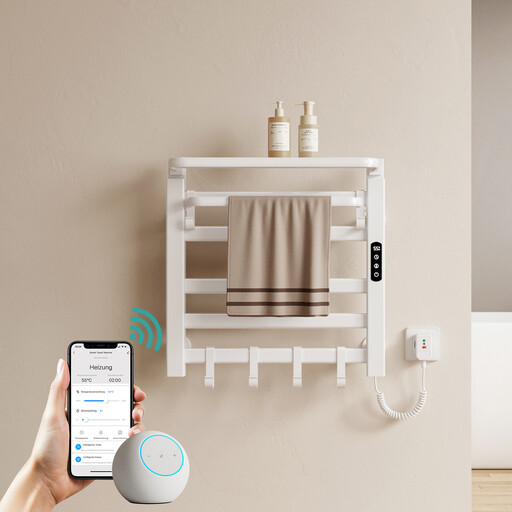
EMKE towel radiator with folding shelf, 50 × 50 cm, 140 W
Could be worth considering for a limited space if a compact wall-mounted appliance with an extra shelf meets your needs.
The listing specifies 50 × 50 cm, 140 W, Wi-Fi control, a folding shelf and six hooks. According to the description, the hooks aren’t heated.
The dimensions alone don’t confirm that the specific space in your bathroom is suitable for the appliance.
View at Joybuy
Frequently asked questions
Do I really need a heater for just a few face flannels?
Not necessarily. If the towels dry in good time on an unheated rack with enough space between them, you don’t need extra heat. The Umweltbundesamt recommends clothes airers or washing lines as an energy-efficient way to dry laundry. Make sure you ventilate to remove the moisture released during drying.
Does a heated clothes airer make flannels hygienically clean?
No. A heating or temperature setting doesn’t mean the appliance has a disinfecting effect. Drying doesn’t replace washing or changing towels regularly. The Umweltbundesamt generally considers additional laundry disinfection unnecessary for normally soiled laundry in a healthy household.
Can I put an electric airer anywhere in the bathroom?
No. There’s no blanket approval for every location. The VDE sets out protection zones and expressly advises keeping electrical appliances away from showers and baths. Whether an appliance is suitable for a particular position or fixed installation depends on the appliance, connection and exact location; the IP rating alone can’t answer that.
How can I estimate the electricity used per cycle?
Multiply the power in kilowatts by the running time in hours for the same operating mode. Adler gives the AD 7821 a rated power of 220 W; running it for two hours at its rated power throughout would work out at 0.44 kWh. This is a calculation, not a measurement of an actual drying cycle.
Is the CE mark an independent safety certification?
No. Electrical appliances with a rated voltage of 220–240 V AC fall within the scope of the EU Low Voltage Directive. As Your Europe explains, the CE mark is part of the manufacturer’s responsibility for compliance; it isn’t a general certificate issued by a central EU testing body.


