Households with very little storage
If you need the floor space back once your washing is dry, compare folding designs with options that can be mounted on a wall or ceiling.


For a few towels, a slim towel warmer is often enough if you have a permanent spot for it. A folding heated clothes airer is a better fit if you sometimes have extra washing to dry and can put it away afterwards. A wall- or ceiling-mounted option keeps the floor clear, but you’ll need a suitable place to install it. Heat doesn’t replace leaving enough space between damp items or airing the room; power and running time determine how much electricity it uses.
If you need the floor space back once your washing is dry, compare folding designs with options that can be mounted on a wall or ceiling.
If you mainly want to hang up small items of washing on a regular basis, consider whether a slim towel warmer will do the job instead of a larger clothes airer.
When drying clothes indoors, remember to plan for regular ventilation as well as choosing the right appliance.
A good fit if: you mainly need to dry a few towels and have a permanent place for the appliance.
Consider: A folding airer is more versatile for larger items of washing, while a freestanding appliance takes up space even when it’s not in use.
A good fit if: you sometimes have extra washing to dry as well as towels, and have somewhere to store the airer.
Consider: The airer needs floor space when set up, so check its folded dimensions too.
A good fit if: floor space is limited, you mainly dry towels and there’s a suitable place to install it.
Consider: The installation location and electrical connection must be suitable for where you plan to use it.
| What matters | What to check when buying | Who is this important to? |
|---|---|---|
| Floor space and storage | Compare the assembled and folded dimensions; if mounting the appliance, check the intended location. | If I need the floor space back once my washing is dry, I check where the appliance can be stored or mounted. Around 33% of consumers also prioritise storage. |
| Hanging space for towels | Check the width of your towels, the usable rails and the gaps between them, as well as how much floor space the airer takes up when set up. | If I want to hang towels with enough space between them, usable hanging space matters more to me than the number of rails alone. Around 27% of consumers focus on towel capacity. |
| Moisture when drying | Consider whether you can ventilate the drying area and how moisture levels may change while the appliance is in use. | If I dry clothes indoors, I need somewhere I can air out to remove the moisture they release. Around 20% of consumers prioritise room humidity. |
| Electricity use | Consider the rated power and planned running time; don’t use the wattage alone to estimate drying time. | If I only want to use extra heat when needed, I compare the rated power with the expected running time and consider air-drying without heat too. Around 20% of consumers put electricity use first. |
A folding airer still needs somewhere to go after use; a wall- or ceiling-mounted option requires a suitable fixing point.
Before buying, measure both the space where you’ll use it and the storage space available. For a mounted appliance, check the installation location.
The heat from the appliance won’t automatically remove moisture from wet towels and take it out of the room. The German Environment Agency recommends paying particular attention to ventilation when drying damp washing indoors; the consumer advice centre also warns about the possible effects of moisture that isn’t removed.
Choose a drying area that you can ventilate, and keep an eye on room humidity while the appliance is in use.
A wattage figure shows the appliance’s stated power, not how well it dries items under comparable conditions.
Compare the rated power with the planned running time. If extra heat isn’t needed, an unheated option may also be suitable.
The product ranges considered include freestanding and folding heated clothes airers.
The 4030 electric towel and clothes warmer is designed for freestanding or mounted use.
The product range considered includes electric wall-mounted heated towel rails; the PTR5050X4W version has a folding shelf.
The Foxydry Pro is a mounted, motorised clothes airer with a switchable warm-air function.
The products below include folding heated clothes airers and wall-mounted electric heated towel rails designed for homes with limited floor space.
 No image available
The folding design is worth considering if you want to put the airer away once your washing is dry.
Dimensions when set up: 144 × 53 × 96 cm. The product description specifies 230 W and fold-out side wings.
 No image available
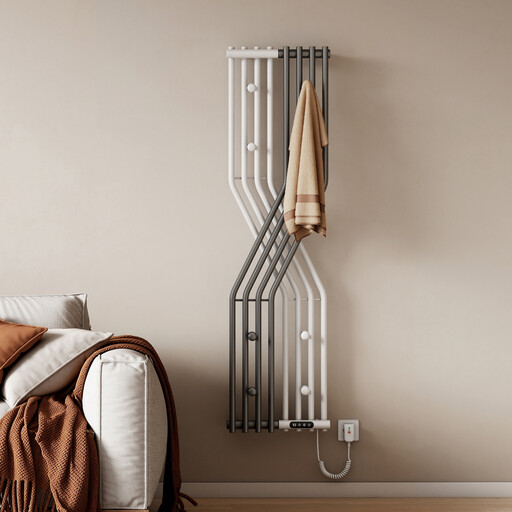
Wall mounting is a good option if you want to keep the floor clear and have a suitable place to install the rail.
The product title lists eight flexible hooks, an X-shaped design, a thermostat and timer, plus app and voice control.
If you’re using it in a bathroom, the installation location and electrical connection must comply with the relevant bathroom zones.
 No image available
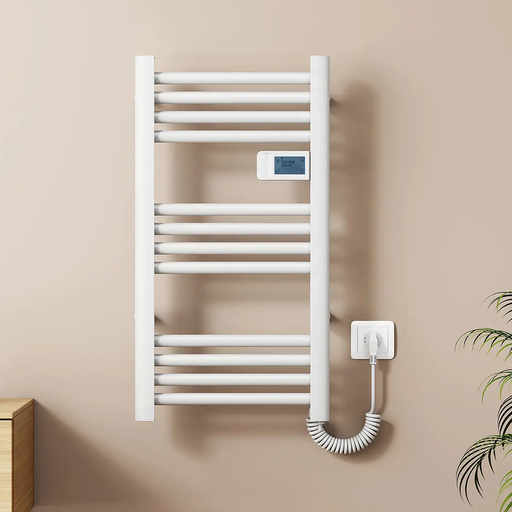
This wall-mounted option is worth considering if you want to warm towels and have limited floor space.
The product title lists 180 W and dimensions of 750 × 400 mm. The description specifies an LCD touch switch and timer.
For use in a bathroom, the installation location and electrical connection must comply with the relevant zones.
 No image available
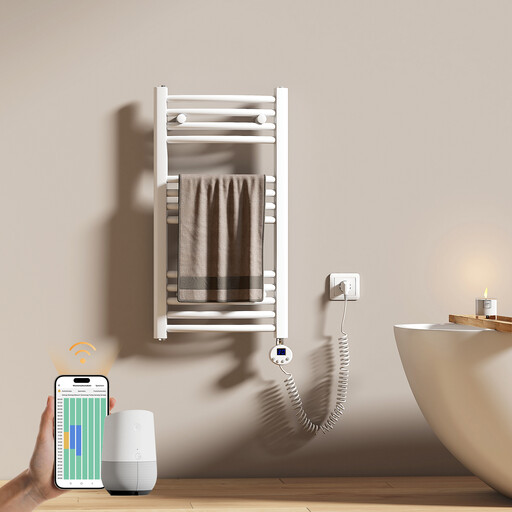
Wall mounting keeps the airer off the floor, provided the intended installation location is suitable.
The product title lists dimensions of 750 × 400 mm and the WiFi version. The description specifies a timer, weekly programming, a pre-installed heating element and a 1.4 m cable.
If you’re using it in a bathroom, take the relevant zones at the installation and connection points into account.
 No image available
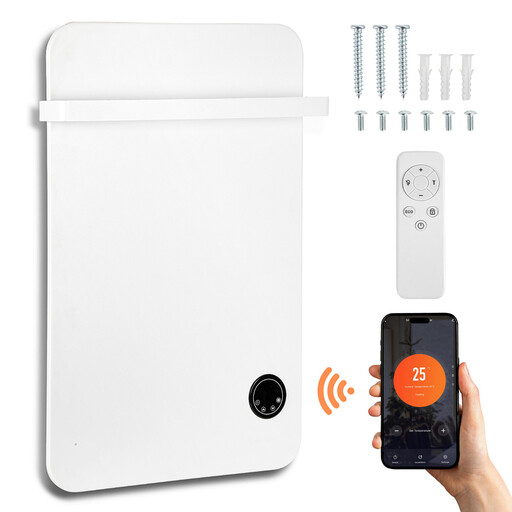
The wall-mounted design with integrated towel rails is an option if you don’t want a freestanding clothes airer on the floor.
The product title lists two towel rails, a remote control and app control. Check the location and electrical installation before fitting it in a bathroom.
No. Bathrooms have designated zones for electrical connections and appliances. The VDE advises keeping electrical appliances away from showers and baths. Check the instructions for the specific model and ask a qualified professional to assess the installation location and connection requirements; an IP rating such as IPX5 doesn’t automatically make an appliance suitable for every area of the bathroom.
Yes. The German Environment Agency recommends paying particular attention to ventilation when drying damp washing indoors. The consumer advice centre warns that moisture which isn’t removed can encourage mould. The airer’s heating element won’t remove moisture from the room by itself.
Multiply the rated power in kilowatts by the number of hours it’s running. At 100 W, two hours of continuous use works out at 0.2 kWh. This calculation doesn’t measure actual electricity use or drying time.
Online purchases generally come with a right to cancel, usually within 14 days of receiving the goods; you must notify the retailer that you wish to cancel. The consumer advice centre explains this time limit. Electrical appliances at the end of their life should be taken to the designated return or collection points, not put in household rubbish. According to information from the European Union, where CE marking is required for a product, it is the manufacturer’s declaration of conformity, not an independent quality mark.
Follow the instructions for the specific model. BETEC’s instructions for its towel warmer say to unplug the appliance before cleaning and not to use it if the mains cable is damaged.