Need your T-shirts again soon
If you want to wear your washed cotton T-shirts again soon after a hiking holiday, consider whether a heating function would suit your drying space.


If you need your washed T-shirts again soon and have a suitable, well-ventilated place to dry them, a heated clothes airer could be a useful addition; it doesn’t guarantee a particular drying time. If you’re not in a hurry, an unheated airer is another option if you want to avoid the electricity used by the heating function. What matters most is the number of usable rails, the airer’s dimensions when set up and the care instructions for your T-shirts.
If you want to wear your washed cotton T-shirts again soon after a hiking holiday, consider whether a heating function would suit your drying space.
If you wash several holiday T-shirts together, you’ll need enough usable rails and space between the garments.
When drying clothes indoors, consider the space the airer takes up while in use, where you’ll store it and how you’ll ventilate the room.
| What matters when buying | What to check | Who it matters most to |
|---|---|---|
| When you can wear them again | Check whether the specific model has a heating function and a timer. Allow plenty of time rather than assuming a particular drying time. | If you need the T-shirts again soon, extra heat may help you meet your schedule. Around 28% of consumers mainly consider when they’ll be able to wear their clothes again. |
| Space for several T-shirts | Compare the number and width of your T-shirts with the usable rails, the gaps between them and the maximum load. | If you’re drying several holiday T-shirts at once, consider how many will fit with space between them. Around 22% of consumers are most concerned about the amount of laundry they need to dry. |
| Floor space and storage | Compare the airer’s dimensions when set up with the space you have available, and check its folded dimensions for storage. | If the airer needs to fit in a small home, the space it takes up in use and the space needed to store it are two separate considerations. Around 17% of consumers mainly consider how much space they have available. |
| Electricity used by the heating function | Compare the specific model’s rated power and how long you plan to run it. To work out the cost, you’ll also need your electricity price per kWh. | If you’re weighing up extra heat against drying without electricity, consider how long you expect to run the airer. Around 17% of consumers are most concerned about electricity use. |
| Humidity while drying | Think about where you can put the airer and how you’ll ventilate the room while your clothes are drying. | If you dry your laundry indoors, moisture remains a consideration, even with a heating function. Around 16% of consumers mainly consider whether they have a suitable drying space and good air circulation. |
The German Environment Agency points out that damp laundry adds moisture to a room. A heating function is no substitute for a suitable place to put the airer or regular ventilation.
Rated power and the timer describe the appliance’s features, not how long your cotton T-shirts will take to dry in your home.
Use the timer to plan the heating period and work out the likely cost using the actual running time, rather than assuming a guaranteed drying time.
Running the airer for longer can increase electricity use.
Even a clothes airer that folds away compactly still needs floor space when set up.
Measure the space for drying and the storage space separately.
Heated rails don’t remove moisture from wet laundry and carry it out of the room.
Choose a suitable place to dry your clothes and ventilate the room regularly when drying laundry indoors.
Poor ventilation can allow moisture to build up in your home and increase the risk of mould.
The details relate to the model ranges listed and can help you compare individual features; they are not a general assessment of the brands.
The AD 7821 is a foldable, mains-powered winged airer with heated rails, designed for smaller loads of laundry.
The BH16 is a foldable heated clothes airer for indoor use. Its timer can help you plan the heating period.
The BAHAMAS is a heated winged airer with a stated line length to help you gauge how many garments it can hold.
The selection includes heated and unheated clothes airers that could suit drying several garments. Check the dimensions and features of each model to make sure it meets your needs.
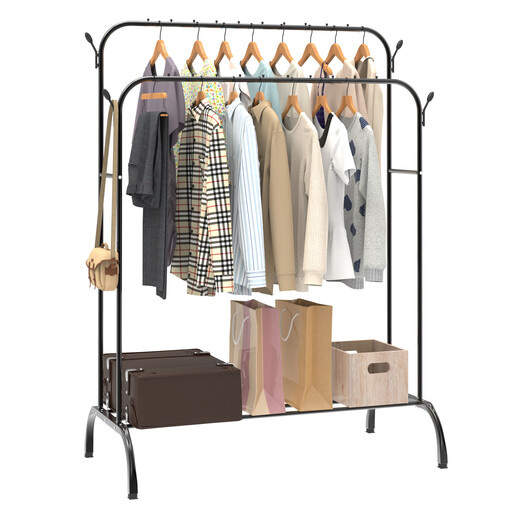 Image unavailable
The two rails offer space to hang several garments, and the airer also has a storage shelf.
Dimensions: approx. 110 × 55 × 150 cm. Stated load capacity: 20–30 kg.
 Image unavailable
The heating function may suit you if you want extra warmth while drying. Follow the care instructions for your T-shirts and the appliance instructions.
Dimensions: 144 × 53 × 96 cm. Stated power: 230 W. Stated load capacity: up to 10 kg. With a central drying area and two fold-out side wings.
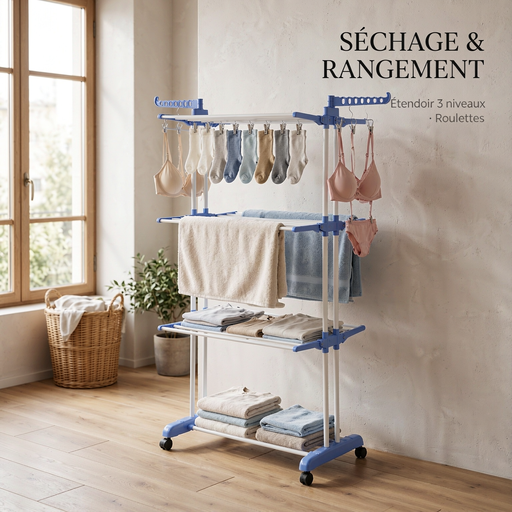 Image unavailable
Three tiers, a central hanging rail and two side wings offer different ways to hang your clothes.
Dimensions: 75 × 49 × 170 cm. Has four wheels, two of which have brakes; described as suitable for indoor and outdoor use.
No. The dots in the tumble-drying symbol refer to temperature settings on a tumble dryer. They don’t show whether a T-shirt is suitable for direct contact with the heating elements of a particular airer. Follow the T-shirt’s care instructions and the appliance instructions; the explanation of the symbols comes from GINETEX Germany.
Yes. The German Environment Agency recommends paying particular attention to regular ventilation when drying damp laundry in living spaces. The heating function doesn’t remove moisture from the room.
Multiply the rated power in kilowatts by the running time in hours to estimate the energy used at that power level. For the Adler AD 7821, running it at its rated power of 220 W for four hours would use a calculated 0.88 kWh; this is not a measured consumption figure. To work out the cost, you’ll also need your electricity price per kWh.
Check the labelling, manufacturer’s information and safety instructions for the specific appliance. For products covered by relevant harmonised EU rules, the manufacturer uses the CE marking to declare that the product complies with the applicable requirements; it is not an independent quality mark. This explanation is in line with information from the European Union on Your Europe.
If a product is faulty, you have statutory rights against the seller. The consumer advice centres distinguish these from a voluntary manufacturer’s guarantee; the first step in putting the problem right may be a repair or replacement.