
Lieferung heute & morgen

Qualitätsgarantie

Willkommens-Angebote freischalten: KOSTENLOSE Lieferung | Bis zu 80 % RABATT | Kostenlose 30-Tage-JoyPlus-Testphase
App herunterladen
By Joybuy Product Recommendation Officer, August 29, 2026
Anyone who needs to move a vehicle in a tight space, whether in a home garage, a workshop, or a showroom, knows the challenge. A heavy-duty car dolly promises a simple solution. However, the market is filled with products whose quality differences often only become apparent after purchase—when the metal bends or the casters jam. This guide highlights the crucial features you must look for, helping you make an informed decision that ensures safety and durability.
Many buyers focus solely on price or marketing promises. This often leads to disappointment and, in the worst-case scenario, damage to the vehicle. Pay special attention to these three pitfalls:
To avoid the problems mentioned above, you should base your selection on objective technical features. A good vehicle dolly is distinguished by three essential characteristics.
The load capacity figure alone (e.g., 1500 lbs or 680 kg per dolly) is only half the story. The construction that can permanently support and move this load is what's crucial.
The casters are the heart of any car dolly. Their quality determines whether moving a car in the garage is effortless or an ordeal.
Additional details significantly enhance safety and ease of use.
Based on the criteria above, some models stand out due to their thoughtful design and a balanced ratio of performance to safety.
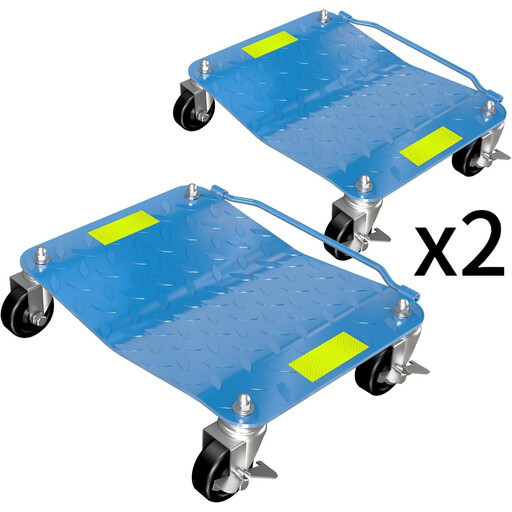
Why This Fits Their Persona: This model is ideal for users who need a robust and durable solution for regular use. The high load capacity and sturdy steel construction make it the right choice for professional workshops as well as ambitious hobby mechanics with heavy vehicles or classic cars.
The construction from 4 mm thick steel prevents deformation under load. The universal casters with locking brakes ensure safe manoeuvrability, and the non-slip diamond plate texture prevents the tyre from slipping.
The combination of a high total load capacity (6000 LBS), reflective safety strips, and a practical, concealed carrying handle offers a comprehensive package for safety and convenience.
We have compiled a complete, real-time list of products that fully satisfy these strict selection criteria and UK safety regulations.
1. How many car dollies do I need for one car? For most applications, four dollies are needed—one for each wheel. This allows for free 360-degree movement of the vehicle. If you only want to pivot the vehicle on one axle (e.g., moving the rear end to the side in a garage), two dollies for the axle being moved may be sufficient.
2. Is a car dolly with a brake absolutely necessary? Yes, for safety reasons, a locking brake is highly recommended. It prevents the vehicle from rolling away uncontrollably on uneven ground or slight inclines. The brake also ensures a secure footing when jacking the vehicle onto the dolly.
3. Can I move a vehicle by myself using car dollies? Yes, car dollies are designed so that a single person can move a vehicle with minimal effort. However, caution is still required. Move the vehicle slowly and with control, and make sure the path is clear of obstacles.