
Lieferung heute & morgen

Qualitätsgarantie

Willkommens-Angebote freischalten: KOSTENLOSE Lieferung | Bis zu 80 % RABATT | Kostenlose 30-Tage-JoyPlus-Testphase
App herunterladen
A heavy-duty garage shelf or basement shelving unit should safely hold tools, tyres, supplies and seasonal items. In practice, however, choosing the right one often comes down not to appearance, but to unclear load ratings, unsuitable materials or a lack of anti-tip protection. Our selection highlights which technical specifications you should check before buying and which shelving unit suits different uses.
A specification such as “600 kg load capacity” generally describes the maximum static total load of the shelving unit. It does not automatically mean that a single shelf can hold 600 kg. You should therefore always check both values:
For example, a 600 kg heavy-duty shelving unit with five levels may have a capacity of 120 kg per shelf. An 875 kg heavy-duty shelving unit may be specified as holding 175 kg per level. These figures cannot automatically be applied to castors, point loads or unevenly distributed items.
A tool-free shelving unit with push-fit or clamp connections can make assembly easier. Nevertheless, all supports must click fully into place and the shelves must sit correctly. Many metal shelving units also recommend using a rubber mallet to carefully fit the connecting tabs.
Work gloves protect against sharp metal edges. Even more important is a shelving unit with anti-tip protection: a supplied anti-tip kit should be secured to the wall in accordance with the instructions. The shelving unit should not be used freestanding, particularly when heavily loaded, on an uneven floor or in a household with children.
Many steel shelving units combine a metal frame with MDF boards. MDF is dimensionally stable in dry indoor areas, but is more sensitive to prolonged damp than galvanised or coated steel. For a garage without sufficient ventilation, a damp basement or an unheated shed, you should therefore check the following:
A steel shelving unit with MDF shelves is particularly suitable for dry garages, workshops, basements and utility rooms.
First, estimate the weight of the items you intend to store. A filled tool case, paint tin or compressor can be considerably heavier than boxes of clothing. You should also allow a safety margin rather than permanently using the stated maximum load.
The manufacturer specifications in this selection refer to static loads. This means that items are standing securely on the shelving unit and are not being thrown or moved across the shelves. Place heavy containers on the lower levels and lighter items higher up.
For a garage shelving unit, the width, depth and height are crucial. Do not just measure the available wall space; also take the following into account:
A shelving unit with adjustable shelves offers greater flexibility when the items being stored change regularly. With some models, the levels can be repositioned at fixed intervals, such as every 5 cm.
A metal shelving unit with a steel frame is generally more suitable for tools and stored goods than a decorative shelving unit designed for living spaces. Pay attention to the precise material specification: “steel frame with MDF shelves” describes a different construction from a storage shelving unit made entirely from metal.
The option of splitting a shelving unit into two separate units can also be useful. It creates two smaller storage areas or a combination of workbench and storage space. However, this only makes sense if the assembly instructions explicitly allow this configuration.
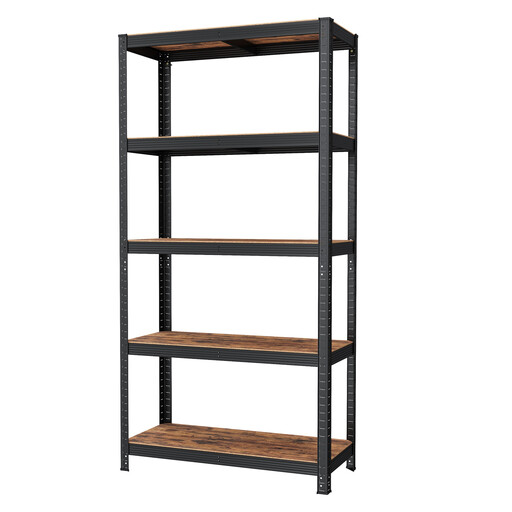
Why this product suits this profile: Measuring 30 × 75 × 150 cm, with five levels and a stated total load of 650 kg, this compact storage shelving unit is suitable for garages, basements or utility rooms with limited floor space.
The specifications state both 130 kg per level and a 650 kg static total load. An anti-tip kit is included.
Adjustable shelves, screw-free push-fit assembly and a divisible design for two units or work surfaces.
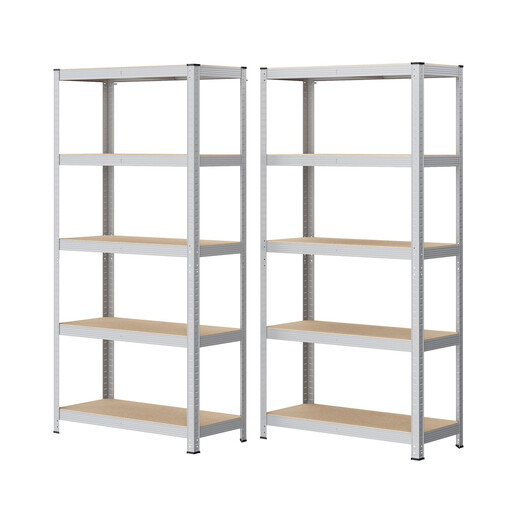
Why this product suits this profile: This two-piece set provides two separate shelving units measuring 40 × 90 × 180 cm. The stated load capacity is 175 kg per level and 875 kg in total per unit.
Considering the per-level and total load separately makes planning easier. Two anti-tip kits are included to support secure wall mounting.
Five adjustable levels, a powder-coated steel frame and flexible positioning as two separate shelving units.
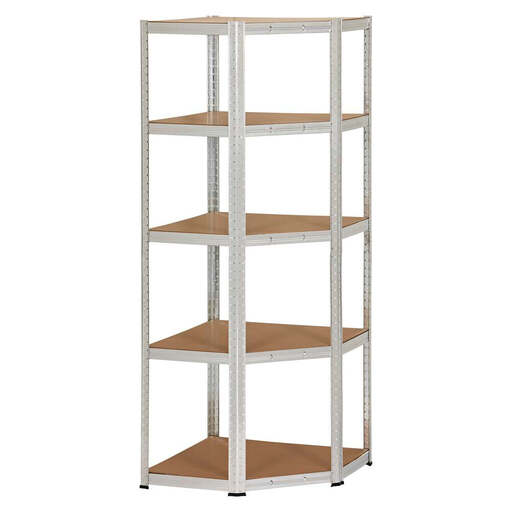
Why this product suits this profile: The corner design makes use of otherwise unused areas in a workshop, garage or storage area. According to the product specifications, each of the five MDF shelves can hold 175 kg, with a total capacity of 875 kg.
The instructions highlight the need for a level surface, even loading and recommended wall mounting. This helps reduce the typical stability issues associated with corner solutions.
Galvanised steel frame, tool-free push-fit assembly and space-saving corner design.
We have put together a complete, regularly updated list of products that fully meet these strict selection criteria and the safety regulations applicable in the EU.
Before assembly, clean the floor and check it for uneven areas. Do not place the shelving unit directly against damp external walls, and leave sufficient clearance from doors or vehicles. After assembly, check all push-fit connections.
When loading the shelving unit:
That depends on the items you intend to store. For tools, canisters and equipment, this selection includes models rated at 120 to 175 kg per level. The key factors are whether the load is distributed evenly and whether the total load capacity is respected.
Tool-free push-fit assembly can provide a stable structure when all connecting elements are fully engaged and the shelving unit is standing on a level surface. For tall or heavily loaded models, you should also use the supplied anti-tip kit.
There is no single answer. Its service life depends on the load, assembly, use and exposure to damp. A steel frame may be suitable for dry indoor areas; however, MDF shelves should be protected from prolonged moisture and checked regularly for warping.