
Lieferung heute & morgen

Qualitätsgarantie

Willkommens-Angebote freischalten: KOSTENLOSE Lieferung | Bis zu 80 % RABATT | Kostenlose 30-Tage-JoyPlus-Testphase
App herunterladen
A heavy-duty garage shelving unit creates storage space for tools, tyres, paint, gardening equipment and supplies. But descriptions such as “extra sturdy” or “for heavy loads” tell you very little on their own. What matters are clear, verifiable figures: the maximum load per shelf, total load capacity, dimensions and the type of assembly.
Many poor purchases result from three typical pitfalls:
When choosing heavy-duty storage shelving, load distribution is more important than a large advertising figure. Check the following:
A 600 kg heavy-duty shelving unit with five levels may be designed to hold around 120 kg per shelf according to the manufacturer’s specifications. A 750 kg model may support 150 kg per shelf, while an 875 kg heavy-duty shelving unit may be specified for 175 kg per shelf. These figures do not automatically apply to concentrated loads, such as individual machines or heavy boxes placed over a small area.
A 5-tier shelving unit is practical for many garages and workshops, as small parts, tool cases and larger containers can be organised separately. Pay attention to:
With some models, the levels can be adjusted at fixed intervals. For example, the JOYFURNOS shelving unit with a 600 kg load capacity can be adjusted in 5 cm increments. This allows the interior space to be tailored to paint tins, toolboxes or storage containers.
A typical steel shelving unit for cellars and sheds combines a steel frame with MDF shelves. This combination of materials is designed for dry indoor areas such as garages, cellars, workshops or storage rooms. In damp spaces, you should also consider corrosion protection, ventilation and the actual condition of the coating.
An anti-tip kit improves stability, but it does not replace a suitable wall or a level surface. Before assembly, check that the wall plugs and fixings are suitable for the type of wall. We recommend wearing work gloves during assembly. Whenever possible, place heavy items on the lower levels and lighter items higher up.
The models below mainly differ in load capacity, dimensions, quantity and possible uses. The figures are based on the manufacturer data provided for static loads.
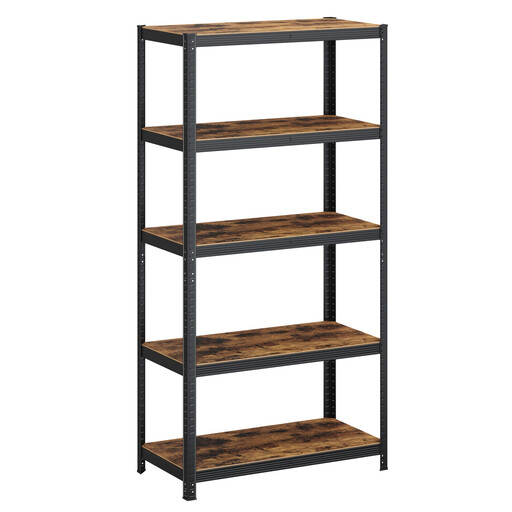
Why this product suits this profile: The five levels, 50 x 100 x 200 cm dimensions and tool-free boltless assembly are ideal for creating well-organised basic storage in a garage, cellar or storage room. This version is available in several colour options.
The manufacturer’s specifications distinguish between a maximum static load of 120 kg per level and a total load of 600 kg. The shelves can be adjusted in 5 cm increments rather than offering just one fixed spacing.
Steel frame, five adjustable levels, can be divided into two units and supplied anti-tip kit.
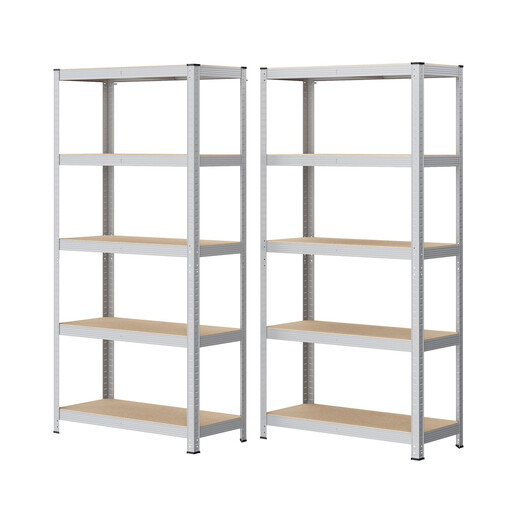
Why this product suits this profile: Two separate units create flexible zones for tools, seasonal items or work materials. According to the product specifications, each level is designed to support up to 175 kg of static load.
The external dimensions of 40 x 90 x 180 cm per unit make planning easier in narrower areas. The stated total load of 875 kg is supplemented by the figure of 175 kg per shelf.
Set of two shelving units, divisible construction, MDF shelves, steel frame and two anti-tip kits.
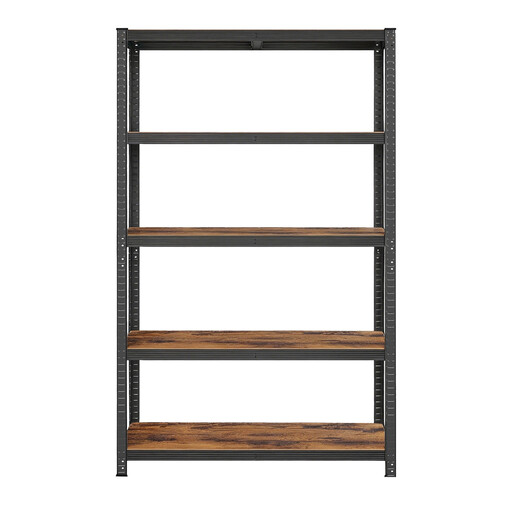
Why this product suits this profile: The greater width and depth provide room for bulky tools, boxes and equipment in a workshop, storage room or spacious garage.
The maximum static load is specified as 150 kg per level. Before buying, you can use the depth of 60 cm and width of 120 cm to check whether you have enough floor space and room to move around.
Five adjustable levels, stated total load capacity of 750 kg, steel frame and tool-free boltless construction.
We have put together a complete, regularly updated list of products that fully meet these strict selection criteria and the safety regulations applicable in the EU.
Before assembly, the installation area should be clear, dry and as level as possible. Check the individual parts against the instructions and fit all the cross braces completely. With a boltless shelving unit, no component should be loose. Adjust the levels so that boxes do not overhang and the load is distributed as evenly as possible.
A workshop shelving unit can also serve as a work surface if it is divided into two units and has a suitable design. However, whether this is practical depends on the construction, working height and permitted load. The shelving unit must not be loaded beyond the manufacturer’s specifications.
That depends on what you intend to store. For toolboxes and supplies, 120 to 150 kg per level may be sufficient. Heavy machinery, metal parts or filled containers require an accurate weight calculation. The key figure is the load capacity per shelf, not just the total figure.
For tall shelving units, uneven floors or heavy loads, securing the unit with the supplied anti-tip kit is advisable and often important for safety. Use fixings that are suitable for the wall and follow the assembly instructions. A shelving unit should not be considered safe to use freestanding simply because it can be assembled without tools.
Its service life depends on the load, moisture levels, assembly and maintenance. In a dry environment, a coated steel frame can be used for many years. Check the connections, MDF shelves, coating and wall fixings regularly. Moisture, consistently excessive loads and concentrated loads can shorten its service life.