
Lieferung heute & morgen

Qualitätsgarantie

Willkommens-Angebote freischalten: KOSTENLOSE Lieferung | Bis zu 80 % RABATT | Kostenlose 30-Tage-JoyPlus-Testphase
App herunterladen
A garage needs to accommodate vehicles, tools and seasonal items – but it often lacks a clear sense of order. Heavy-duty garage shelving creates vertical storage space, but it is not automatically suitable for every room or load. Marketing claims such as “Heavy Duty”, high total load capacities or “tool-free assembly” can conceal important details.
Before buying, you should therefore avoid three common pitfalls:
The stated capacity per shelf is particularly relevant for everyday use. For example, a model with 120 kg per level is suitable for toolboxes, paint or smaller equipment, provided the weight is distributed evenly. With 150 kg or 175 kg per level, there is more capacity in reserve for heavy containers and machinery.
Look for the wording maximum static load capacity. This describes a stationary load. Placing heavy items on a shelf is not comparable to putting them down abruptly, pulling them across the shelf or applying weight to a single point. Heavy items should preferably be stored on the lower levels.
For sets containing two shelving units, check whether the stated total load capacity applies to one unit or to the entire set. The product data should make this clear.
A 5-tier shelving unit makes good use of the available room height. Before ordering, check:
Height-adjustable shelves are useful when storing items of different sizes. Some models can be adjusted at fixed intervals, such as 5 cm. A dividable shelving unit can also be split into two lower units and, depending on the design, used as a storage surface or workbench.
A heavy-duty steel shelving unit should have a clearly described frame. Powder-coated steel is commonly used for dry indoor areas such as garages, cellars or workshops. Galvanised steel frames may be suitable for certain environments, but they do not replace protection against prolonged exposure to moisture.
The shelves on many models are made from MDF. This material should not be exposed to water for extended periods and is only conditionally suitable for damp cellars, outdoor areas or leaky sheds. For cellar storage shelving, a dry, level surface is recommended.
Plug-in systems can save time during assembly. However, tool-free assembly does not mean that no preparation is required. Work gloves, a level surface and checking all plug-in connections remain important. Follow the assembly instructions and secure the shelving unit to a suitable wall using the supplied anti-tip safety fixing.
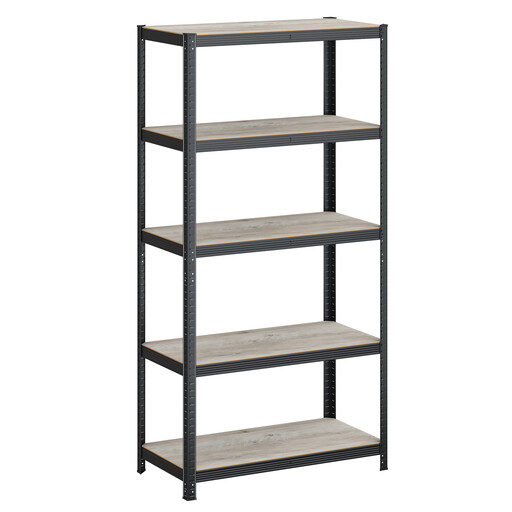
Why this product suits the profile: This model offers five levels for garages, cellars or workshops, with a static load capacity of 120 kg per shelf and shelf-height adjustment in 5 cm increments.
The product data specifies both the total load capacity of 600 kg and the capacity per level. An anti-tip safety fixing is included in the delivery.
Tool-free plug-in system, dividable construction and galvanised steel frame in a 50 x 100 x 200 cm format.
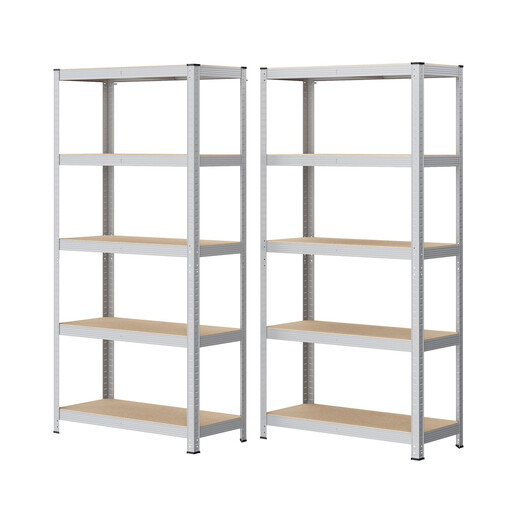
Why this product suits the profile: This set of two units is ideal for users who want to divide a garage, storage room or workshop into separate zones.
The specifications state 175 kg per shelf and 875 kg as the maximum total static load. Before loading, check how the weight should be distributed between the two units.
Two separately usable shelving units, adjustable levels, steel frames and two anti-tip safety fixings included in the pack.
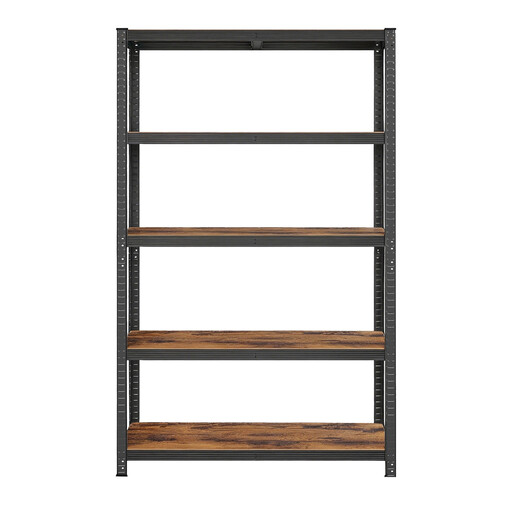
Why this product suits the profile: The larger footprint is designed for extensive tool collections, supplies or bulkier items in garages, sheds or storage rooms.
The dimensions and the load capacity of 150 kg per level are clearly stated. Due to the depth of 60 cm, the available space should be measured carefully beforehand.
Five adjustable levels, a maximum total static load of 750 kg and a dividable design.
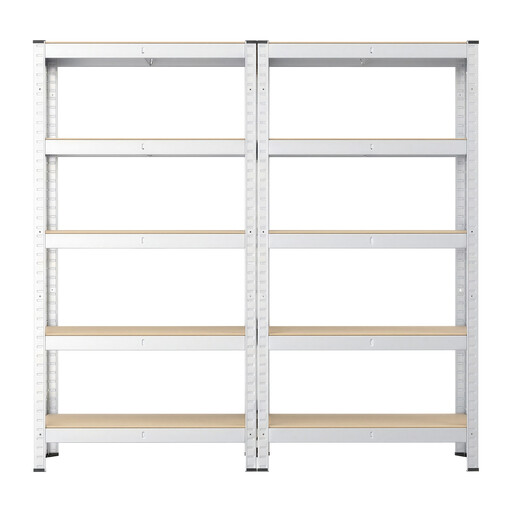
Why this product suits the profile: The more compact units can be set up separately in smaller cellars, workshops or utility rooms.
The product description states 130 kg per level and 650 kg as the maximum total static load. The two supplied anti-tip safety fixings support the intended wall mounting.
Two dividable shelving units, five adjustable levels per unit and a tool-free plug-in system.
We have put together a complete, regularly updated list of products that fully meet these strict selection criteria and the safety regulations applicable in the EU.
Before assembly, the floor should be level, dry and free from obstacles. A workshop shelving unit also requires sufficient room to move around. Check whether the wall is suitable for the intended fixing method; different fixing solutions apply to concrete, brick and lightweight construction.
The following arrangement is recommended for even loading:
That depends on what you intend to store. For tools, paint and household supplies, 120 to 130 kg per level may be sufficient. For heavier machinery or larger containers, models with 150 or 175 kg per shelf may be more suitable. The manufacturer’s specifications for static load and even weight distribution are always decisive.
A tool-free plug-in shelving unit can be stable when all connections are fully engaged, the unit is standing level and the permitted load is observed. Stability does not depend solely on the assembly method. Wall mounting with an anti-tip safety fixing is particularly important for tall shelving units and heavy loads.
There is no standard service life that applies in every case. It is influenced by factors including humidity, corrosion, the load, assembly quality and how the shelving unit is handled. In dry indoor areas, steel frames and MDF shelves will remain functional for longer with proper use than in permanently damp or leaky environments. Inspect the shelving unit regularly for rust, deformation and loose plug-in connections.