
Lieferung heute & morgen

Qualitätsgarantie

Willkommens-Angebote freischalten: KOSTENLOSE Lieferung | Bis zu 80 % RABATT | Kostenlose 30-Tage-JoyPlus-Testphase
App herunterladen
A heavy-duty shelving unit for your garage should safely hold tools, tyres, paint, gardening equipment or spare parts. But low load capacities aren’t the only cause of disappointing purchases. The dimensions may not fit the available space, the shelves may not adjust to suit your needs, or the unit may be used without adequate wall fixings.
This buying guide explains which details really matter when choosing a metal shelving unit for your garage, and which features suit different uses.
A stated load capacity of “600 kg” doesn’t automatically mean that each shelf can hold 600 kg. The distribution is what matters. For example, a five-tier shelving unit with a total load capacity of 600 kg may have a limit of 120 kg per shelf.
The figure often refers to a static load capacity. This applies to stationary items distributed evenly across the shelf. Heavy machinery concentrated in one spot or dynamic loads while putting items away may call for different considerations.
A 5-tier heavy-duty shelving unit makes good use of vertical space, but at 200 cm tall it needs to be positioned securely. In garages, cellars and workshops in particular, a tall unit should be fixed to the wall using the supplied anti-tip kit. Uneven floors, regularly removing heavy items or a high centre of gravity can increase the risk of tipping.
A boltless shelving unit can be assembled using an interlocking frame system. This reduces the need for tools, but you’ll still need to align the unit carefully. Work gloves help protect your hands from sharp metal edges during assembly. Before you start, check the floor space, ceiling height and access to the chosen position.
When choosing a 600 kg storage shelving unit, start by estimating the weight of the items you plan to store. For example, a unit with a capacity of 120 kg per shelf is suitable for tool cases, smaller machines, containers or spare parts, provided they’re distributed evenly.
Check the following details:
Do not exceed the permitted load. Whenever possible, place heavy items on the lower shelves to keep the centre of gravity low.
A shelving unit measuring 50 x 100 x 200 cm offers a usable width of 100 cm and a depth of 50 cm. Before buying, check:
A 30 x 75 x 150 cm unit may be more practical for smaller cellars or narrow alcoves. A slim shelving unit takes up less room, but naturally offers less storage space.
Height-adjustable shelves make it easier to store items of different sizes. Adjustment points every 5 cm allow finer adjustments than a few fixed positions. This makes it easier to arrange tall canisters, tool cases and shallow storage boxes together.
The frame material and shelf panels also matter when choosing steel shelving. Galvanised steel may be suitable for dry indoor spaces such as garages, cellars and workshops. However, consistently high humidity may limit your choice of materials. MDF or chipboard shelves should be protected from splashes and standing water.
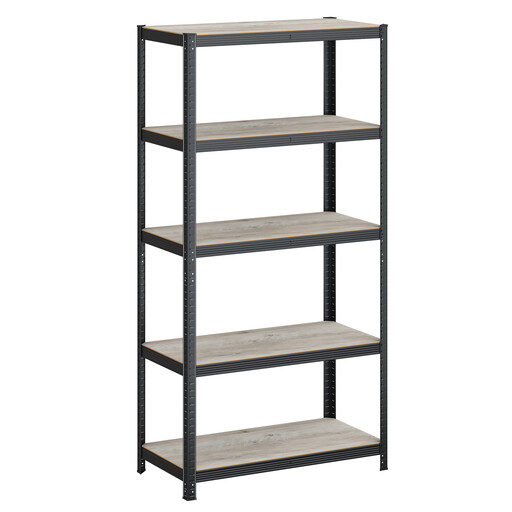
Why it suits this type of buyer: With five shelves and dimensions of 50 x 100 x 200 cm, this unit is ideal if you want to organise a clearly defined area in your garage, cellar or workshop.
The specifications state both a capacity of 120 kg per shelf and a total load capacity of 600 kg. The shelves adjust in 5 cm increments, and an anti-tip kit is included.
Galvanised steel frame, tool-free assembly with interlocking parts, and a split design that can be used as two separate units or workbenches.
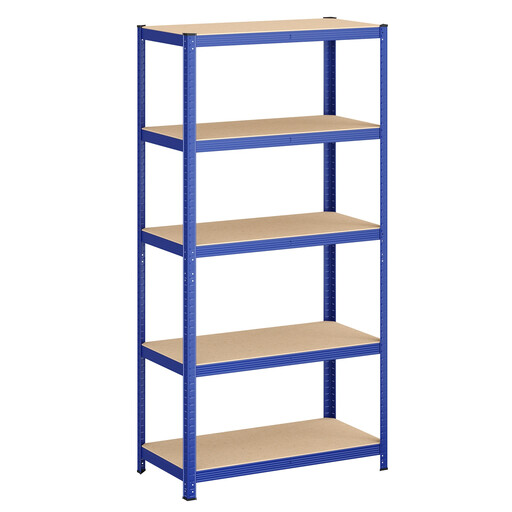
Why it suits this type of buyer: This black model combines a clearly stated load capacity with a flexible shelf layout. It’s a good choice if you want a long-term storage solution for dry indoor spaces.
The product details distinguish between the static load capacity per shelf and the total load capacity. They also clearly advise fixing the unit to the wall and warn against using it in very damp environments.
120 kg static load capacity per shelf, 600 kg in total, 5 cm shelf adjustment and an anti-tip kit included.
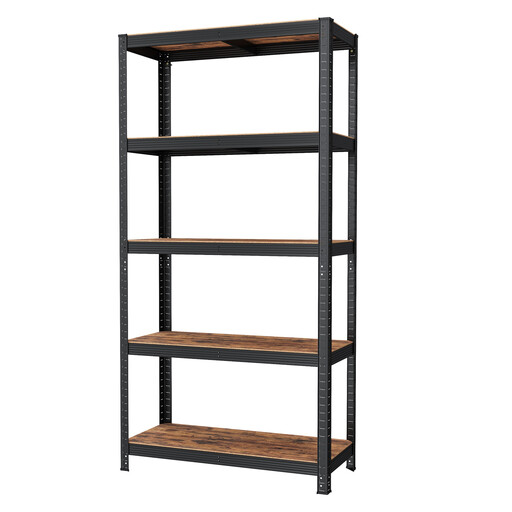
Why it suits this type of buyer: Its compact size is designed for smaller garages, cellar storage areas or workshops with limited depth. The five shelves offer plenty of storage for the space it occupies.
Its lower height and shallower depth make it easier to fit into tight spaces. The stated static load capacity is 130 kg per shelf, or 650 kg in total.
30 x 75 x 150 cm, 130 kg static load capacity per shelf, tool-free interlocking assembly and an anti-tip kit.
Before assembly, clean the floor and check for any significant unevenness. Fit all the parts together securely and make sure the unit is level. For tall models, fixing the unit to the wall with the supplied anti-tip kit is an important safety step.
Follow these practical guidelines during everyday use:
We’ve put together a complete, regularly updated list of products that meet these strict selection criteria and fully comply with the safety regulations in force in the EU.
It depends on what you’re storing. A capacity of 120 to 130 kg per shelf may be enough for tool cases, equipment and spare parts, provided the weight is distributed evenly. Do not exceed the manufacturer’s stated static load capacity.
Fixing tall or heavily loaded shelving units to the wall with the supplied anti-tip kit is recommended, and the product details explicitly call for it. Tool-free assembly refers to how the shelving components fit together; it doesn’t mean you can skip the additional anti-tip fixings.
There’s no single answer. Its lifespan depends on the load, assembly, room conditions and care. In dry indoor spaces, steel frames and shelf panels can last longer if you stay within the load limits and keep them dry. Regular visual checks can help you spot damage or deformation early.