
Lieferung heute & morgen

Qualitätsgarantie

Willkommens-Angebote freischalten: KOSTENLOSE Lieferung | Bis zu 80 % RABATT | Kostenlose 30-Tage-JoyPlus-Testphase
App herunterladen
A heavy-duty shelving unit for the garage should safely hold tools, tyres, supplies or garden equipment, while making good use of the space available. In practice, low prices aren’t the only reason people end up with the wrong product. Load capacities are often misunderstood, dimensions are underestimated or shelving is installed without being properly secured.
This buying guide explains which details really matter when choosing a metal shelving unit, storage shelving unit or workshop shelving unit, and which type is right for your garage, cellar, shed or storage room.
A figure such as ‘120 kg load capacity’ usually refers to a single shelf. With five shelves, that could mean a calculated total load capacity of 600 kg. However, this only applies when the load is evenly distributed and the manufacturer’s conditions are followed.
Where possible, put heavy boxes on the lower shelves. Concentrated loads, items that overhang and uneven weight distribution can affect stability. So, when storing tools, paint tins or spare parts, it’s not just the figure on the product page that matters: how you store them matters too.
Before buying, measure the shelving unit’s width, height and depth, as well as the space in front of it. A 200 cm-high boltless shelving unit may not be suitable for a garage with a low ceiling. Make sure it won’t block doors, windows, heaters or the garage door either.
The depth determines whether Euro containers, tool cases or storage boxes will sit fully on the shelves. A shelf that’s too narrow increases the risk of items overhanging or sitting unstably.
A boltless shelving unit, also known as a clip-together shelving unit, can usually be assembled using connecting tabs and a rubber mallet. This can make assembly easier, but it doesn’t remove the need to check the connections. The shelves must be fully in place, and the frame should stand on a firm, level surface.
For tall or unevenly loaded shelving, securing it to the wall is advisable or required, depending on the manufacturer’s instructions. That’s why an anti-tip kit is an important part of the equipment. Never use the shelving unit as a ladder or step.
Look for three details:
A shelving unit with a high load capacity isn’t automatically right for every purpose. A lower capacity may be enough for light boxes, while machinery, tools or liquid containers need more headroom. Don’t plan to load it right up to the stated limit on a permanent basis.
A frame made from galvanised steel is designed for dry indoor spaces such as garages, cellars or workshops, and offers built-in protection against corrosion. Powder-coated steel is also a popular choice. MDF shelves are stable enough for many storage tasks, but should be protected from prolonged exposure to moisture.
For damp cellars or unheated sheds, check whether the shelves and the overall construction are suitable for the environment. Good ventilation and keeping the shelving away from damp walls can help extend its life.
Adjustable shelves make it easier to store items of different heights. On some models, the shelves can be repositioned at fixed intervals, for example every 5 cm. A boltless shelving unit can also be split into two shorter units or used as a work surface with storage underneath.
Before you buy, check that the flexibility you want is actually available. Not every heavy-duty shelving unit with 5 shelves offers the same height adjustment or the same option to split it into two units.
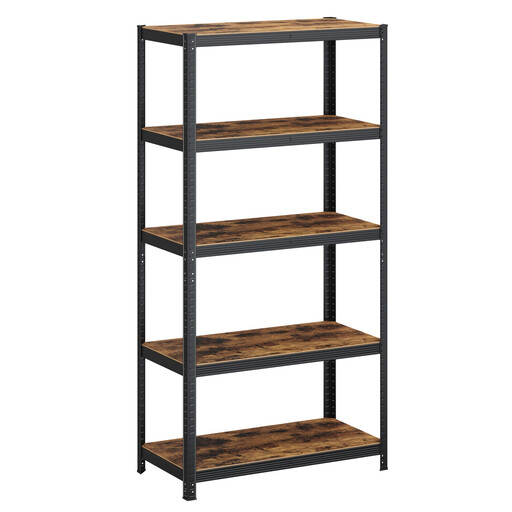
Why this product suits this use: Measuring 50 × 100 × 200 cm, with five shelves, it offers a practical storage solution for a garage, cellar or shed. According to the product details, each shelf can hold up to 120 kg.
The load capacity is listed separately for each shelf and for the unit as a whole. An anti-tip kit is also included; secure the unit to the wall as instructed.
Galvanised steel frame, five shelves adjustable in 5 cm increments and a tool-free clip-together system.
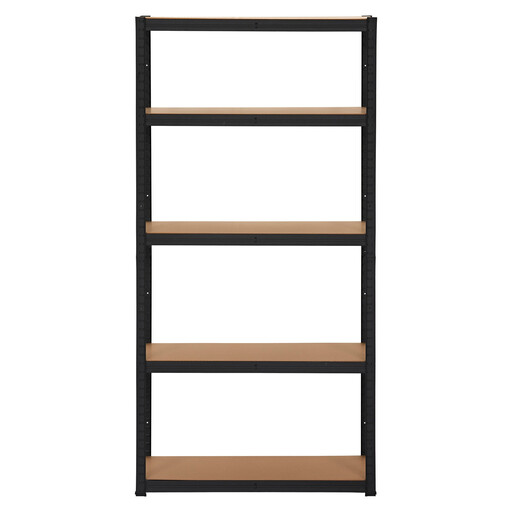
Why this product suits this use: For anyone looking for a high stated load capacity, this model has five MDF shelves and measures 180 × 90 × 45 cm.
The manufacturer specifies 265 kg per shelf and a total capacity of 1.325 kg. The load must still be evenly distributed, and the unit must not be used as a step.
Powder-coated steel frame, five MDF shelves, and clearly stated high load capacities per shelf and for the unit as a whole.
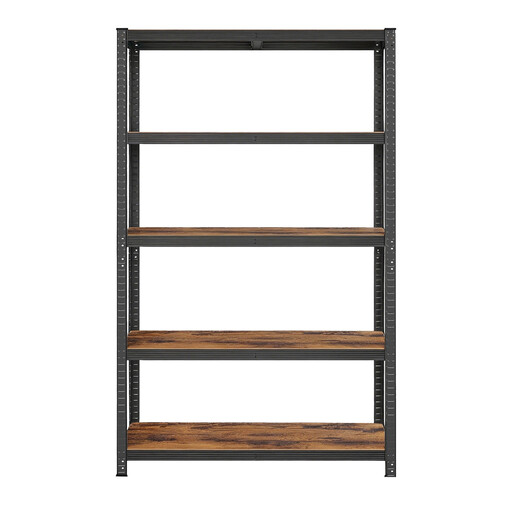
Why this product suits this use: Measuring 60 × 120 × 200 cm, this shelving unit is suited to larger garages, workshops and storage rooms where bulky equipment or lots of containers need to be stored.
The stated capacity of 150 kg per shelf and 750 kg overall makes the load limits clear. The included anti-tip kit is designed to help secure the unit safely in place.
Five adjustable shelves, a split-able design and a stated total load capacity of 750 kg.
We’ve put together a complete, regularly updated list of products that meet these strict selection criteria and fully comply with the safety regulations in force in the EU.
Place the shelving unit on a firm, level surface. Uneven floors can put strain on the frame and its clip-together connections. It’s a good idea to wear work gloves during assembly, as metal edges can cause cuts.
Once assembled, you should:
For a shelving unit for tools and storage, it’s also worth keeping things organised: put frequently used cases at an easy-to-reach height, heavy machinery on the bottom shelves, and seasonal items you rarely use on the upper shelves.
It depends on what you’re storing. A capacity of 120 kg per shelf may be enough for toolboxes and smaller equipment. For machinery, liquid containers or heavy spare parts, a higher stated shelf capacity is a good idea. The key is to distribute the load evenly and avoid overloading any one area.
Securing tall shelving to the wall is particularly important if the load is unevenly distributed or there are children or pets in the home. Always follow the assembly and safety instructions from the manufacturer. An anti-tip device reduces the risk of the unit falling over, but it doesn’t make up for an uneven surface.
There’s no set lifespan. It depends on the load, moisture, assembly, maintenance and the quality of the shelves. A dry location, evenly distributed loads and regular checks of the connections can help extend its service life. MDF shouldn’t be exposed to damp or condensation over long periods.