
Lieferung heute & morgen

Qualitätsgarantie

Willkommens-Angebote freischalten: KOSTENLOSE Lieferung | Bis zu 80 % RABATT | Kostenlose 30-Tage-JoyPlus-Testphase
App herunterladen
A heavy-duty shelving unit for the garage has to do more than provide extra storage. Tools, tyres, paints, spare parts and garden kit quickly add up in weight. At the same time, garages, cellars and workshops are often tight on space. If you focus only on a big kilogram figure or a bargain price, you’ll miss important details.
A statement such as “600 kg load capacity” often refers to the static total load. That doesn’t automatically mean any weight distribution is safe. On a unit with five shelves and a total load capacity of 600 kg, for example, 120 kg per shelf may be intended. The load should be evenly distributed and must not exceed the manufacturer’s specifications.
Likewise, the phrase “garage shelving 600 kg” on its own says little about real-world use. Also check whether the figure applies per shelf or to the entire unit, and whether it refers to a static load.
A tool-free boltless shelving unit can simplify assembly. However, the clip-in connections must be properly locked in place. Easy assembly doesn’t replace wall fixing either. A shelving unit with anti-tip restraint should be secured to a suitable wall with the supplied anti-tip kit, especially if heavy items are stored on upper levels.
A two-metre-high steel shelving unit won’t fit every garage. Before buying, consider ceiling height, door openings, walkways and clearance to vehicles. In damp cellars or unheated rooms, it’s also important to know whether the frame and shelves are suitable for the environment. For the black model measuring 50 × 100 × 200 cm, the product description explicitly states it is not designed for very damp conditions.
Load capacity should always be considered together with the construction. A heavy-duty metal shelving unit with five shelves is only suitable for heavy items if the frame, shelf boards and connectors are matched to the intended load.
Look for:
An MDF shelf can be practical for tools and boxes. Liquids must still be securely closed and stored so that nothing leaks or soaks into the shelf panel.
Dimensions are usually given as depth × width × height. A model measuring 50 × 100 × 200 cm offers different options from a more compact unit at 30 × 75 × 150 cm. For large toolboxes or machines, shelf width is key. For narrow cellar corridors, depth may be more important.
Also measure the height of your items. Height-adjustable shelves allow better adaptation when crates, cans and equipment vary in size. On JOYFURNOS models measuring 50 × 100 × 200 cm, the levels can be positioned in 5 cm increments.
A steel shelving unit or workshop rack with a steel frame is engineered differently for heavy storage than a lightweight living-room unit. However, it’s not just the material label that matters, but also the profile thickness, connection system, shelf board and anti-tip restraint.
Before use you should:
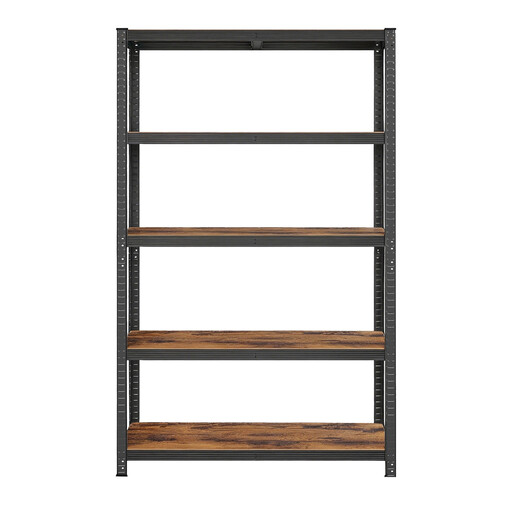
Why this product fits the profile: The compact dimensions make it suitable for smaller garages, cellars or sheds. Five levels and a stated static total load of 650 kg provide organised storage for toolboxes and supplies.
The product data lists both 130 kg per shelf and 650 kg total load. That makes it easier to assess than vague load claims. An anti-tip kit is included in the box.
30 × 75 × 150 cm, five shelves, steel frame, tool-free boltless system and the option to split into two units.
Why this product fits the profile: Adjustable levels and the option to split into two units give you flexibility for changing storage needs in the garage, cellar or workshop.
The product description lists specific dimensions, per-shelf load and total load instead of a generic stability claim. The supplied anti-tip kit is intended for wall fixing.
Steel frame, 130 kg static load per shelf, 650 kg total, and a build height of 150 cm.
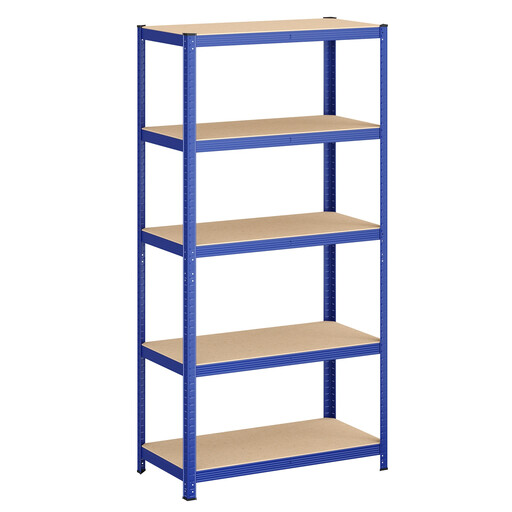
Why this product fits the profile: The increased width and depth suit extensive tool collections, bulky equipment or frequent use in the workshop, warehouse and garage.
The higher total load is complemented by a stated per-shelf load of 150 kg. Wall fixing with the anti-tip restraint as specified remains mandatory before use.
150 kg static load per level, 750 kg total load, height-adjustable shelves and the option to split into two separate units.
Read the instructions before assembly and wear work gloves. For a boltless system, make sure the locking tabs are fully seated in the intended slots. Don’t place the unit directly in front of doors, heaters or escape routes.
Store the heaviest items on the lower levels. Lighter boxes and infrequently used items can go higher up. An anti-tip restraint is no substitute for correct load distribution. The appropriate wall fixing depends on wall material and fixings; use suitable wall plugs and screws.
For a cellar or storage shelving unit, also consider humidity. MDF shelves and metal frames are not automatically designed for permanently damp conditions.
We’ve put together a complete, continuously updated list of products that fully meet these exacting selection criteria and the safety regulations in force in the EU.
That depends on what you’re storing. Add up the weight of the intended items and plan for even distribution across the shelves. Then compare both the load capacity per shelf and the total load capacity of your chosen unit.
The unit should stand on a level, stable surface. Clip-in connections must be fully locked. Then, fix the anti-tip restraint to the wall as instructed. Heavy items should be placed low down and as centrally as possible.
There’s no one-size-fits-all lifespan. It depends on loading, assembly, use and environment. Regular visual checks for bent components, loose connections, damaged shelf panels or corrosion help you spot changes early. Only use a model that’s suitable for damp rooms where applicable.