
Lieferung heute & morgen

Qualitätsgarantie

Willkommens-Angebote freischalten: KOSTENLOSE Lieferung | Bis zu 80 % RABATT | Kostenlose 30-Tage-JoyPlus-Testphase
App herunterladen
A garage needs to store tools, tyres, garden equipment and seasonal items without turning every available square metre into storage space. Heavy-duty garage shelving can help – provided its load capacity, dimensions and construction are suited to how you actually intend to use it.
Many poor purchases are not caused by insufficient nominal load capacity, but by unclear specifications and unsuitable planning. Before buying, you should check three common pitfalls:
Load capacity is only meaningful when it is clear under which conditions it applies. Look out for the following specifications:
For example, a metal shelving unit with five tiers and a capacity of 120 kg per shelf may be listed with a total load capacity of 600 kg. Another steel shelving unit may specify 175 kg per tier and 875 kg in total. These figures do not automatically apply to point loads, castors or unevenly distributed loads. Heavy items should preferably be placed on the lower levels.
For a garage or cellar, depth and width are just as important as height. 180 cm-high heavy-duty shelving may be easier to use in rooms with lower ceilings. 200 cm-high heavy-duty shelving, on the other hand, provides more vertical storage space but requires a sufficiently high and preferably level surface.
Before buying, check the following:
With some clip-together systems, adjustment is possible at fixed intervals, for example in 5 cm increments. This is practical when storing boxes or equipment of different heights. Also pay attention to the actual compartment height after assembly, not just the shelving unit’s external height.
A steel shelving unit generally consists of a metal frame and shelves made from MDF, chipboard or metal. Metal shelves are less sensitive to moisture and sparks, while MDF inserts can provide a solid, continuous storage surface. In unheated garages and sheds, the environment should be dry enough to prevent wood-based panels from absorbing moisture over a prolonged period.
A powder-coated or galvanised steel construction can protect the surface against everyday wear and tear. However, it is not a substitute for positioning the unit in a dry place and following the manufacturer’s instructions.
Anti-tip protection is an essential part of safety planning. A tall garage shelving unit should be secured to the wall using the supplied anti-tip kit. Beforehand, check that the wall type, wall plugs and fixings are compatible. Porous walls in older buildings or plasterboard walls may require professional advice when selecting suitable fixings.
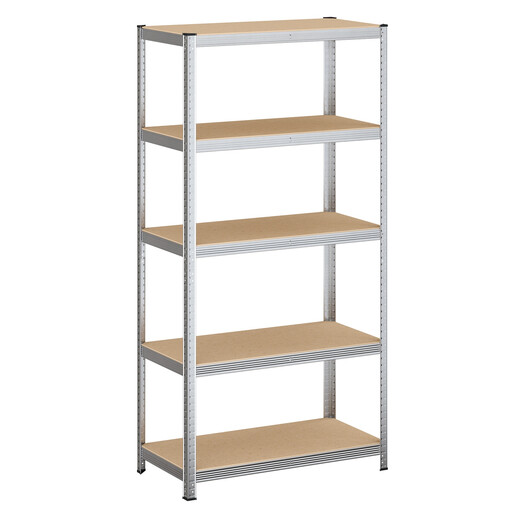
Why this product suits this profile: This shelving unit offers five tiers, a height of 200 cm and a total load capacity of 600 kg. It is suitable for typical garage, cellar and hobby applications involving items of different sizes.
The specifications state both 120 kg per tier and 600 kg in total. The shelves can be adjusted in 5 cm increments, and an anti-tip kit is included.
Galvanised steel frame, tool-free clip-together assembly, can be split into two units, and external dimensions of 50 x 100 x 200 cm.
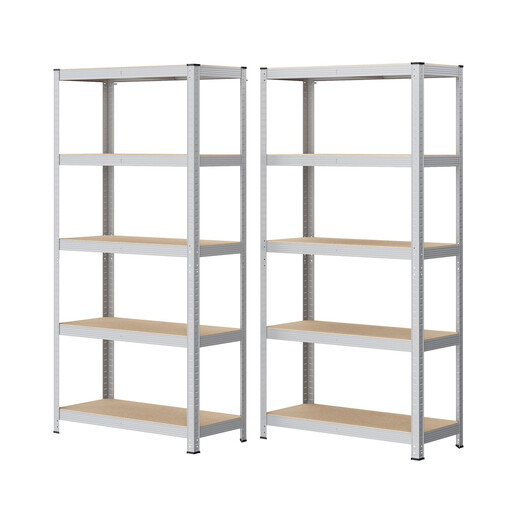
Why this product suits this profile: The set contains two shelving units, each measuring 40 x 90 x 180 cm. It is an appealing choice for buyers who want to create two separate storage areas in a garage, workshop or cellar.
The load figures are listed separately: 175 kg per tier and 875 kg per shelving unit. The included anti-tip kits provide the necessary wall-fixing solution.
Powder-coated steel frame, five tiers, adjustable shelves and the option to use the units separately.
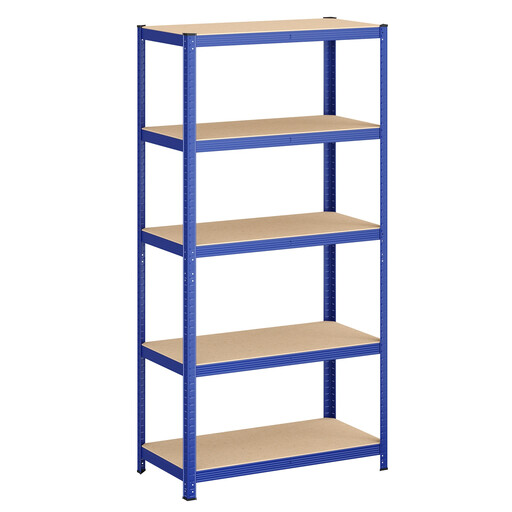
Why this product suits this profile: The 200 cm-high construction provides plenty of vertical storage space for tools, equipment and supplies. Its split design can be used alongside a workbench to provide additional storage.
Rather than giving only a blanket total figure, the specifications state 120 kg per tier and 600 kg overall. Shelf height can be adjusted in 5 cm increments, helping to minimise wasted space.
Galvanised steel frame, tool-free assembly, five tiers, dimensions of 50 x 100 x 200 cm and an included anti-tip kit.
We have put together a complete, regularly updated list of products that fully meet these strict selection criteria and the safety regulations applicable in the EU.
A clip-together shelving unit with interlocking connections can often be assembled without screws or specialist tools. Even so, you should follow the instructions in full and wear work gloves during assembly. After assembly, check the following:
A workshop shelving unit should not be loaded in a way that places point loads from heavy equipment on individual MDF shelves. For items with small contact areas, use a suitable load-distributing base, provided this is compatible with the manufacturer’s specifications. In damp environments, it is advisable to check the frame, coating and shelf inserts regularly.
That depends on what you are storing. A total load capacity of 600 kg may be sufficient for tool boxes, paint tins and spare parts. For particularly heavy equipment or large quantities of metal components, a model with a total load capacity of 875 kg and a higher load capacity per tier may be more suitable. The key factors remain the specifications for static load and evenly distributed weight.
A tool-free clip-together system can produce a stable construction when the frame and shelves are correctly locked into place. Stability also depends on a level surface, the load distribution and wall fixing. The supplied anti-tip kit should be used with tall shelving units.
There is no universal service life. It is influenced by factors including the load, moisture, assembly quality and how the shelving unit is handled. Keeping it in a dry location, distributing the load evenly and carrying out regular visual checks can help maintain the structure in its intended condition.