
Lieferung heute & morgen

Qualitätsgarantie

Willkommens-Angebote freischalten: KOSTENLOSE Lieferung | Bis zu 80 % RABATT | Kostenlose 30-Tage-JoyPlus-Testphase
App herunterladen
A heavy-duty shelving unit for your garage should reliably store tools, tyres, paint tins or gardening equipment. In practice, though, the wrong purchase is often down to unclear specifications, unsuitable dimensions or a lack of secure fixings – not simply a load capacity that’s too low. So if you’re looking to buy a metal shelving unit for your garage, a storage rack for your cellar or shelving for your workshop, check several technical details before you buy.
A claim such as “600 kg load capacity” sounds clear at first. But the key question is whether this figure applies to the whole unit or to each individual shelf. There may also be a distinction between static load capacity and loads applied while the unit is moving. When planning your storage, check the permitted weight per shelf and whether the load needs to be distributed evenly.
A tall shelving unit makes good use of space, but may be impractical in a low garage or beneath pipes. A shallow unit can also be a problem if you need to store bulky boxes. Before you buy, measure the available floor space, width of walkways, garage door, radiators and sockets. A model measuring 50 x 100 x 200 cm needs plenty of room and shouldn’t be placed directly against a damp external wall.
Being able to assemble shelving without tools doesn’t automatically mean it will be safe and stable once built. Plug-in joints, cross-braces, shelf supports and wall fixings all need to be fitted correctly. On a tall shelving unit, an included anti-tip kit is an important safety feature and should be used as instructed.
For a 600 kg storage rack, compare the stated total load capacity with the limit for each shelf. For example, five shelves with a maximum capacity of 120 kg each add up to 600 kg. These figures apply only to a static, evenly distributed load. Place heavier items on the lower shelves, with lighter boxes or smaller items higher up.
A 5-shelf heavy-duty shelving unit is more flexible if you can adjust the shelves to suit boxes and containers of different heights. Shelf positions that adjust in fixed increments, such as 5 cm, are more practical than shelves that are permanently bolted in place.
A sturdy steel shelving unit is generally suitable for garages, cellars, sheds and workshops. Galvanised steel can help protect the surface from everyday wear and tear. MDF shelves, on the other hand, shouldn’t be exposed to high humidity or direct contact with water for long periods. In damp cellars, make sure there’s good ventilation, keep the unit off the floor and choose a dry wall for installation.
The term “metal garage shelving” alone doesn’t tell you how stable a unit is. Important factors include the frame profile, shelf supports, bracing and type of joints. You should also secure the unit to a suitable wall if the manufacturer recommends it.
A plug-in shelving unit rated at 120 kg per shelf may be suitable for toolboxes, supplies or spare parts, provided the weight is distributed evenly. Models that can be split into two units are particularly practical. This lets you use one section as low workshop shelving or as a work surface with storage underneath.
Before assembly, check that all the parts are present. Work gloves reduce the risk of cuts from metal edges. A second person can help you raise a two-metre-tall shelving unit, even if you don’t need tools to connect the parts.
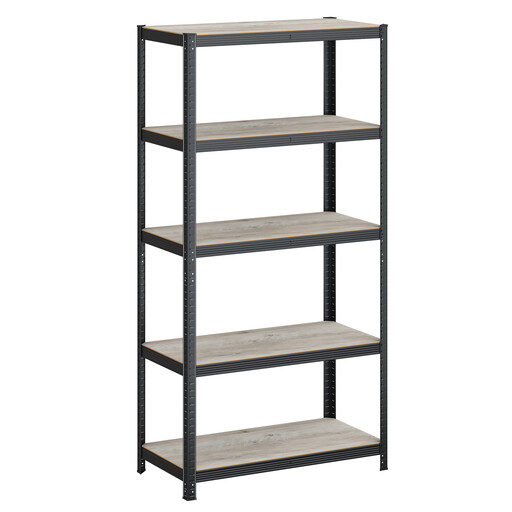
Why it suits this type of buyer: Measuring 50 x 100 x 200 cm, this unit has five height-adjustable shelves, making it an easy-to-plan storage solution for your garage, cellar or shed.
The load capacity is specified as 120 kg per shelf and 600 kg in total. The included anti-tip kit helps address the stability of a tall shelving unit.
Galvanised steel frame, MDF shelves, 5 cm adjustment increments and tool-free plug-in assembly.
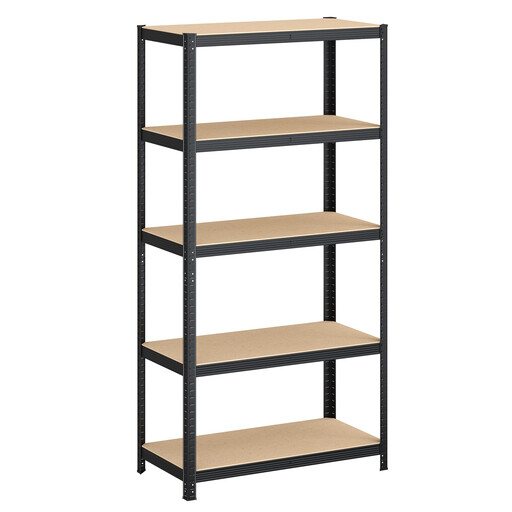
Why it suits this type of buyer: The black finish blends neatly into a workshop or garage, while combining clearly stated load capacities with a flexible layout.
The specifications distinguish between the static load per shelf and the total load capacity. They also highlight the need for wall fixings and the unit’s limited suitability for very damp environments.
600 kg total static load capacity, shelves adjustable in 5 cm increments and a split-able design.
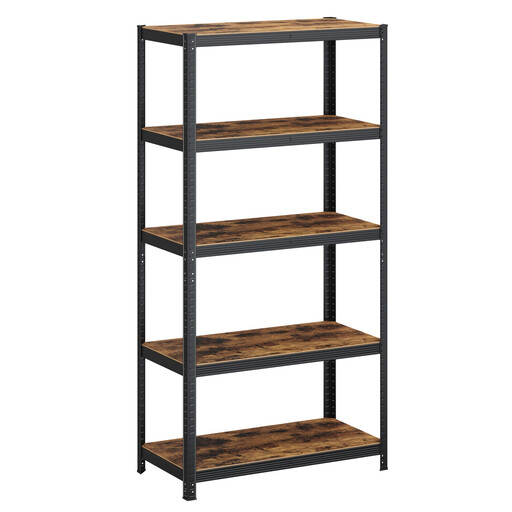
Why it suits this type of buyer: The split-able design is ideal if you need two shorter units or a combination of work surface and storage.
Adjustable shelf heights help you avoid wasting space between shelves. The anti-tip kit remains important when using the unit at its full height.
Can be configured as two units, with a 120 kg static load capacity per shelf and an interlocking assembly system.
We’ve put together a complete, regularly updated list of products that meet these strict selection criteria and fully comply with the safety regulations in force in the EU.
It depends on the model. The JOYFURNOS shelving unit is rated for a static load of 120 kg per shelf and 600 kg in total. The weight must be distributed evenly. Castors, impact loads or heavy items resting on one side aren’t automatically covered by this rating.
Wall fixings are generally advisable for a tall shelving unit and, according to the product specifications, are required for the JOYFURNOS models mentioned here. Fit the anti-tip kit using fixings suitable for your wall. First, check the wall material, any pipes or cables, and where the fixing points will go.
It’s not possible to give a reliable lifespan without knowing how the unit will be used, how heavily it will be loaded and the conditions it will be kept in. Keeping it in a dry place, distributing the load evenly, assembling it correctly and checking it regularly can help maintain its condition. In persistently damp rooms, steel frames and MDF shelves are exposed to greater strain. Pay particular attention to corrosion, swelling and loose joints.