
Lieferung heute & morgen

Qualitätsgarantie

Willkommens-Angebote freischalten: KOSTENLOSE Lieferung | Bis zu 80 % RABATT | Kostenlose 30-Tage-JoyPlus-Testphase
App herunterladen
A heavy-duty metal shelving unit provides extra storage in your garage, cellar, workshop or warehouse. However, models can vary considerably in load capacity, materials, shelf spacing and stability. A high figure on the packaging doesn’t tell you much on its own if it refers only to evenly distributed weight per shelf or doesn’t account for wall fixings.
Before you buy, check for these three common pitfalls:
Check two separate figures: maximum static load capacity per shelf and maximum total load capacity. “Static” means the load is stationary and evenly distributed. Concentrated loads from machine feet, toolboxes or individual boxes can put more strain on the shelves.
So don’t choose a heavy-duty shelving unit with 5 shelves based on the number of levels alone. Check:
Models with a 600 kg, 650 kg or 875 kg total load capacity suit different needs. The key is to consider what you want to store, such as supplies, toolboxes or heavy equipment, and how the weight will be distributed.
Measure the available floor space before you buy. For a cellar shelving unit, remember to account for doorways, heating equipment and any risk of damp, as well as width and height. In a garage, check the depth and clearance from your vehicle. A garage shelving unit with a depth of 50 cm gives you more storage space, but takes up more room than a narrower model.
Adjustable shelves are useful for storing items of different sizes. For example, a shelving unit with adjustable shelves can be set up to fit paint tins, toolboxes or plastic storage boxes. Some models can also be split into two separate units. Whether that’s a useful option depends on the layout of your room and how you plan to distribute the load.
A metal shelving unit isn’t necessarily made entirely from steel. Steel frames are often paired with MDF shelves. MDF provides a smooth surface, but should be protected from prolonged exposure to moisture. This combination can work well in dry indoor spaces such as workshops, storerooms or cellars with controlled humidity.
A tool-free boltless shelving unit is assembled using tabs and slot-in connections. This can reduce assembly time, but you’ll still need to check each connection carefully. Depending on the design, a rubber mallet may come in handy. Wear work gloves during assembly, place the unit on a level surface and secure it to the wall as instructed.
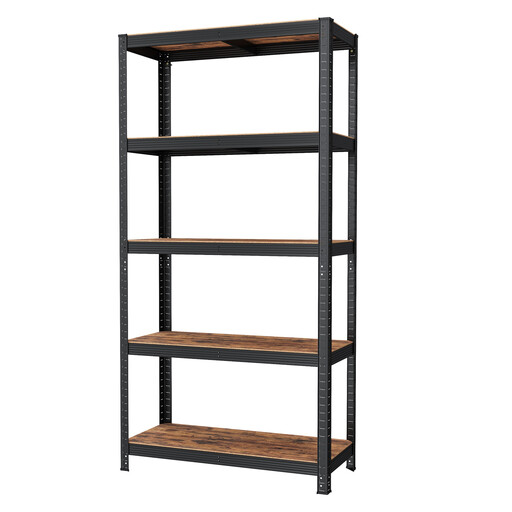
Why it suits this type of buyer: Measuring 30 × 75 × 150 cm, with five shelves, it’s a good fit for garages, cellars and utility rooms where floor space is limited.
The load capacity is clearly stated as 130 kg per shelf and 650 kg in total. An anti-tip kit is included.
Adjustable shelves, tool-free slot-in assembly and a design that can be split into two units.
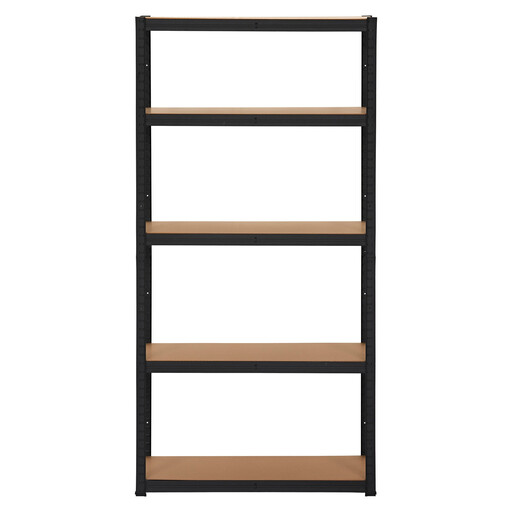
Why it suits this type of buyer: The shelving unit has five MDF shelves, a powder-coated steel frame and product dimensions of 180 × 90 × 45 cm, according to the supplier.
The maximum load capacity is listed separately as 265 kg per shelf and 1,325 kg in total, making it easier to plan your storage more accurately.
High stated load capacity per shelf, five storage levels and a powder-coated metal frame for dry indoor spaces.
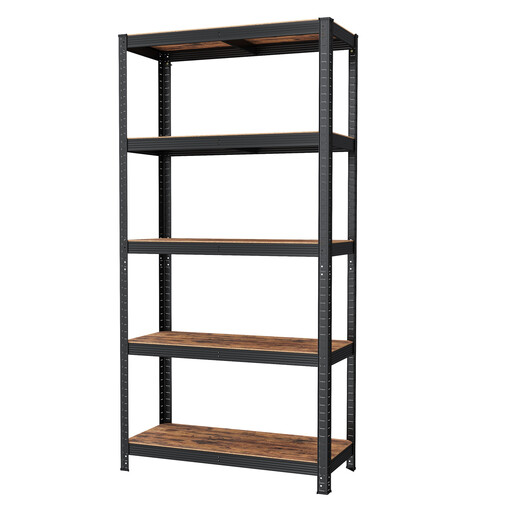
Why it suits this type of buyer: Measuring 40 × 90 × 180 cm, with five shelves each holding 175 kg, this model is designed for workshops, garages and storerooms where you need plenty of storage.
The total static load capacity of 875 kg is stated alongside the 175 kg capacity per shelf. An anti-tip kit is included and the shelves are adjustable.
Tool-free slot-in assembly, a design that can be split into two units, and a powder-coated steel frame with five MDF shelves.
We’ve put together a complete, regularly updated list of products that meet these strict selection criteria and the safety regulations in force across the EU.
That depends on the model. In the product examples above, figures such as 120 kg, 130 kg, 175 kg or 265 kg refer to the maximum static load per shelf when the weight is evenly distributed. The total load capacity is listed separately and must not be exceeded either.
A slot-in system can be stable when assembled correctly. Make sure all the connections are fully engaged, the surface is level, the load is evenly distributed and the unit is properly secured to the wall. Check regularly that the frame and connections are still in place.
For a garage, look for a corrosion-protected or coated steel frame, suitable dimensions and anti-tip safety. In a workshop, adjustable shelves are useful when toolboxes, equipment and consumables need different amounts of clearance. If the room is damp, also check whether the MDF shelves are suitable.