
Lieferung heute & morgen

Qualitätsgarantie

Willkommens-Angebote freischalten: KOSTENLOSE Lieferung | Bis zu 80 % RABATT | Kostenlose 30-Tage-JoyPlus-Testphase
App herunterladen
A heavy-duty metal shelving unit should provide long-term storage for tools, supplies, equipment or boxes. In practice, however, a high weight rating alone does not guarantee you’ll choose the right one. The key factors are the actual static load capacity, the dimensions, the condition of the floor and the type of assembly.
That’s why it’s worth checking the technical details carefully, whether you’re buying for a garage, cellar, workshop or small storage room. The criteria below can help you avoid common buying mistakes and choose a unit that suits the way you plan to use it.
A figure such as ‘600 kg load capacity’ often refers to the combined capacity of all the shelves. It doesn’t mean that one shelf can hold 600 kg. Check whether the product also specifies a maximum static load per shelf.
It’s also important to distribute the load evenly. Heavy machinery or toolboxes concentrated in one spot can put more strain on a shelf than evenly distributed boxes.
A wide workshop shelving unit can offer plenty of storage space, but it also needs enough depth. Before you buy, measure:
For a cellar with a low ceiling, a 150 cm-high model may be more practical than a 200 cm-high storage shelving unit. In a garage, you’ll also need to allow for where the vehicle is parked.
A boltless shelving unit, also known as a slot-together unit, can be assembled using an interlocking system. This can reduce assembly time, but it doesn’t automatically replace the need to secure the unit to a wall.
For tall units or shelves carrying unevenly distributed loads, use the supplied anti-tip kit as instructed. It’s also important to make sure the unit is level. Work gloves can help protect your hands from sharp metal edges during assembly.
When comparing a 600 kg heavy-duty shelving unit, make sure you distinguish between three figures:
These figures generally refer to a stationary load. Placing, moving or lifting heavy items off the shelves can create additional forces. For particularly heavy equipment, it’s a good idea to spread the weight across several shelves or use a suitable supporting structure.
A metal shelving unit with 5 shelves often has a steel frame and MDF shelves. MDF stands for medium-density fibreboard. It provides a flat, enclosed surface for boxes, tools and supplies, but should be protected from prolonged exposure to high levels of moisture.
So, if you’re using the unit in a garage, cellar or shed, consider the conditions in the space. Damp environments can put extra strain on metal surfaces and shelf boards. Good ventilation, keeping the unit away from standing water and following the manufacturer’s instructions can all help.
Height-adjustable shelves make it easier to store items of different sizes. With 5 cm spacing, for example, you can fit shallow containers, tool cases and taller boxes more flexibly.
Some models can also be split into two separate units. One section can then serve as a low workbench with storage, while the other can be used as cellar or garage shelving. Before splitting the unit, check that all the connectors and the specified safety features can be fitted correctly.
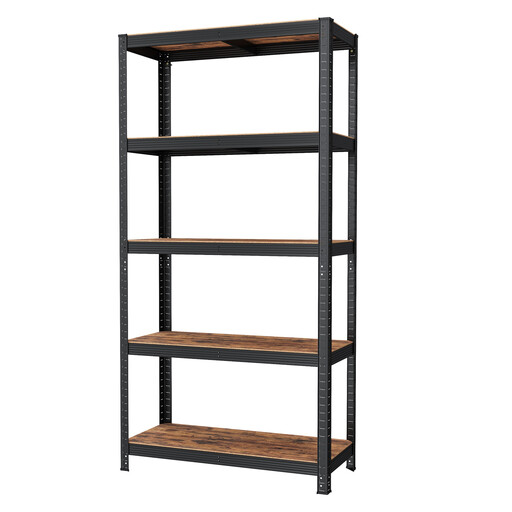
Why this product suits this profile: Measuring 30 × 75 × 150 cm, this model is well suited to smaller workshops, cellars or utility rooms where ceiling height is limited. According to the product details, each of its five shelves can hold up to 130 kg, for a total static load capacity of 650 kg.
The specifications state both the load capacity per shelf and the total capacity. Its lower height also makes it easier to plan for rooms with low ceilings.
Steel frame, MDF shelves, adjustable heights, split-unit design and a supplied anti-tip kit.
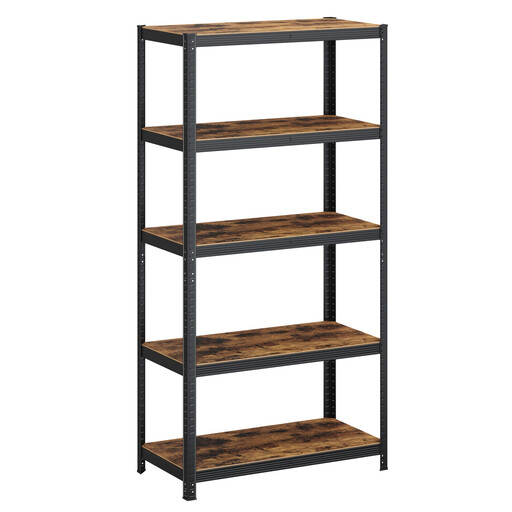
Why this product suits this profile: This 50 × 100 × 200 cm storage shelving unit combines a galvanised steel frame with five MDF shelves. The shelves can be adjusted in 5 cm increments, and each is rated to hold up to 120 kg.
The product details clearly distinguish between the load capacity per shelf and the total capacity. Adjustable shelf heights also help you make better use of the space when storing containers of different sizes.
Tool-free slot-together assembly, galvanised steel frame, 5 cm adjustment increments and the option to split it into two units.
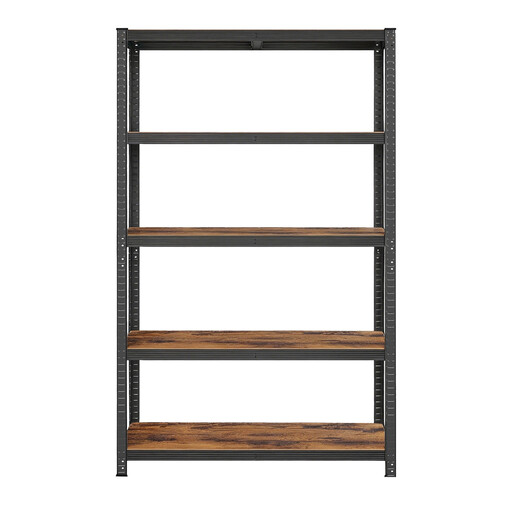
Why this product suits this profile: Measuring 60 × 120 × 200 cm and with a stated total load capacity of 750 kg, this shelving unit is suited to anyone needing more space, such as for a workshop, garage or small storage area.
The stated capacity of up to 150 kg per shelf makes it clear how much each level can hold. You’ll still need to allow for the room depth and plan how to secure the unit to the wall before buying.
Powder-coated steel frame, five adjustable shelves, split-unit design and a stated total static load capacity of 750 kg.
We’ve put together a complete, regularly updated list of products that meet these strict selection criteria and fully comply with the safety regulations in force in the EU.
First, place the unit on as level a surface as possible and assemble it fully. Then secure the supplied anti-tip kit to a suitable wall, following the instructions. For plasterboard, porous walls or unusual wall constructions, you’ll need to choose suitable wall plugs and fixings.
Its lifespan depends on the load, the room conditions, assembly and care. Evenly distributed static loads, a dry location and regular checks of the connections can all help extend its service life. Check for rust, bent components or damaged MDF shelves before putting the unit under load again.
A heavy-duty shelving unit normally doesn’t need electricity, so it won’t add to your energy bills. The only potential costs to consider are extra wall fixings, replacement shelves or a future extension. When comparing prices, look beyond the purchase price and check whether the dimensions, load capacity and features already suit your intended use.