
Lieferung heute & morgen

Qualitätsgarantie

Willkommens-Angebote freischalten: KOSTENLOSE Lieferung | Bis zu 80 % RABATT | Kostenlose 30-Tage-JoyPlus-Testphase
App herunterladen
Tools, paint cans, car tyres, and boxes are piling up in the garage or basement, creating more chaos than order. If you're looking for a functional and durable solution to safely store heavy items and reclaim control over your storage space, you'll quickly come across heavy-duty shelving. However, the selection is vast, and the technical specifications can be confusing.
This article serves as a practical guide. We'll explain the key criteria to consider when making your choice and present a selection of models that stand out for their construction and functionality. Our goal is to provide you with an objective basis for your decision.
Before you decide on a model, several fundamental aspects should be considered. These will help you find a shelving unit that not only fits your space but also withstands the demands of everyday use.
The most important metric is the high load capacity. A distinction is made here between the load capacity per shelf and the maximum total load capacity of the unit. Consider what you plan to store: lightweight boxes or heavy engine parts?
A robust metal shelving unit, usually made of powder-coated or galvanised steel, offers high stability and durability. The shelves are often made of MDF (medium-density fibreboard) panels, which create a smooth and resilient storage surface.
Carefully measure the available space in your garage, basement, or workshop (height, width, depth). Be sure to plan for enough room to comfortably load and unload items.
Modern shelving systems often offer a high degree of flexibility:
Most modern heavy-duty shelving units for home and small business use are designed as boltless shelving. With this system, the components are connected using a smart interlocking mechanism, enabling quick and tool-free assembly. This is a clear advantage over traditional bolted shelving, which requires more time and tools to set up.
Based on the criteria mentioned, we have compiled a few models suitable for various applications.
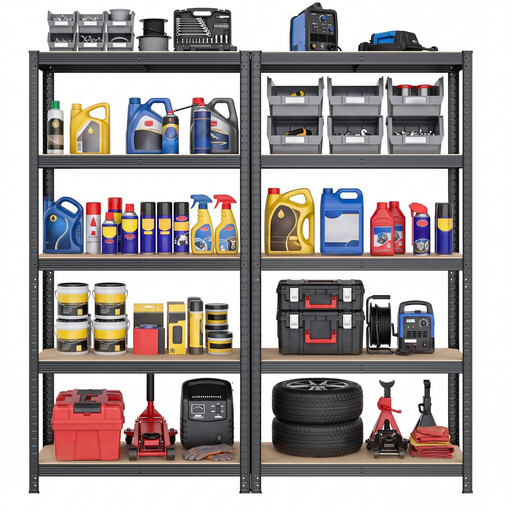
Why It Stands Out: With two shelving units, this set offers a comprehensive solution for larger spaces. The impressive total load capacity of 875 kg per unit (175 kg per shelf) makes it an option for storing particularly heavy equipment. Reinforced crossbars under each shelf provide additional stability.
Advantages:
Who Is It For? Ideal for users who want to outfit an entire wall in their garage or create a basement shelving system and need a solution for very heavy loads like engines, large tool chests, or heavy material crates.
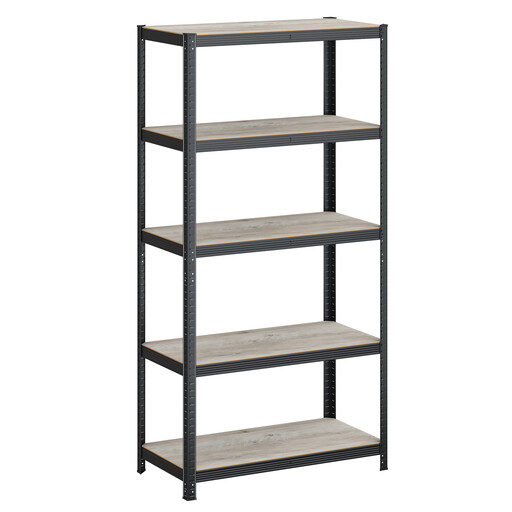
Why It Stands Out: At a height of 200 cm, this garage shelving unit makes optimal use of vertical space. The 50 cm depth also provides room for larger storage bins. The total load capacity of 600 kg (120 kg per shelf) is more than sufficient for most DIY and household applications.
Advantages:
Who Is It For? A great choice for tall basements, garages, or storage rooms where maximum vertical storage space with a solid load capacity is needed. The greige and black colour combination also gives it an appealing look for a workshop shelf.
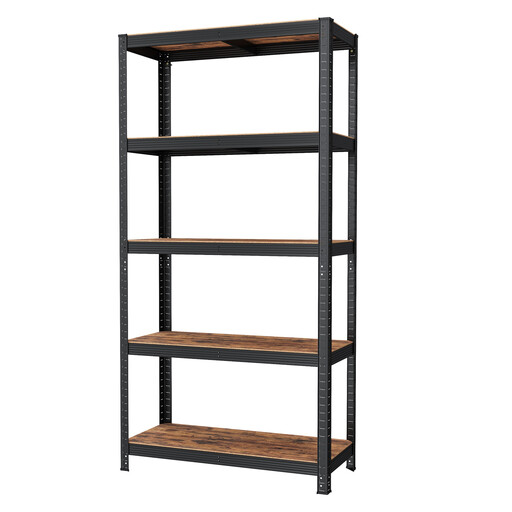
Why It Stands Out: This model is a compact yet highly durable solution. With a width of 75 cm and a depth of 30 cm, it fits well in narrower alcoves, pantries, or smaller workshops. Despite its smaller footprint, it offers a remarkable total load capacity of 650 kg (130 kg per shelf).
Advantages:
Who Is It For? Perfect for workshops, pantries, or smaller utility rooms where a space-saving yet robust storage rack is needed to create order.
Every space and every application has different requirements for a shelving system. If the models presented here don't exactly match your needs for size or load capacity, you may find the right solution in our wider selection.
Browse our complete collection of Assembly Shelving to discover more configurations and sizes.
It is strongly recommended, especially for tall units or when storing heavy items on the upper shelves. Most quality kits include an anti-tip kit to securely anchor the unit to the wall. This significantly increases stability and safety, particularly in households with children or on uneven floors.
The load-bearing capacity varies greatly depending on the model, material, and construction. Always pay attention to the manufacturer's specifications. There are two important values: the load capacity per shelf (e.g., 175 kg) and the maximum static total load capacity (e.g., 875 kg). Do not exceed these limits and distribute the weight as evenly as possible.
The main advantage of a boltless shelving unit is its simple and mostly tool-free assembly. The parts are interlocked and often secured with a rubber mallet. This allows for quick setup and disassembly. Bolted shelving can offer high stability but requires significantly more time and tools for assembly.