
Lieferung heute & morgen

Qualitätsgarantie

Willkommens-Angebote freischalten: KOSTENLOSE Lieferung | Bis zu 80 % RABATT | Kostenlose 30-Tage-JoyPlus-Testphase
App herunterladen
A cluttered basement, a disorganized garage, or a workshop where tools and materials are taking up all the space—these situations call for a structured solution. A heavy-duty shelving unit is often the answer for creating order and giving heavy items a secure place. However, the market is flooded with options whose promises don't always hold up to reality.
This guide will help you identify the crucial features and avoid common pitfalls when buying. This way, you can ensure that your new storage rack will perform its job reliably for the long term.
Before you make a decision, you should be aware of three common problems that often only become apparent after the purchase and lead to frustration.
To make an informed decision, focus on the following technical parameters. These determine the durability, safety, and functionality of your shelving unit.
Ignore the promotional total load capacity and instead check the maximum static load capacity per shelf. This value indicates how much weight a single shelf can permanently support when evenly distributed. For storing toolboxes, paint cans, or car tires, this value should be sufficiently high. Also, look for additional crossbars under the shelves. These simple metal reinforcements prevent sagging and contribute significantly to the stability of the entire unit.
The frame material is usually steel, but the surface treatment makes all the difference.
The shelves are often made of MDF (Medium-Density Fibreboard). These are cost-effective and stable but are sensitive to moisture. In a damp basement, they can swell and lose their load-bearing capacity. For such conditions, metal shelves are the better choice.
Modern heavy-duty shelving units are typically designed as boltless systems. A high-quality system is characterized by precisely manufactured components that connect firmly and securely with little effort. A crucial safety feature is the included anti-tip kit. Every tall shelving unit, especially one with a high load capacity, should be anchored to the wall for safety to prevent it from tipping over due to uneven loading or accidental bumps.
Here are some models tailored to specific use cases that meet the quality criteria mentioned above.
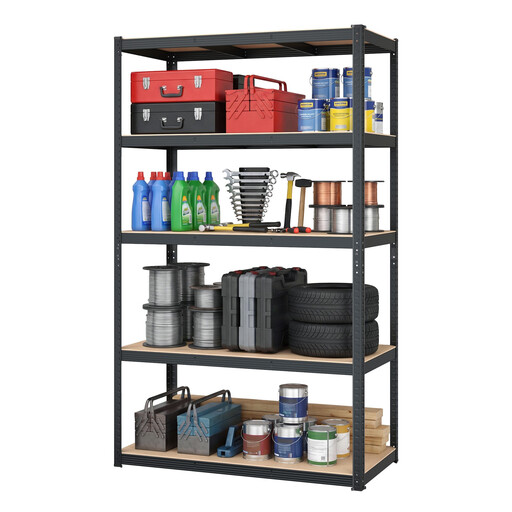
Why This Fits Their Persona: Ideal for users looking for a reliable and flexible all-round solution for a garage shelf or workshop rack. Its standard dimensions and high load capacity cover most use cases.
The clearly defined load capacity of 150 kg per shelf is realistic. Reinforced crossbars under each shelf prevent sagging and ensure stability.
Can be assembled as one tall rack or two half-height workbenches. The powder-coated steel shelving system offers solid protection.
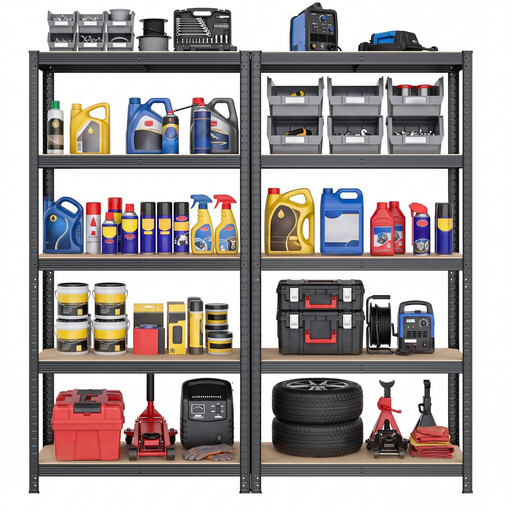
Why This Fits Their Persona: Perfect for users who need to equip a larger area in a basement or warehouse and value good value for money. The set offers maximum storage space.
This set avoids the stability trap with a high load capacity of 175 kg per shelf and the inclusion of two separate anti-tip kits for secure wall mounting of both units.
A two-pack for cost-effective outfitting of large spaces. The shelves are height-adjustable, allowing for customized storage.
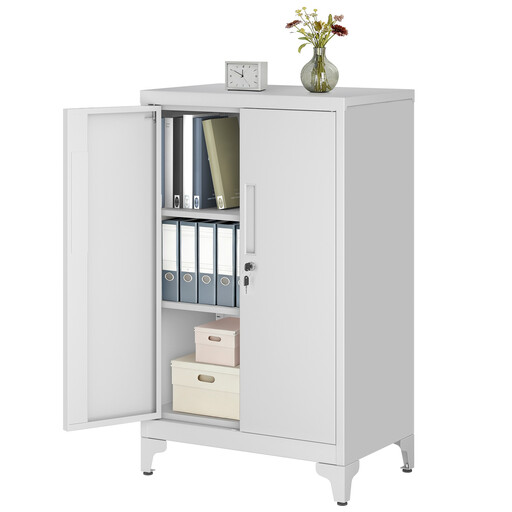
Why This Fits Their Persona: For anyone who needs not just order, but also security. Ideal for storing valuable tools, chemicals, or important documents in a workshop, office, or garage.
The anti-rust steel construction counteracts the risk of corrosion in damper environments. Unlike open shelving, this cabinet provides protection against unauthorized access.
Lockable double doors with a reliable steel lock. The shelves are adjustable, allowing for a flexible interior layout.
We have compiled a full list of products that meet these strict selection criteria and are suitable for use in homes and workshops.
Wall anchoring is a critical safety feature. It prevents the shelving unit from tipping over, especially when it is heavily loaded, unevenly stocked, or if children are nearby. It is strongly recommended to use the included anti-tip kit to securely fasten the unit to a sturdy wall.
Using MDF shelves in permanently damp environments, such as unventilated basements, is not recommended. The material can absorb moisture, swell, and lose its stability. For a basement shelf, models with a galvanized steel frame and metal shelves are the more robust and durable choice.
The static load capacity specifies the maximum weight that a shelf or the entire unit can support under a stationary and evenly distributed load. Exceeding this value can lead to material fatigue, deformation of the shelves, or, in the worst-case scenario, the collapse of the structure. Adhering to this specification is essential for safe use.