
Lieferung heute & morgen

Qualitätsgarantie

Willkommens-Angebote freischalten: KOSTENLOSE Lieferung | Bis zu 80 % RABATT | Kostenlose 30-Tage-JoyPlus-Testphase
App herunterladen
By the Joybuy Product Recommendation Officer, 28 July 2026
A cluttered basement, a disorganised garage, or a workshop where tools and materials block the floor—these situations demand a robust and reliable storage solution. Heavy-duty shelving seems like the obvious answer. Yet, the market is flooded with options whose promises don't always hold up in practice. Before you make a decision, it's crucial to understand the common pitfalls that can lead to a poor purchase.
Many buyers focus on price or tempting marketing terms, only to later find that their new shelving wobbles, the shelves sag, or it's unsuitable for a damp basement. The three most common problems are:
A well-considered purchase not only saves you hassle but also ensures safety and long-lasting order.
To avoid the problems mentioned above, you should focus on three core technical parameters. These determine the functionality and longevity of your shelving far more than any marketing slogan.
Load capacity is the most important criterion for high-capacity shelving. Pay attention to two separate values:
Always note the "with even load distribution" clause. This means the weight should be spread across the entire surface of the shelf, not concentrated at a single point.
The frame of a good heavy-duty shelving unit is made of steel. The surface finish is crucial for corrosion protection, especially in basements or garages.
Modern boltless shelving allows for quick, screw-free assembly. The quality of the system is evident in the precision of the components. High-quality systems have precisely stamped tabs and slots that lock firmly together. A rubber mallet is often the only tool needed to ensure a stable connection. Additional cross-braces under the shelves or the option to anchor the unit to the wall (anti-tip hardware) are features of a well-thought-out design.
Based on these objective criteria, we have identified several models that represent a suitable solution for specific user profiles and their requirements.
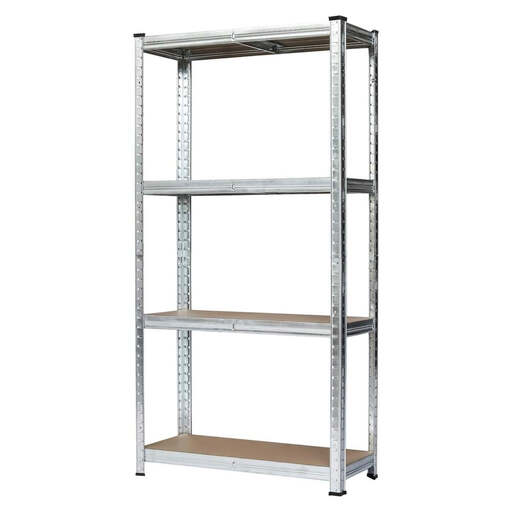
Why it's a match: Ideal for homeowners looking for a solid, foundational setup to organise a basement or storage room. It offers a reliable solution for storing household items, beverage crates, or seasonal decorations without breaking the bank.
The galvanised steel frame provides basic corrosion protection, thus avoiding the pitfall of unsuitable materials for standard basement environments. The clear specification of 125 kg per shelf is a realistic capacity for general storage purposes.
Excellent value for a functional, entry-level solution. The boltless system allows for straightforward assembly.
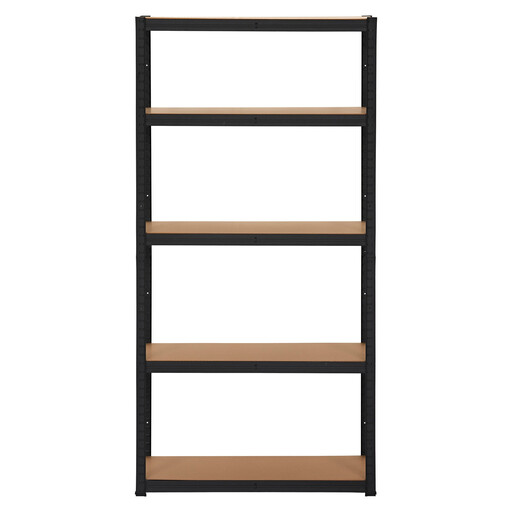
Why it's a match: Perfect for the workshop or garage of ambitious DIYers and small business owners who need to safely store heavy tools, spare parts, or material stock. The high load capacity provides the necessary safety margin.
With a specified load capacity of 265 kg per shelf, it avoids the trap of misleading, underrated capacities. The powder-coated finish also offers superior protection against scratches and corrosion compared to simple galvanisation.
Very high load capacity of 265 kg per shelf (1325 kg total). The matte powder-coated finish is robust and visually appealing for a workshop environment.
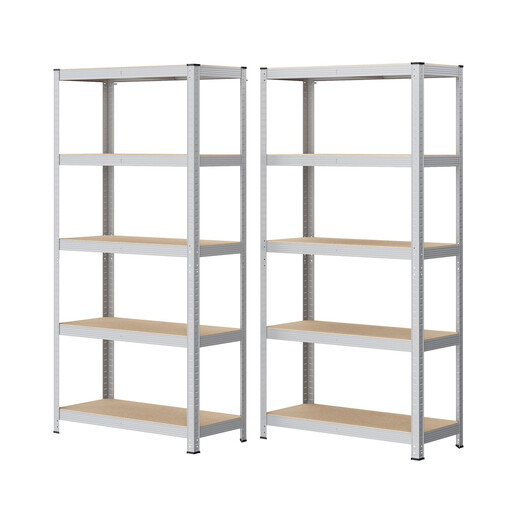
Why it's a match: For anyone looking to systematically outfit an entire room—be it a stockroom, a large garage, or a basement. This set provides a uniform, expandable, and high-capacity solution for extensive storage projects.
Instead of combining multiple, potentially unstable individual units, this set offers two coordinated, stable units. With 175 kg per shelf, it avoids the pitfall of insufficient load capacity for serious projects.
Two complete shelving units in one package. Each unit can also be reconfigured into two half-height units (workbenches), offering maximum flexibility.
We have compiled a complete, up-to-date list of products that fully meet these strict selection criteria and safety requirements.
It is strongly recommended to anchor any heavy-duty shelving unit to a sturdy wall with an anti-tip device. This is an essential safety measure to prevent tipping, especially if the load is unevenly distributed, higher shelves are loaded, or children are in the household. Many kits already include the necessary mounting hardware.
This specification means that the weight must be spread across the entire surface of the shelf to achieve the stated maximum load capacity. Concentrating the entire weight on a single point in the middle of the shelf can lead to overloading and cause the shelf to bend or break, even if the total weight is below the maximum limit.
Assembling a boltless shelving unit is theoretically possible alone, but it is significantly easier, faster, and safer with a second person. One person can hold the parts in position while the other taps them firmly into place with a rubber mallet. This ensures that the connections are tight and flush from the start, which is crucial for the stability of the entire structure.