
Lieferung heute & morgen

Qualitätsgarantie

Willkommens-Angebote freischalten: KOSTENLOSE Lieferung | Bis zu 80 % RABATT | Kostenlose 30-Tage-JoyPlus-Testphase
App herunterladen
A heavy-duty shelving unit should help you keep things tidy, store tools safely and make good use of the space available. But in a garage, cellar, shed or storeroom, it’s not enough to look only at the high weight limit in the product description. What matters is the combination of load capacity, dimensions, material, assembly and anti-tip safety.
If you’re looking to buy a metal shelving unit for your garage or a storage rack, you should also check that its design suits the way you’ll actually use it. A narrow cellar shelving unit needs different features from a deep workshop shelving unit designed for machinery and toolboxes.
Figures such as 600 kg shelving unit load capacity or 750 kg shelving unit load capacity generally refer to the maximum static load for the whole unit. That doesn’t automatically mean that each shelf can hold that much weight. You should also check the load capacity per shelf.
For example, a unit with five shelves and a total load capacity of 600 kg may be designed to hold 120 kg per shelf. These figures usually apply when the load is evenly distributed and the unit is placed on a stable, level surface. Point loads – such as a heavy machine resting on a small area – can put more strain on the shelves.
A boltless shelving unit can often be assembled more quickly, but it still needs to be put together carefully. The connectors must be fully engaged. Uneven floors, loose crossbars or incorrectly fitted MDF boards can affect stability.
For tall shelving units, wall fixing or anti-tip protection should also be part of your safety plan. This is especially important in homes with children, where floor space is limited or where the load is uneven. Secure the unit to the wall according to the instructions.
A shelving unit that’s 200 cm tall may be impractical in a garage with a low ceiling or beneath a door. Before buying, measure the available floor space, ceiling height, doorway width and room to move around. Remember to check the depth, too: a 60 cm-deep model offers more storage space, but needs a wider walkway than a 30 cm-deep cellar shelving unit.
Check these three details:
A sturdy steel shelving unit with a capacity of 120 to 150 kg per shelf may be suitable for toolboxes, provisions, paint or household items. Place heavy items on the lower shelves wherever possible. The actual load capacity also depends on assembly, the condition of the floor and correct use of the unit.
Steel frames are a practical choice for garage or workshop shelving, as they provide a sturdy supporting structure. Depending on the model, the shelves may be made from MDF boards, for example. These should be protected from prolonged exposure to moisture. If you’re using the unit in a damp cellar, an unheated shed or an area prone to condensation, check that the materials and surface finish are suitable.
A galvanised or powder-coated steel frame can provide extra surface protection. However, this doesn’t replace the need to place the unit on a dry, level surface and check it regularly for damage.
An adjustable heavy-duty shelving unit is useful if you need to store containers, tool cases or boxes of different sizes. Shelf spacing in increments of, for example, 5 cm can be handy, as long as it allows you to position the shelves flexibly enough.
Some boltless shelving units can be split into two separate units. This can create a low workbench with storage or let you divide your storage between two areas. Before making any changes, check whether the instructions specifically allow this configuration and whether each unit needs to be secured separately.
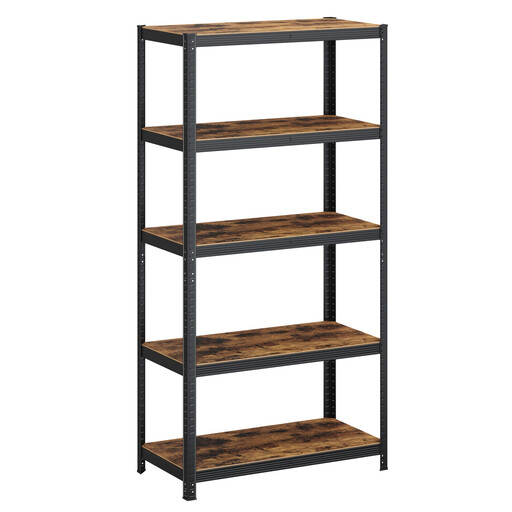
Why this product suits these needs: This unit has five shelves, measures 50 × 100 × 200 cm and has a stated maximum static load capacity of 600 kg. It’s suitable for a garage, shed, cellar or utility room when you need plenty of vertical storage space.
The product details state both the total load capacity of 600 kg and the capacity of 120 kg per shelf. The shelves are adjustable in 5 cm increments, and an anti-tip kit is listed as included.
Galvanised steel frame, tool-free boltless assembly and a divisible design with five shelves.
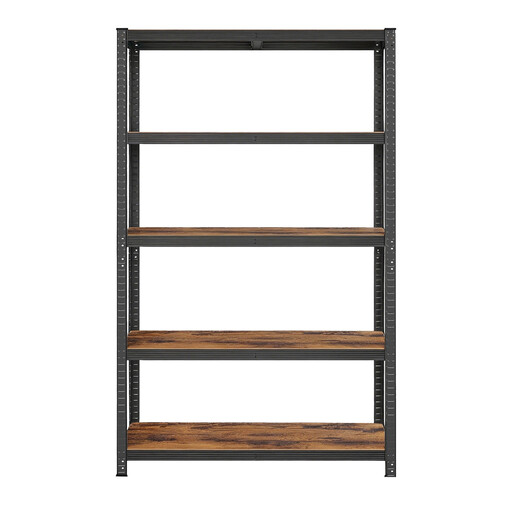
Why this product suits these needs: Measuring 60 × 120 × 200 cm, with five shelves and a capacity of 150 kg per shelf, this model is designed to offer plenty of storage space. Before buying, check that its larger footprint will fit your available space and leave enough room to pass through.
The product details distinguish between a total load of 750 kg and 150 kg per shelf. The anti-tip kit helps prevent the unit from tipping, but doesn’t replace proper wall fixing.
Powder-coated steel frame, adjustable shelves and a divisible design for organising different storage areas.
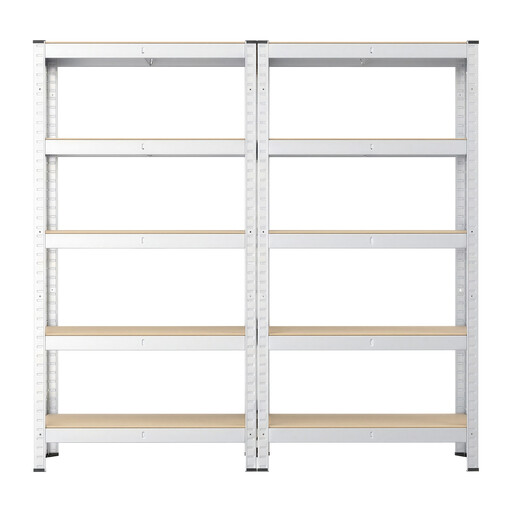
Why this product suits these needs: Two compact units are ideal for creating separate storage areas in a cellar, garage or workshop. Each unit has five adjustable shelves and a stated total load capacity of 650 kg.
The compact depth of 30 cm makes it easier to plan for tight spaces. The product description lists a capacity of 130 kg per shelf and includes two anti-tip kits.
Two separate shelving units, boltless assembly and adjustable shelves for organising smaller items.
We’ve put together a complete, regularly updated list of products that meet these strict selection criteria and fully comply with the safety regulations in force in the EU.
The key figures are the static load capacity per shelf and the total load capacity. These figures usually apply when the load is evenly distributed, the unit is correctly assembled and it’s placed on a level surface. Point loads, sideways forces and moisture can all affect the practical load capacity.
Many models are designed for tool-free boltless assembly. However, it’s still a good idea to have a second person help with tall or heavy units, so that the frame, shelves and safety fittings can be positioned correctly. Work gloves can help protect your hands from sharp metal edges during assembly.
There’s no set lifespan that applies to every shelving unit. It depends on the load, humidity, assembly quality and maintenance. A unit placed in a dry area, with its load evenly distributed and its condition checked regularly, may last longer than one that’s constantly exposed to moisture or overloaded.