
Lieferung heute & morgen

Qualitätsgarantie

Willkommens-Angebote freischalten: KOSTENLOSE Lieferung | Bis zu 80 % RABATT | Kostenlose 30-Tage-JoyPlus-Testphase
App herunterladen
A cluttered basement, a disorganized garage, or a workshop where tools and materials have no permanent home—these situations call for a robust and reliable storage solution. Heavy-duty shelving seems like the obvious answer. However, the market is flooded with options whose promises often don't hold up in practice. Choosing the wrong material or overestimating load capacity claims can quickly lead to a purchase you'll regret.
This guide will help you identify the crucial features of a quality heavy-duty shelf and avoid the three most common pitfalls, ensuring you find a durable and safe solution for your needs.
Before deciding on a model, it's important to critically evaluate common marketing promises. Many buyers regret their decision because they fell into one of these three traps.
To make an informed decision, you should focus on the technical facts. These three parameters are crucial for the longevity and safety of your shelving unit.
Instead of just looking at the maximum kilogram rating, examine the construction details. A high-capacity shelf is characterized by the following features:
The choice of material is directly linked to the intended location.
A good boltless shelving unit can be assembled with a precise and stable fit. Look for accurately punched connecting pieces. A rubber mallet is generally recommended for assembly to firmly join the parts without damaging the material. An essential safety feature is the anti-tip kit. Every tall storage rack should be securely anchored to the wall to prevent it from tipping over, especially with uneven loads or in households with children.
Instead of making a blanket recommendation, we have matched models based on specific user profiles.
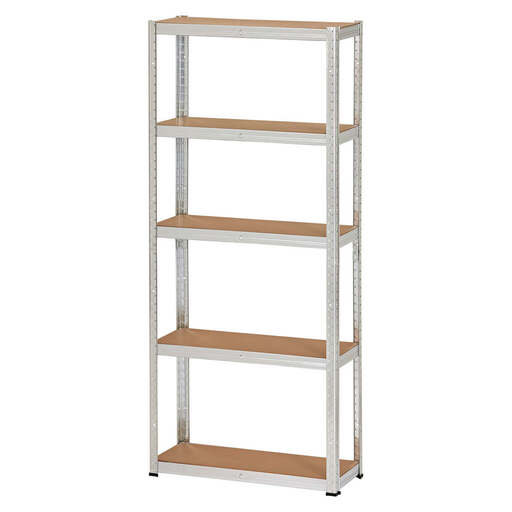
Why it's a good fit: Ideal for organizing light to medium-weight items in the pantry or a dry storage room. With a 75 cm width, it also fits into narrower niches.
The rating of 75 kg per shelf is a realistic estimate for household items and prevents overloading. The galvanized steel frame offers basic protection against corrosion in dry to slightly damp environments.
Compact dimensions for limited spaces. Simple interlocking system for straightforward assembly.
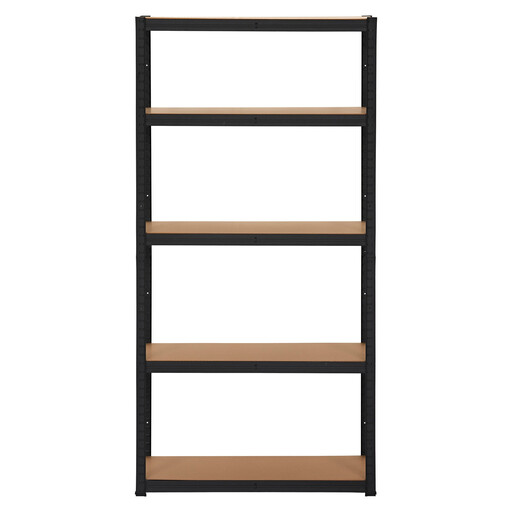
Why it's a good fit: Designed for storing heavy tools, machinery, or large supply containers in a workshop, garage, or warehouse. The high load capacity provides a large safety margin.
The explicit rating of 265 kg load capacity per shelf signals a construction designed for heavy loads, far surpassing standard models. The powder-coated finish is robust and resilient.
Very high load capacity for demanding applications. The matte black finish provides a clean look in the workshop.
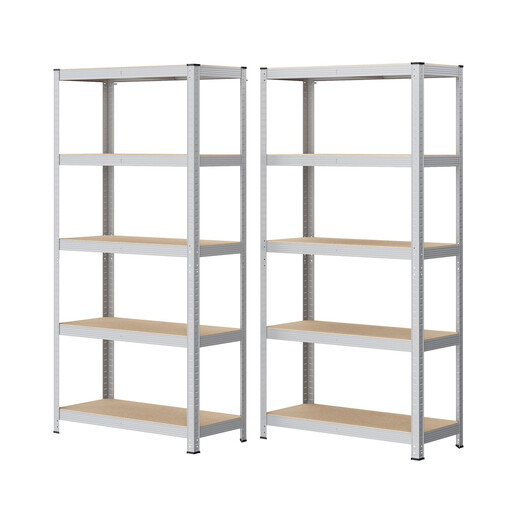
Why it's a good fit: This set of 2 offers maximum flexibility. It can be assembled as two tall shelving units or as four half-height units, such as workbenches. Perfect for systematically organizing an entire room.
It solves the problem of rigid configuration by being designed as a modular system from the outset. The included anti-tip kit directly addresses the stability issue of tall boltless shelves and increases safety.
Can be configured as two separate shelves or workbenches. The set offers excellent value for money for larger organization projects.
We've compiled a complete, up-to-date list of products that fully meet these strict selection criteria and safety regulations.
1. How do you ensure a heavy-duty shelf doesn't tip over? The most important measure is to use the included anti-tip kit to secure the shelf to a solid wall. Additionally, place the heaviest items on the bottom shelves to lower the center of gravity. Ensure the shelf stands on a level surface and that the specified maximum load capacity is not exceeded.
2. Can you use a heavy-duty shelf with MDF boards in a damp basement? This is not recommended. MDF (Medium-Density Fibreboard) is susceptible to moisture. In a damp basement, the material can swell, lose its stability, and grow mould, which poses a safety risk. For such environments, models with shelves made of steel or specially treated wood are the far more durable and safer choice.
3. Do you need special tools to assemble a boltless shelving unit? Typically, no screws or wrenches are needed. However, a rubber mallet is highly recommended. It allows you to firmly and securely join the interlocking connections without damaging the metal's coating. Wearing work gloves is also advisable to protect yourself from potentially sharp edges.