
Lieferung heute & morgen

Qualitätsgarantie

Willkommens-Angebote freischalten: KOSTENLOSE Lieferung | Bis zu 80 % RABATT | Kostenlose 30-Tage-JoyPlus-Testphase
App herunterladen
Heavy-duty shelving should safely hold tools, supplies, equipment or spare parts. In garages, cellars, workshops and storage rooms, it’s not just the stated load capacity that matters. The actual dimensions, a sturdy design and suitable assembly are important too. If you focus only on claims such as “extremely strong” or “quick to assemble”, you may overlook important details.
A figure such as 600 kg or 875 kg often refers to the maximum static load across all shelves. You should also check the load capacity per shelf. If you’re storing heavy items on just one shelf, its individual weight limit applies. What’s more, these figures usually assume evenly distributed loads. A concentrated load, such as a heavy machine with small feet, can put more strain on the shelves.
Many models have a steel frame but MDF shelves. This can be suitable for dry indoor spaces, but it’s not the same as having steel shelves throughout. So, if you’re choosing shelving for a cellar or garage, check whether the room is dry and whether the shelf panels need protection from prolonged exposure to moisture.
Boltless shelving can be assembled using a push-fit or locking system. This reduces the need for tools, but it doesn’t remove the need to secure the unit against tipping over. Wall fixing is particularly important for tall shelving, unevenly distributed loads or use in homes with children. Fit any included anti-tip kit according to the instructions.
Start by listing what you plan to store on your workshop shelving, in your shed or in your storage room. Add up the weight for each shelf and allow a suitable margin. Keep the following in mind:
For example, 600 kg heavy-duty shelving may have five shelves rated at 120 kg each. 875 kg heavy-duty shelving may hold 175 kg on each of its five shelves, provided the load is distributed evenly. Always follow the manufacturer’s specifications.
A frame made from galvanised or powder-coated steel has clear, verifiable properties in terms of its finish and corrosion protection. However, its suitability depends on the environment. A steel shelving unit with MDF shelves may be a practical choice for a dry indoor space. In rooms that are consistently damp, check whether the materials and coating are specifically designed for those conditions.
MDF shelves are suitable for many stored items, provided they stay dry and aren’t loaded beyond their stated capacity. Also check that the shelves rest fully on the crossbars and that the push-fit connections are locked into place correctly.
Measure the available space in several places before you buy. As well as the width, depth and height, you’ll need room to assemble the unit and access it. Height-adjustable shelving is handy if you plan to store boxes, canisters or equipment of different sizes.
Some models can be split into two units. This can be useful in a small workshop or if your storage needs change. Even so, check that each separate section stands securely and can be fixed against tipping on its own.
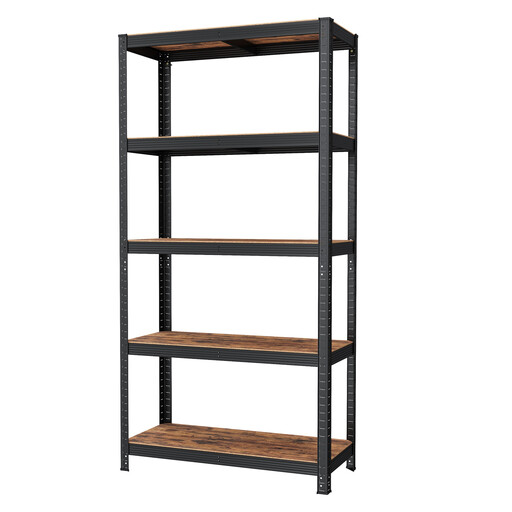
Why it suits this type of buyer: Measuring 30 × 75 × 150 cm, it’s a good fit for a garage, cellar or utility room where floor space is limited. According to the product details, each of the five shelves can hold up to 130 kg, with a total static load capacity of 650 kg.
The product description gives the load capacity both per shelf and for the unit as a whole. An anti-tip kit is included; fit the wall fixings before use.
Steel frame, five shelves adjustable in 5 cm increments, and a design that can also be split into two units, according to the product details.
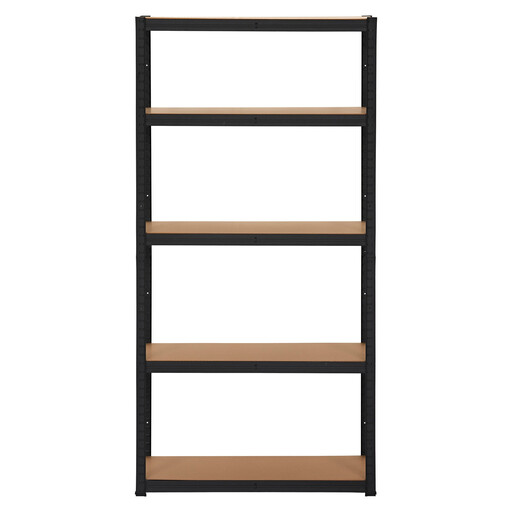
Why it suits this type of buyer: This metal shelving unit has five MDF shelves and a matt black-coated steel frame, with a stated load capacity of 265 kg per shelf. According to the product details, it measures 180 × 90 × 45 cm.
The 265 kg load capacity per shelf and the total load capacity of 1.325 kg are listed separately. Loads must be distributed evenly, and the unit should be assembled on a flat, stable surface.
High stated load capacity per shelf, five levels and a steel-and-MDF construction for dry indoor spaces.
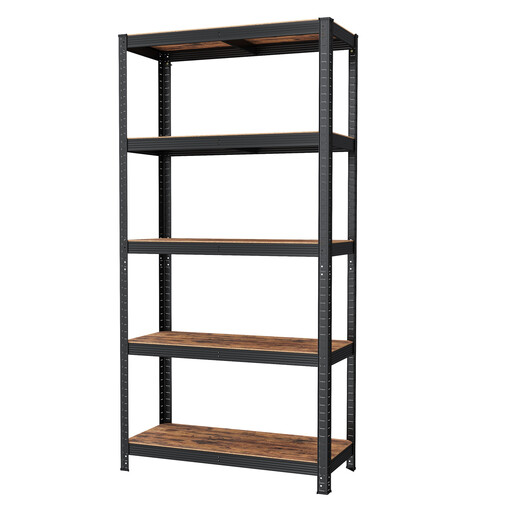
Why it suits this type of buyer: Measuring 40 × 90 × 180 cm and with a stated total load capacity of 875 kg, this steel shelving unit is designed for people who need to organise several heavy items on a limited floor area.
According to the product details, each of the five shelves can hold up to 175 kg. The included anti-tip kit helps with stability, but it doesn’t replace a level surface or correct loading.
Adjustable shelves, a push-fit system requiring few tools and, according to the product description, the option to split the shelving into two units.
For a safe assembly, set up the shelving on a firm, level surface. With push-fit systems, a rubber mallet can help you gently tap the metal tabs into the slots provided. Wear work gloves, as the edges may be sharp.
Once assembled, follow these steps:
Heavy-duty shelving isn’t designed to be used as a ladder or step. If you notice any damage, remove the load from the affected shelf and check or replace the component according to the manufacturer’s instructions.
We’ve put together a complete, regularly updated list of products that meet these strict selection criteria and fully comply with the safety regulations in force in the EU.
It depends on what you’re storing. A capacity of 120 kg per shelf may be enough for toolboxes and supplies. For machinery, building materials or heavy spare parts, consider models with a load capacity of 150, 175 or 265 kg per shelf. The actual weight distribution and the manufacturer’s static load specifications remain key.
Use the anti-tip kit supplied and choose wall plugs and screws suited to your wall material. Concrete, brick and plasterboard require different fixing solutions. Only load the shelving once it has been secured and you’ve checked all the connections.
There’s no reliable one-size-fits-all answer. Its lifespan depends on factors such as load capacity, moisture, assembly quality and regular checks. With proper use, a steel frame with an intact coating and MDF shelves kept dry may last longer than shelving that’s overloaded or kept in a damp space.