
Lieferung heute & morgen

Qualitätsgarantie

Willkommens-Angebote freischalten: KOSTENLOSE Lieferung | Bis zu 80 % RABATT | Kostenlose 30-Tage-JoyPlus-Testphase
App herunterladen
A basketball hoop in your own garden or driveway is an excellent way for children and teens to stay active and have fun. The challenge for many families is finding a model that grows with their kids and flexibly adapts to different spaces. A height-adjustable basketball hoop is the ideal solution.
This article serves as a guide. We'll walk you through the key aspects to consider when choosing a suitable outdoor basketball system and present a selection of models that stand out for their functionality and adaptability.
Choosing the right model depends on several factors. To make an informed decision, you should consider the following three points.
Safety is a critical aspect of a freestanding basketball hoop with a stand. Most portable systems use a base that is filled for stability. A fillable basketball hoop base, using water or sand, is the standard.
Pay attention to the maximum fill weight of the base. A heavier weight ensures greater stability, especially during intense play or in windy weather.
A key advantage of a hoop that isn't permanently installed is its mobility. A portable basketball stand is usually equipped with wheels on its base. These allow you to move the entire system without significant effort. This is practical for mowing the lawn, clearing the driveway for a car, or storing the hoop in a sheltered spot when not in use. A portable basketball hoop with integrated wheels thus offers maximum flexibility for everyday use.
The defining feature of these hoops is their adjustable height. This makes them an ideal basketball hoop for kids, as it can grow with them over the years and also be used by teenagers or adults. Check the adjustment range (minimum and maximum rim height) and the mechanism. Common systems use telescopic poles with locking pins that allow for adjustment in several predefined increments. Simple and safe handling is crucial here.
Based on the criteria mentioned, we have compiled a selection of models suitable for home use.
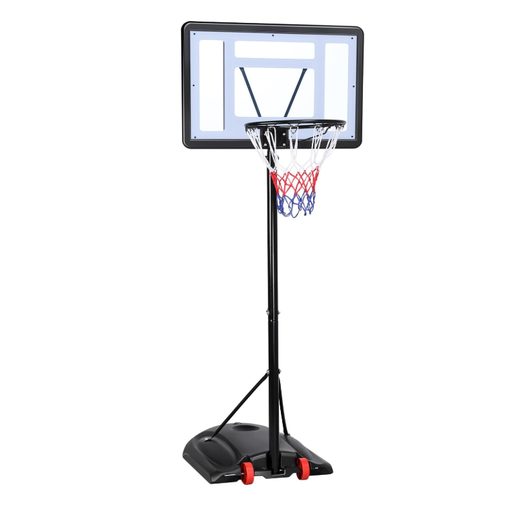
Key Feature: With its greater overall height and a rim height range from 170.5 cm to 230.5 cm, this model is specifically aimed at teenagers and adults. A practical detail is the ball holder on the base.
Advantages:
Best for: This system is a great choice for families with older children or for recreational players looking for a home practice setup that can adapt to different player heights.
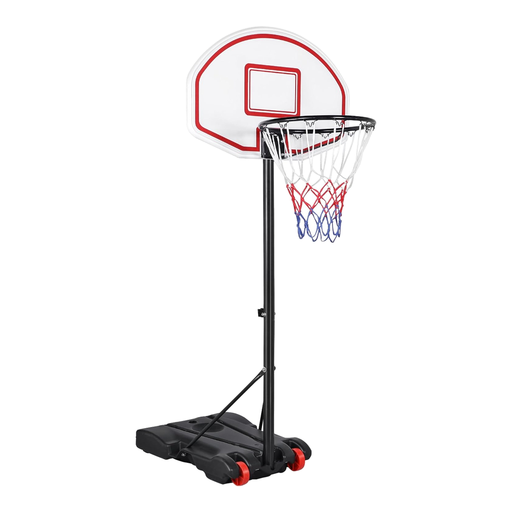
Key Feature: With an adjustable overall height from 1.9 m to 2.5 m (rim height 159 cm to 214 cm), this model is specially tailored to the needs of children and beginners.
Advantages:
Best for: Ideal for families with younger children who want to practise their first shots. The lower starting height encourages fun and early success.
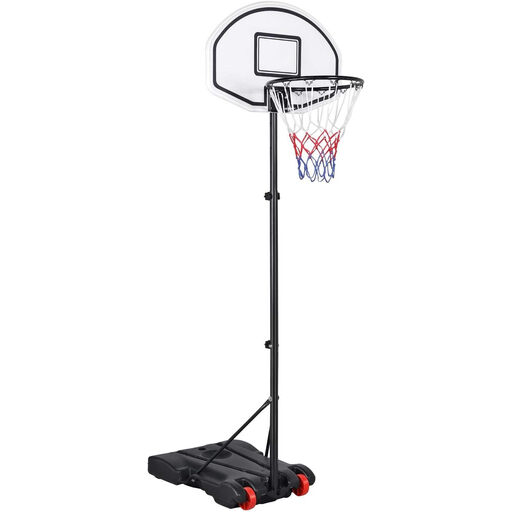
Key Feature: This model's focus is on easy storage. It can be disassembled into flat parts, making it especially practical for users with limited storage space.
Advantages:
Best for: This model is the right solution for anyone who values space-saving storage or needs to occasionally transport the basketball hoop to another location.
The models presented here offer a good overview of the available options. If you want to compare other variants with different sizes, materials, or designs, you will find a wider selection in our category.
Discover more models in the Hoops with Wheels category.
Both water and sand are suitable filling materials. Sand offers a higher mass and is frost-proof, making it the more stable and year-round option. Water is easier to handle but should be drained in winter to prevent frost damage to the plastic tank.
For children aged 6 to 9, a rim height between 1.80 m and 2.40 m is often recommended. For children aged 10 and up, the height can be gradually increased towards the official youth height of 3.05 m. A height-adjustable basketball hoop is ideal here, as it can be adapted to the child's development.
It is recommended to follow the manufacturer's instructions. Generally, it is advisable to store the system in a sheltered location during extreme weather conditions such as heavy frost, snow, or storms to extend the lifespan of the materials (especially the net and backboard). If the base is filled with water, it must be drained before the first frost.