
Lieferung heute & morgen

Qualitätsgarantie

Willkommens-Angebote freischalten: KOSTENLOSE Lieferung | Bis zu 80 % RABATT | Kostenlose 30-Tage-JoyPlus-Testphase
App herunterladen
Long workdays at a desk have become the norm for many, whether in a home office or a traditional one. However, sitting for hours can lead to tension and a static posture. A height-adjustable desk offers a practical solution by allowing you to easily switch between sitting and standing, thus integrating more movement into your workday.
This guide is here to help. We will highlight the key features to consider when choosing a desk and present a selection of different models to make your decision easier.
Selecting the right model depends on your individual needs. The following three criteria will help you make an informed decision for an ergonomic workspace.
An electric desk can be effortlessly adjusted in height at the touch of a button. This is especially convenient if you plan to switch between sitting and standing multiple times a day. Look for models with a quiet motor to avoid disturbing your work environment.
A particularly useful feature is a desk with a memory function. This allows you to save your preferred heights for sitting and standing. A single press of a button is all it takes for the desk to automatically move to the preset position. This saves time and ensures you always find the ergonomically correct height.
A height-adjustable office desk must remain stable even at its highest position, without wobbling. A sturdy steel frame is a good foundation for this. Check the desk's maximum static load capacity, which is specified in kilograms (kg). Consider the weight of all your equipment: monitors, laptop, docking station, lamps, and other devices. A load capacity of 70 kg is sufficient for most standard home office setups.
Measure the available space in your room before deciding on a desk size. Also, consider how much workspace you need. Do you work with one or more monitors? Do you need extra space for documents or writing? Common widths range from 120 cm to 160 cm. An electric computer desk with a depth of 60 cm to 80 cm generally offers enough room for a screen, keyboard, and armrest.
Here is a selection of desks that meet different functional and design requirements.
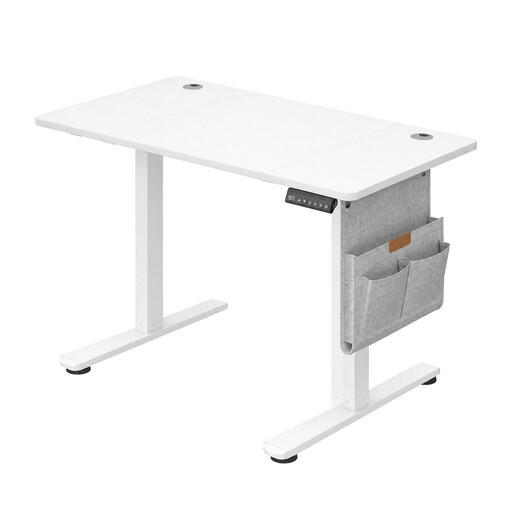
Why it stands out: This model is a targeted solution for anyone looking for a functional home office standing desk. The electric drive allows for seamless height adjustment from 72.1 cm to 120.1 cm. The four memory presets make switching between individual working heights particularly easy.
Pros:
Who is it for? This model is aimed at users who want to actively switch between sitting and standing to make their workday more dynamic and who value ergonomic comfort.
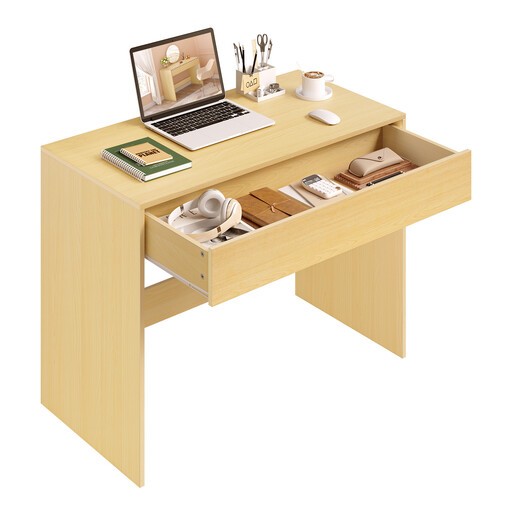
Why it stands out: The eSituro desk is a fixed, non-adjustable alternative that impresses with its clean, minimalist design and compact dimensions of 100 x 50 cm. It is perfectly suited for smaller rooms or for users who prefer a traditional desk solution.
Pros:
Who is it for? Ideal for individuals with limited space or for those looking for a stylish, fixed desk with integrated storage.
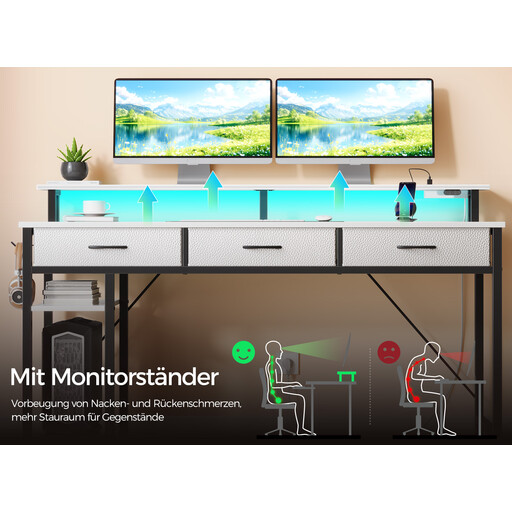
Why it stands out: This desk is designed as a multifunctional command centre. While not height-adjustable, it offers a wealth of tech features that make it particularly appealing to gamers and tech-savvy users.
Pros:
Who is it for? Perfect for gamers, streamers, and anyone who needs a central hub for all their tech and values integrated features and an organised peripheral setup.
Are you looking for a desk with even more integrated storage? If drawers and shelves are crucial for your organisation, you can find a wider selection of models tailored to your needs in our desk with drawers and bookshelf category.
As a general rule of thumb, you should change your position every 30 to 60 minutes. The goal is not to stand for hours on end, but to incorporate regular movement into your workday. A balanced alternation between sitting and standing is ideal for activating muscles and avoiding a rigid posture.
A memory function allows you to save multiple custom height settings. Typically, users program an optimal sitting height and a standing height. With the press of a button, the desk then automatically moves to the saved position, without needing to manually readjust the height each time.
The load capacity, often listed as the maximum static load, varies depending on the model and construction. Basic models often support around 50 kg, while more robust versions with solid steel frames can handle 70 kg, 100 kg, or more. It is important to check the product specifications and consider the total weight of your equipment.