
Lieferung heute & morgen

Qualitätsgarantie

Willkommens-Angebote freischalten: KOSTENLOSE Lieferung | Bis zu 80 % RABATT | Kostenlose 30-Tage-JoyPlus-Testphase
App herunterladen
As a Joybuy Product Recommendation Officer, I see a lot of products every day. My job is to help you make informed purchasing decisions based on facts, not marketing hype. A height-adjustable feeding station can significantly improve your pet's dining comfort, but the market is flooded with models that have hidden flaws.
Many pet owners invest in a feeding station believing they're doing something good for their dog or cat, only to find the product creates more problems than it solves. Before you make a decision, you should know the most common pitfalls.
Common Flaws in Feeding Stations That Are Often Overlooked:
A well-thought-out purchase considers not only the height but also the material, stability, and the specific needs of your pet.
To avoid a bad purchase, you should check three crucial parameters. These determine whether a feeding station is a sensible long-term investment or will need to be replaced after a short time.
Height adjustability is the key feature. A good height-adjustable feeding station should offer several, securely locking levels. Look for a sturdy mechanism that won't give way, even with an enthusiastic eater.
The material of the food bowls is crucial for hygiene and durability.
An elevated pet bowl must be stable. Rubberized feet or a full-surface silicone mat are essential to prevent it from slipping on smooth floors like tile or hardwood.
Additionally, specialized bowls can make a big difference:
Here are three models that are suitable for different user profiles based on their objective features.
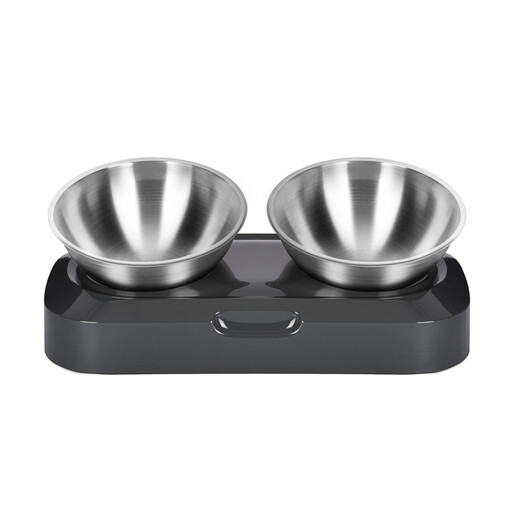
Why This Fits Their Persona: This model is a straightforward and hygienic solution for cats or small dog breeds. The slight elevation improves dining comfort without needing a complex adjustment mechanism. Its compact design fits into any home.
It bypasses the material pitfall by using 304 stainless steel for the bowls. The non-slip silicone base prevents wobbling and sliding, which solves the stability pitfall.
Hygienic and durable double stainless steel bowl that is dishwasher-safe. The non-slip base ensures a secure stand.
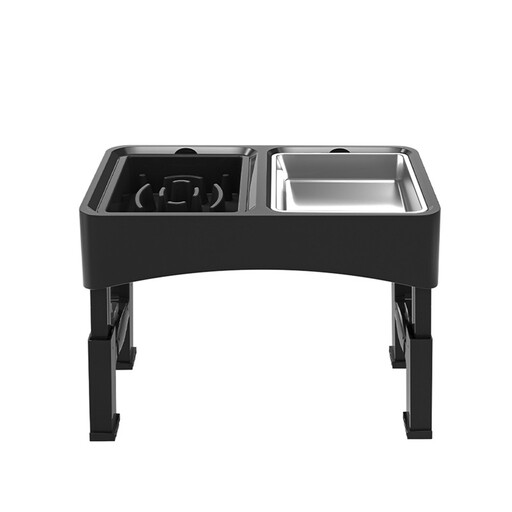
Why This Fits Their Persona: This model is ideal for owners who need maximum flexibility. The four-level height adjustment adapts to a puppy's growth or is suitable for households with dogs of different sizes. The included slow-feeder bowl is a direct solution for fast eaters.
It solves the problem of limited flexibility with four clearly defined height levels (10 cm to 31 cm). The foldable yet stable construction is easy to store and still sturdy in use.
Four-level height adjustment and the combination of a slow-feeder bowl and a standard stainless steel bowl. The foldable design makes storage easy.
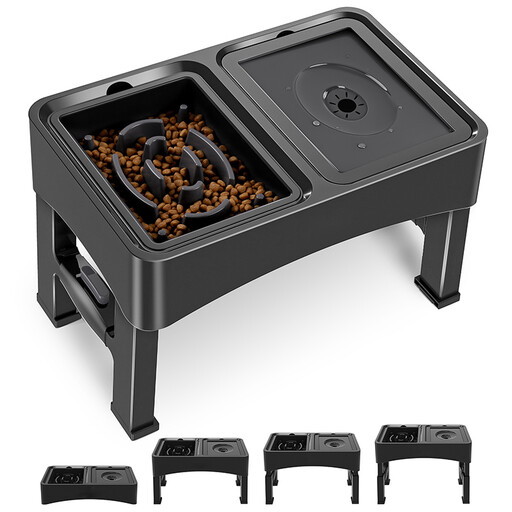
Why This Fits Their Persona: For pet owners whose main concern is a clean and dry feeding environment. The floating water bowl is specially designed to minimize water splashing—a common problem with many dogs.
It directly addresses the problem of messiness caused by unstable or poorly designed bowls. The combination of a stable, height-adjustable base and a splash-proof water bowl offers an all-in-one solution.
The floating water bowl effectively reduces splashing. It also offers the benefits of height adjustability and an integrated slow-feeder bowl.
We have compiled a comprehensive list of products that meet our strict selection criteria for material, stability, and functionality.
As a general rule of thumb, the top edge of the food bowl should be about level with your dog's lower chest. A more precise method is to measure the withers height (distance from the floor to the shoulder) and subtract 10-15 cm, depending on the dog's size. Observe your pet while it eats: it should be able to tilt its head comfortably without arching its neck or bending its legs significantly. An adjustable food bowl allows for fine-tuning.
Although the ergonomic benefits are most pronounced in large dogs, an elevated food bowl can also be advantageous for cats. Older cats with arthritis or other joint issues, in particular, benefit from a posture that puts less strain on their neck. A slightly elevated, fixed station is sufficient for most cats; a fully adjustable feeding station for dogs and cats is usually only necessary if you have pets of very different sizes in the same household.
Hygienic cleaning is simple and one of the biggest advantages of stainless steel. The bowls should be removed from the frame and cleaned daily. They can easily be washed by hand with warm water and mild dish soap or cleaned in the dishwasher. The frame itself should be regularly wiped down with a damp cloth to remove food residue and dust.