Choose a dehydrator based first on the size of your harvest and the space actually available for setting it up and storing it in your shared kitchen. For small batches of herbs, compact models with fine-mesh trays may be suitable; for larger harvests, consider the usable drying area and room for air to circulate. Then compare the temperature range, trays and timer of the specific model. A manufacturer’s claim that a model is quiet is no substitute for a like-for-like noise test. If you only have small harvests occasionally, freezing may be an alternative to buying another appliance.
Who can benefit from a dehydrator?
Gardeners with a larger herb harvest
If you want to preserve several batches, look for plenty of usable drying space and avoid spreading the herbs too close together. Rommelsbacher highlights the need for air circulation in the instructions for the DA 350.
People sharing a kitchen with limited space
If you need to coordinate worktop space, running time and storage with others, the appliance’s dimensions, storage space and timer are important factors. WMF and Rommelsbacher list features on their respective models that you can compare.
Buyers drying delicate herb leaves
For small leaves, it’s worth comparing fine-mesh trays or a herb mat, as well as how easy the inserts are to clean. WMF lists fine-mesh drying trays, while the Steba ED 5 comes with a herb mat.
What should you look for when buying?
The information is aimed at consumers considering a dehydrator for garden herbs in a shared kitchen. Each row covers the main buying priority in that category.
| Buying priority |
What to check |
Who it matters most to |
| Drying area and performance |
Compare the total area, usable space between trays and the distance between the herbs—not just the number of trays. |
If my harvest is larger, I want enough space to spread the herbs out loosely. This is the top priority for around 36% of consumers. |
| Space and running time |
Check the appliance’s dimensions and the clearance it needs, where you’ll store it and whether it has a timer; agree how it will be used with your housemates. |
If we share the worktop, I want to plan the appliance and its running time so they fit around our kitchen routine. This is the main concern for around 29% of consumers. |
| Small herbs and cleaning |
Compare the mesh size, whether a herb mat is included, removable parts and cleaning instructions. |
For small leaves, I want suitable inserts that are easy to clean afterwards. Around 21% of consumers put this first. |
| Purchase and running costs |
Compare the cost of the appliance and any accessories; calculate electricity costs using the actual running time, power consumption and your own tariff. |
If I only dry small amounts occasionally, I want to weigh up whether buying another appliance is worthwhile compared with freezing the herbs. Around 14% of consumers prioritise this cost comparison. |
Avoid common buying mistakes
-
Comparing only the number of trays
More trays don’t automatically mean more usable drying space. If the herbs are packed too closely together, air may not circulate as well.
Compare the drying area, trays and usable space between them. Spread out your harvest and, if needed, dry it in several batches.
Overfilled trays may mean you need to run extra drying cycles.
-
Assuming “quiet” means the noise level has been measured
A long running cycle can be disruptive in a shared kitchen. A manufacturer’s description such as “quiet” isn’t an independent comparison of noise levels.
Agree running times with the other people using the kitchen. If noise is a deciding factor, compare measurements for the specific models tested under similar conditions.
-
Assuming a timer means you can leave the appliance unattended
Safety instructions vary by model. The instructions for the Steba ED 4 require you to supervise the appliance while it’s running.
Read the instructions for the model you choose before setting it up, and follow its guidance on clearance and use.
Brands to consider
Rommelsbacher
The DA 350 is worth considering if you want to compare stated drying area and adjustable trays for your harvest.
- Rommelsbacher says the model has five height-adjustable trays, a drying area of 0.42 m², a temperature range of 35–75 °C and a 36-hour timer.
- The manufacturer’s claim that it is “quiet” isn’t an independent noise comparison. Also check that the drying area and dimensions suit your kitchen.
WMF
The KÜCHENminis Snack to go may suit smaller batches of herbs if fine-mesh trays are important to you.
- WMF lists five fine-mesh drying trays, a temperature range of 30–70 °C and a timer of up to 24 hours.
- Claims about saving space and quiet operation are the manufacturer’s descriptions, not the result of an independent comparison.
Steba
The ED 5 is worth considering if you want a herb mat to be included as standard.
- Steba lists five trays, a herb mat, a temperature range of 40–70 °C and a timer that can be set from 1–36 hours.
- Check the specific listing to see which model and accessories are included.
Stöckli
The Dörrex range includes models with different timers and trays, so it’s important to check the exact version.
- For model 0076.70, Stöckli lists a 12-hour timer and three plastic trays.
- When comparing models, check the full model number and the exact type of tray.
Severin
Severin lists the OD 2940 as a dehydrator for fruit, vegetables and herbs.
- According to Severin, herbs are also included among its intended uses.
- Check the temperature controls and noise level for the specific model if these features will influence your choice.
Joybuy products for herbs
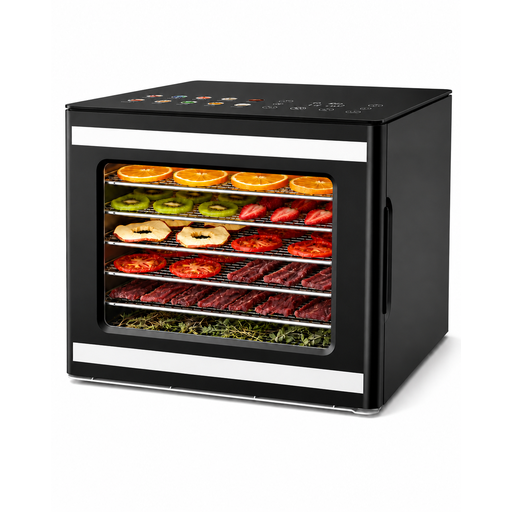
The Joybuy dehydrators below are listed as suitable for herbs and have six, eight or ten trays. Check the information for the specific appliance about materials that come into contact with food and, where applicable, the required CE marking. Germany’s Federal Institute for Risk Assessment outlines requirements for food contact materials; according to Your Europe, CE marking is required for products covered by relevant EU rules. It is not an independent performance test.
 No image available
HavenWell dehydrator with 6 stainless steel trays
The description lists herbs and small to medium quantities among its intended uses.
Six removable stainless steel trays; manual temperature selection from 35–75 °C and ten preset programmes, according to the product description. Dimensions: 32 × 33.2 × 25.6 cm.
View at Joybuy
 No image available
Havenwell dehydrator with 10 stainless steel trays
The ten-tray version may suit herbs and larger batches; remember to spread the food out loosely.
Variable temperature control, a 48-hour timer, ten programmes and 850 W, according to the product title.
View at Joybuy
 No image available
Havenwell dehydrator with 8 stainless steel drying trays
With eight trays and suitability for herbs mentioned in the product title, this model may be a good option for drying several batches.
Temperature range of 35–85 °C, a 48-hour timer and 650 W, according to the product title.
View at Joybuy
Frequently asked questions
Can I pack different garden herbs tightly onto every tray?
No. Spread the herbs out so air can circulate, and don’t overfill the trays. The instructions for the Rommelsbacher DA 350 specifically warn against overfilled trays. The time needed also depends on the quantity and condition of the food being dried.
How should I store dried herbs?
Germany’s Federal Centre for Nutrition recommends storing homemade dried herb mixes in a tightly sealed, dark-coloured glass jar. Only put herbs in once they’re sufficiently dry.
Can I leave a dehydrator running unattended in a shared kitchen?
That depends on the instructions for the appliance. The Steba instructions for the ED 4 say that it must be supervised while running and kept at least 10 cm away from other objects on all sides. These requirements don’t automatically apply to other models.
Which product regulations should I be aware of when buying in Germany?
Relevant food contact regulations apply to parts intended to come into contact with food, including Regulation (EC) No 1935/2004. Electrical appliances must carry CE marking if they fall under relevant EU rules. Your Europe explains that the marking is the manufacturer’s declaration, not an independently awarded quality mark.
Who should I contact if there’s a fault: the retailer or the manufacturer?
You should generally make a statutory warranty claim to the seller. A manufacturer’s guarantee is separate and voluntary. Germany’s Verbraucherzentrale explains the difference. Also check the relevant manufacturer’s terms for accessories or spare parts.


