What should you look for when buying?
Start by choosing a model that suits the time you have free in the kitchen and the type of herbs you’re drying. Harvest size, available space and cleaning requirements can then help you narrow down the right design.
| Consideration |
What to check before buying |
Who is it important to? |
| Predictable running time |
Timer range, automatic shut-off and the specific model’s safety instructions. |
If I need to coordinate the dehydrator with others, I need a time slot when both the appliance and worktop are available. Around 36% of consumers are likely to prioritise planning the running time. |
| Gentle herb drying |
Lowest temperature setting, airflow and a suitable tray or mesh for small leaves. |
For delicate, moisture-rich leaves, I want to choose a suitable temperature and airflow and check on the drying process. Around 29% of consumers are likely to prioritise this. |
| Room for larger harvests |
Usable tray area, mesh design and overall construction. |
When I have a larger harvest, I need enough space to avoid piling the leaves on top of one another. Around 21% of consumers are likely to prioritise space for a larger batch. |
| Space and cleaning |
Appliance dimensions, removable parts and specific cleaning instructions. |
If I only dry herbs occasionally, I want to weigh up the space it takes and the effort involved in cleaning it against the benefits. Around 14% of consumers are likely to prioritise this. |
Herb dehydrator brands to consider
The details below relate to the models and manufacturer information mentioned. They don’t indicate the availability or drying performance of an entire brand.
CASO Design
The DH 450 is a stackable model with five height-adjustable tiers for herbs and other foods.
- CASO Design lists a temperature range of 30–70 °C in 5-°C increments and a timer from 0.5 to 48 hours.
- These settings don’t demonstrate measured drying performance for garden herbs.
WMF
The KÜCHENminis Snack to go dehydrator has five stackable trays and a compact design.
- WMF lists a temperature range of 30–70 °C and a timer of up to 24 hours.
- Check the appliance dimensions and make sure the usable drying area suits the size of your usual harvest.
Rommelsbacher
The DA 350 is stackable, while the DA 650 has fixed trays.
- According to Rommelsbacher, the DA 350 has five tiers and a drying area of 0.42 m². The DA 650 has seven trays, a drying area of 0.5 m² and a 99-hour timer.
- These details apply to the specific models listed and don’t demonstrate consistently even drying across the range.
KLAMER
The XL dehydrator is a larger model with eight slide-in trays.
- KLAMER lists a temperature range of 35–80 °C and a 24-hour timer for this model.
- The model-specific safety instructions say not to leave the appliance unattended while it’s in use.
Herb dehydrators at Joybuy
This Joybuy selection includes herb dehydrators with adjustable temperature settings and a 48-hour timer. Check that the temperature range and space available suit your harvest and the time you have free in the kitchen.
 No image available
Havenwell dehydrator with 10 stainless steel trays
The product title lists herbs among the foods you can dry. It also mentions variable temperature control and a 48-hour timer to help you plan the running time.
10 stainless steel trays; variable temperature control; timer up to 48 hours; 10 programmes; 850 W.
View at Joybuy
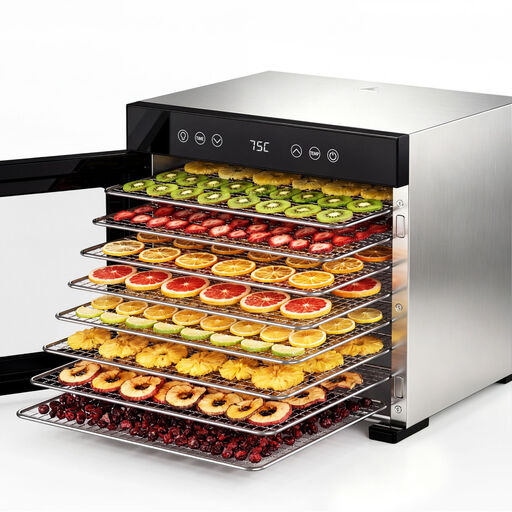 No image available
Havenwell dehydrator with 8 stainless steel drying trays
The product title lists herbs among the foods you can dry, as well as an adjustable temperature range and a 48-hour timer.
8 stainless steel drying trays; 35–85 °C; timer up to 48 hours; 650 W; touch display and interior light.
View at Joybuy
Frequently asked questions
Can I use the timer to schedule a start around a shared kitchen routine?
A runtime timer doesn’t automatically mean the appliance has a delayed-start function. The manufacturer information for the models listed describes adjustable running times, so plan the start around a time slot that’s genuinely free and follow the safety instructions for the appliance.
How should I prepare freshly harvested herbs for drying?
Penn State Extension recommends using clean equipment, removing damaged plant matter, rinsing the herbs and thoroughly removing excess moisture. Delicate, moisture-rich herbs need to dry quickly; air-dried bunches need a dry environment with good airflow.
How should I store dried herbs?
For a blend of fully dried garden herbs, the German Federal Centre for Nutrition recommends an airtight, dark glass jar. Don’t store herbs just because the timer has finished; wait until they’re completely dry.
What are my rights when shopping online in Germany?
For a qualifying distance contract with a business seller, you generally have a 14-day right to cancel, starting from the date of delivery; exceptions may apply. If goods are faulty, EU consumer information says you’re entitled to a minimum of two years’ statutory guarantee from the seller. These rights are separate from any additional manufacturer’s warranty.
What should I check on a dehydrator’s labelling?
The German Federal Network Agency lists checks including correct CE marking, identifiable manufacturer details and German-language instructions with the required warnings. Check these details for the specific product listing; a product description alone doesn’t confirm them.


