Shoppers who prioritise fibre
You want to compare the fibre content of different breakfast cereals, so you check the figures per 100 g rather than relying solely on claims on the front of the pack.


If fibre is your priority when ordering breakfast cereals online, start by comparing the nutrition information for the specific product. Under EU Regulation (EC) No 1924/2006, the claim ‘high fibre’ requires at least 6 g of fibre per 100 g or 3 g per 100 kcal. Then check the sugar per 100 g, ingredients and allergens, as well as the size of your usual portion. As recipes can change, always refer to the label on the product you receive.
You want to compare the fibre content of different breakfast cereals, so you check the figures per 100 g rather than relying solely on claims on the front of the pack.
You want to choose crunchy breakfast cereals online and see how the sugar per 100 g differs between products.
Alongside fibre, you compare the protein content and check whether the ingredients and allergen information for the specific muesli meet your needs.
When ordering breakfast cereals online, start by comparing the nutrition information per 100 g. Then consider flavour, ingredients and the portion you actually eat to find a product that suits your needs.
| Criteria | What to check when buying | Who it matters most to |
|---|---|---|
| Fibre content | Compare fibre per 100 g. Under EU Regulation (EC) No 1924/2006, the claim ‘high fibre’ requires at least 6 g per 100 g or 3 g per 100 kcal. | If fibre is my main priority, I want to compare the stated figure with my usual portion size. Around 44% of shoppers put this criterion first when choosing. |
| Sugar and taste | Check ‘of which sugars’ per 100 g and the ingredients list, rather than comparing portions of different sizes directly. | For a crunchy breakfast, I want to choose a flavour I enjoy without overlooking the sugar content. Around 33% of shoppers put this trade-off first. |
| Protein and ingredients | Check protein per 100 g, as well as the ingredients and allergen information for the specific product. | If protein matters to me in muesli too, the recipe also needs to meet my requirements for ingredients. This is the main buying criterion for around 23% of shoppers. |
Wholegrain ingredients alone do not guarantee a particular fibre content. Kellogg's lists its Corn Flakes as containing 3.0 g of fibre per 100 g, which is below the 6 g per 100 g threshold for the ‘high fibre’ claim specified in EU Regulation (EC) No 1924/2006.
Check the fibre content in the nutrition information for each product, rather than assuming it from the type of cereal.
Portion sizes can vary. Nestlé Cerealien lists FITNESS Original as containing 8.8 g of sugar per 100 g and Cini Minis as containing 24 g per 100 g.
First compare ‘of which sugars’ per 100 g, then take your usual portion size into account.
‘Muesli’ and ‘wholegrain flakes’ are no substitute for checking the ingredients and allergen information. Depending on the recipe, products described in manufacturers’ information may contain wheat, barley, soya or almonds, for example, or carry a ‘may contain’ warning.
Check the information for the specific item before ordering, and again on the pack you receive.
Nestlé Cerealien notes that different packs may be on sale at the same time when recipes change.
Use the information in the shop to help narrow down your choices, then check the ingredients, allergens and nutrition information on the pack you receive.
The documented muesli varieties offer different combinations of cereal flakes, seeds or nuts. The figures below apply to individual products, not the entire range.
FITNESS Original is a crunchy wholegrain flake option with product-specific nutrition information.
These sweet cinnamon cereals are a different type of product from muesli, so it’s the nutrition information for the specific product that matters when choosing.
Kellogg's Corn Flakes are included here as a comparison with classic breakfast flakes, not as a statement about every cereal from the brand.
This selection includes oat and spelt flakes, crunchy muesli and wholegrain flakes for a breakfast made with cereals ordered online. To help you choose, compare the nutrition information and ingredients for each product on the pack you receive.
 No image available
For shoppers looking to use coarse rolled oats as the basis of their breakfast. Compare the fibre content and ingredients on the pack you receive with your requirements.
 No image available
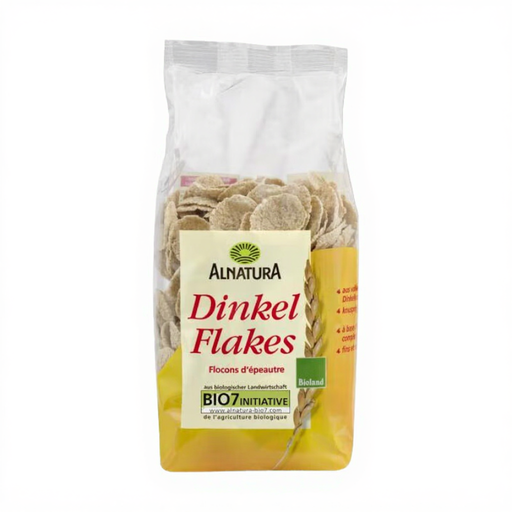
For shoppers looking for spelt flakes instead of a crunchy muesli mix. When choosing, check the fibre content, ingredients and allergens for the specific product.
 No image available
For shoppers looking for a crunchy oat muesli. Assess this variety using the sugar and fibre figures per 100 g; the words ‘Less Sweet’ in the name are no substitute for comparing them.
 No image available
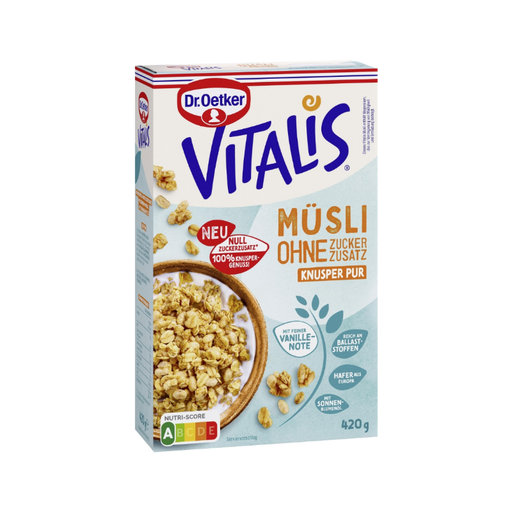
For shoppers considering a crunchy muesli in the ‘No Added Sugar’ variety. Check the actual sugar and fibre content, as well as the ingredients and allergens, on the label.
 No image available
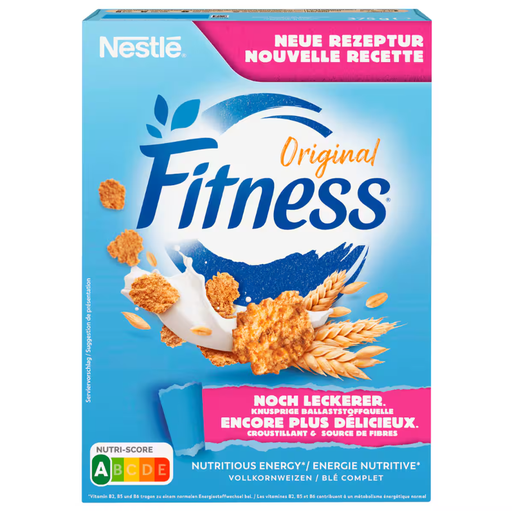
For shoppers looking for crunchy wholegrain flakes. Check the fibre and protein figures on this pack particularly carefully: the available product information assigns these two values differently.
For this nutrition claim, EU Regulation (EC) No 1924/2006 specifies at least 6 g of fibre per 100 g or 3 g per 100 kcal. Check the information for the specific product; the word ‘wholegrain’ alone doesn’t answer the question.
First compare the figure per 100 g, then calculate it for the amount you actually eat. The German Nutrition Society recommends at least 30 g of fibre a day for adults; a portion of cereal is just one part of your overall diet.
Wholegrain content alone doesn’t tell you how much sugar a product contains. Nestlé Cerealien lists FITNESS Original as containing 8.8 g of sugar per 100 g and Cini Minis as containing 24 g per 100 g. The ‘of which sugars’ line lets you compare products on the same basis.
Check the product variety, ingredients, allergens, nutrition information, pack size and best-before date on the pack you receive. Recipes can change, so the information on the delivered pack is important when deciding whether you want to use that specific product.