Guests prioritising fibre
You want to check the fibre content of a specific cereal, rather than choosing based on labels such as ‘wholegrain’ alone. The nutrition information on the pack being used is what matters.


If fibre is a priority at the hotel breakfast buffet, choose your cereal by checking the fibre information for the exact variety being served. Wholegrain flakes and unsweetened cornflakes may also be options, but wholegrain ingredients or an unsweetened recipe alone do not prove that a cereal is high in fibre.
You want to check the fibre content of a specific cereal, rather than choosing based on labels such as ‘wholegrain’ alone. The nutrition information on the pack being used is what matters.
You’re looking for a simple, unsweetened cornflake option. Sugar content and ingredients are separate criteria; on their own, they don’t tell you how much fibre a cereal contains.
For cereals served from open bowls or dispensers, guests need access to information about the exact variety on offer. Germany’s Federal Ministry of Agriculture, Food and Home Affairs notes that allergen information is also required for non-prepacked foods in Germany.
For a buffet with a focus on fibre, start by checking the fibre information for the specific variety. Sugar, ingredients, flake type and accessible allergen information will then help you decide which other options suit your guests.
| Criterion | What to check | Who it matters to |
|---|---|---|
| Fibre content | Check the fibre per 100 g on the current pack. To claim ‘high fibre’, EU Regulation (EC) No 1924/2006 specifies at least 6 g per 100 g or 3 g per 100 kcal. | Guests looking specifically for fibre at the buffet need clear information about the variety they choose; around 36% of consumers would put this first. |
| Sugar and ingredients | Compare the ingredients list and sugar per 100 g; don’t assume that an unsweetened recipe is high in fibre. | If you’re looking for a simple cornflake option, the recipe and sugar information come first. This would be the main concern for around 29% of consumers. |
| Wholegrain and flake type | Check the wholegrain content and flake type of the exact variety. If fibre is a priority, check the fibre information too. | Some guests want familiar flakes with a stated wholegrain content, without assuming that this automatically means they’re high in fibre; around 21% of consumers would prioritise this. |
| Allergen information | Make the ingredients, declared allergens and ‘may contain’ information for the pack being used accessible for every variety served unpackaged. | Guests who need to check ingredients and allergens before serving themselves rely on clear information about the variety on offer. Around 14% of consumers would need this information first. |
These describe different aspects of a product. None replaces checking the fibre content if a cereal is to be labelled as high in fibre.
Read the nutrition information for the variety being served. To claim ‘high fibre’, the thresholds set out in EU Regulation (EC) No 1924/2006 apply: 6 g per 100 g or 3 g per 100 kcal.
A fibre figure or wholegrain content applies only to the specific product. For example, Kellogg’s figure of 4.5 g of fibre per 30 g serving refers specifically to ALL-BRAN Apple & Fig.
Check the variety name, ingredients and nutrition information against the pack actually being used at the buffet.
Guests may not be able to see the pack when cereal is served in an open bowl or dispenser. Germany’s Federal Ministry of Agriculture, Food and Home Affairs says that allergen information must also be available for non-prepacked foods in Germany.
Keep information for every variety served readily accessible and update it whenever you change varieties.
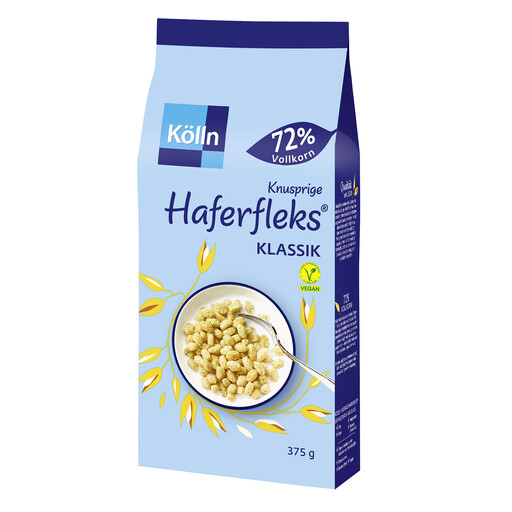
Vollkorn-Haferfleks Klassik are an oat flake option, not classic cornflakes.
ALL-BRAN Apple & Fig is a bran cereal, so it differs from classic cornflakes.
Nestlé describes FITNESS as wholegrain cornflakes with oat flakes in the cereal.
EDEKA Bio unsweetened cornflakes are a cornflake option to compare by ingredients and sugar content.
REWE Bio unsweetened cornflakes are another option for comparing cornflakes.
This oat cereal could be an alternative to cornflakes if you want to offer other types of cereal at the buffet as well as flakes. Check the current pack to see whether it is suitable for a high-fibre label.
 No image available
An option for a buffet that serves oat cereal as well as cornflakes. The pack contains 375 g; these pillows are not classic cornflakes. Before serving, check the latest nutrition, ingredients and allergen information on the pack being used.
To claim ‘high fibre’, EU Regulation (EC) No 1924/2006 specifies at least 6 g of fibre per 100 g or 3 g per 100 kcal. Check this against the nutrition information for the variety actually being served at the buffet.
No. Neither wholegrain ingredients nor an unsweetened recipe can replace checking the fibre information. If fibre is your key selection criterion, check the figure on the current pack for each variety.
Yes. Germany’s Federal Ministry of Agriculture, Food and Home Affairs notes that allergen information is also required for non-prepacked foods in Germany. Make information about each variety on offer easy for guests to access.