Breakfast shoppers focused on fibre
You want to compare fibre content using the nutritional information per 100 g, rather than relying on the front of the pack alone.


When comparing granola and crunchy muesli, start by checking the fibre per 100 g, then look at the total sugar content. For a sweet breakfast, your preferred crunch, the ingredients and any allergen information will also help you decide. A high fibre content alone won’t answer all your questions.
You want to compare fibre content using the nutritional information per 100 g, rather than relying on the front of the pack alone.
You’re looking for a crunchy mix for a sweet breakfast, while also taking total sugar and ingredients such as sugar or syrup into account.
You’d rather add your own fruit or other ingredients to a wholegrain base. If allergens are a concern, check the information on the current pack too.
First decide whether you want baked granola or crunchy muesli, or a muesli base you can customise yourself. Then compare the nutritional information on the same 100 g basis and check the ingredients and allergen information.
| Criteria | What to check | Who it matters to |
|---|---|---|
| Fibre | Fibre in g per 100 g; if the product is labelled “high fibre”, check the basis used for the claim too. | If you’re choosing a product specifically for its fibre content, comparing the figures across different mixes makes it easier to choose. Around 36% of consumers put this first. |
| Total sugar | “Of which sugars” per 100 g, as well as sugar, syrup and dried fruit in the ingredients list. | If you want a sweet breakfast but also want to keep an eye on total sugar, don’t just look for information about added sugar. Around 29% of consumers prioritise this comparison. |
| Crunch | Distinguish baked granola or crunchy muesli from a flake-based mix; compare sugar and fat figures too. | If crunchy clusters are what you’re after, a simple muesli base won’t give you the same texture. Crunch is the main priority for around 21% of consumers. |
| Ingredients and allergens | Check the current pack for highlighted allergens and “may contain” warnings; with a base mix, choose the ingredients you want to add yourself. | If you want to combine ingredients yourself or need to choose carefully because of an allergy, you’ll need a clear ingredients list. This is the main priority for around 14% of consumers. |
EU Regulation (EC) No 1924/2006 requires a product labelled “high fibre” to contain at least 6 g of fibre per 100 g or at least 3 g per 100 kcal. Figures per 100 g make it particularly easy to compare two packs side by side, although your serving size may differ.
Fibre and total sugar are separate nutritional values. For example, REWE lists 12 g of fibre and 12 g of sugar per 100 g for Wholey Bio Granola.
Compare both figures per 100 g and check the ingredients list too, especially for sweet mixes.
Kölln and Brüggen describe their respective crunchy muesli recipes as baked grain mixes containing ingredients such as sugar, syrup or oil. You can’t tell the nutritional value of a specific mix from its texture alone.
If crunchy clusters are important to you, compare “of which sugars”, fat and ingredients per 100 g across the products you’re considering.
Wholegrain and seed mixes may contain allergenic ingredients or carry “may contain” warnings. If you need to avoid a particular ingredient, the exact recipe matters.
Check the current packaging for highlighted allergens and “may contain” warnings, even if you already know the product.
EDEKA notes that information on its website may differ from what’s shown on the packaging, and that some products may not be available in every store.
Before buying, check the specific product listing and refer to the current pack for ingredients and nutritional information.
Oat mueslis and crunchy mueslis with a variety of fruit and crunch recipes.
Fruit and wholegrain muesli for shoppers choosing by stated fibre content and ingredients.
Organic crunchy muesli to consider if ingredients and “may contain” warnings matter as well as texture.
When exploring the REWE range, it’s worth comparing individual mueslis and granolas using their nutritional information.
A muesli base rather than baked granola, for shoppers who like to customise their breakfast.
This selection includes crunchy muesli, a fruity oat muesli and crunchy oat cereals for a sweet breakfast. The products have different textures, so compare the information on each pack before weighing them up against one another.
 No image available
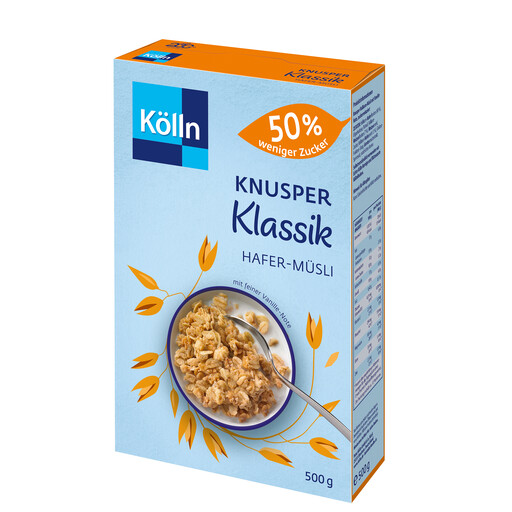
For shoppers who want crunchy muesli and want to compare fibre and sugar together: Kölln lists 17 g of fibre and 8 g of sugar per 100 g for this recipe. If you have allergies, check the current pack.
 No image available
A crunchy muesli option if you want to judge sweetness by the nutritional information rather than the name alone. When choosing, take note of the information about gluten, soya and milk.
 No image available
A crunchy oat muesli for a sweet breakfast. Compare its total sugar content with other mixes and check the ingredients list for sugar, palm oil and glucose-fructose syrup. If you have allergies, pay close attention to the information on the pack.
 No image available
A fruity oat muesli rather than baked granola clusters. Even when a product is labelled “no added sugar”, check the total sugar per 100 g and, if you have allergies, refer to the current pack.
 No image available
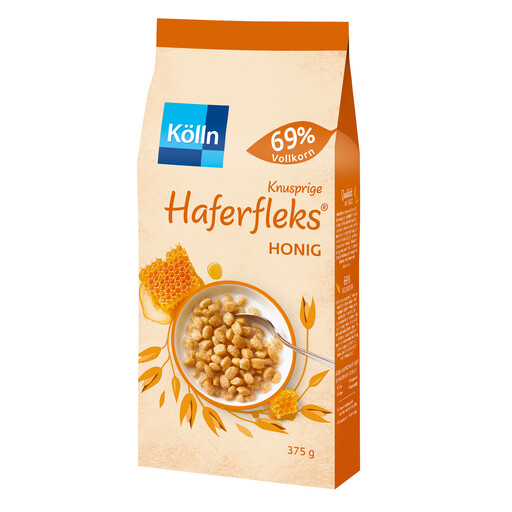
Crunchy oat cereals in pillow shapes for shoppers who aren’t specifically looking for granola clusters. When comparing products, pay particular attention to total sugar and, if you have allergies, the information on the pack.
Under EU Regulation (EC) No 1924/2006, a product labelled “high fibre” must contain at least 6 g of fibre per 100 g or at least 3 g per 100 kcal. For a straightforward product comparison, you can compare the fibre figures per 100 g side by side.
No. Kölln lists 22 g of sugar per 100 g for its fruit oat muesli with no added sugar; the recipe includes ingredients such as dried fruit. So, whatever the claim about added sugar, always check “of which sugars” on the specific pack.
Read the ingredients list for the specific mix. REWE lists date and tapioca syrup in Wholey Bio Granola; Kölln describes its crunchy muesli as a baked mix containing sugar and vegetable oil. Compare the sugar and fat content per 100 g too.
Check the current pack for gluten-containing cereals, other highlighted allergens and “may contain” warnings. EDEKA lists gluten-containing cereals in its Mühlenklassiker wholegrain base muesli and notes that information online may differ from the packaging.