If you want to compare fibre content
You want to check the “high fibre” claim against the nutrition information. The value per 100 g makes it easier to compare different pack sizes and portions.


When comparing granola and muesli, start by checking the fibre per 100 g: under EU Regulation (EC) No 1924/2006, a product can be described as “high fibre” if it contains at least 6 g per 100 g or 3 g per 100 kcal. Whether a variety is right for your shop also depends on its sugar content, ingredients and allergens, as well as delivery options for your address.
You want to check the “high fibre” claim against the nutrition information. The value per 100 g makes it easier to compare different pack sizes and portions.
You’re looking for a crunchy mix, but want to check its sugar content and ingredients. If you need to avoid certain ingredients, it’s also important to check the allergen and may-contain information for the specific variety.
You’d like to order muesli with the rest of your shopping. Alongside the nutrition information, you’ll need to check what’s available at your address and find a suitable delivery slot.
First decide which feature matters most to you. Then compare the specific variety and check it’s available for delivery to your address before placing your order.
| What to consider | What to check before buying | Who it matters most to |
|---|---|---|
| Fibre | Compare the nutrition information per 100 g. Under EU Regulation (EC) No 1924/2006, a product can be described as “high fibre” if it contains at least 6 g per 100 g or 3 g per 100 kcal. | If I’m specifically looking for a high-fibre product, I want to be able to check the figure on the pack. For around 42% of consumers, this comparison comes first. |
| Ingredients and allergens | Check the “of which sugars” figure per 100 g, the ingredients list and, if needed, the allergen information for the exact variety. | When choosing a crunchy or fruit-based mix, I want to know what it contains besides fibre. Around 33% of consumers focus on this. |
| Delivery | Enter your postcode to check which varieties are available and what delivery slots are offered. | If I want my muesli to arrive with my weekly shop, I need delivery to my address at a suitable time. This is the most important consideration for around 25% of consumers. |
These claims aren’t interchangeable. Under EU Regulation (EC) No 1924/2006, a product can be described as “high fibre” if it contains at least 6 g of fibre per 100 g or 3 g per 100 kcal.
Check the nutrition information for the specific pack. If it only gives figures per portion, make sure you also check the portion size stated.
Even without added sugar, fruit muesli can contain sugars from its ingredients. For example, Kölln describes its No Added Sugar Fruit Oat Muesli as containing dried fruit.
Compare the “of which sugars” figure per 100 g and read the ingredients list, rather than relying on the claim on the front of the pack alone.
REWE says it confirms whether it delivers to an address after you enter your postcode. A product appearing in its online range doesn’t, by itself, mean there’s a suitable delivery slot.
Check what’s available for your postcode, then choose the variety, pack size and delivery slot you want.
Even muesli with a stated fibre content may contain ingredients or traces you need to avoid. EDEKA also notes that online product information may differ from the packaging.
If you have allergies, check the information for the exact variety before buying, then check the label on the pack when it arrives.
The range includes mueslis made with different flakes, seeds and other ingredients.
Alnatura’s range includes muesli varieties made with wholegrain flakes and seeds.
You can compare Kölln’s oat muesli and crunchy muesli by checking the information for each variety.
REWE has an online category for high-fibre muesli and offers grocery delivery.
EDEKA stocks a range of basic and crunchy mueslis, including own-brand products.
Brüggen describes itself as a manufacturer of cereals and muesli for retailer own-label ranges.
This selection includes crunchy oat mueslis, an oat mix with fruit and nuts, and a fruit muesli. Compare the information for each variety on its product page, then check the pack.
 No image available
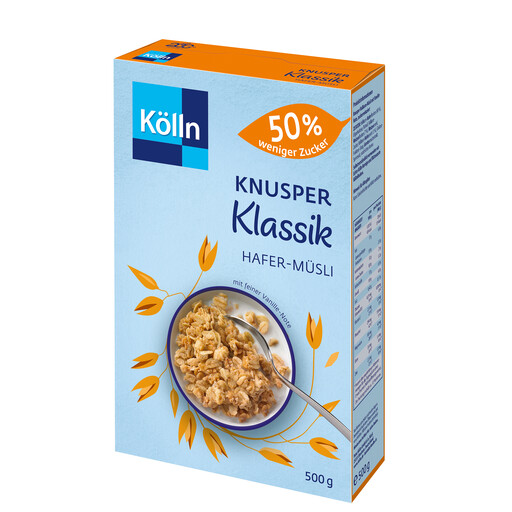
A crunchy oat muesli to consider if you want to compare fibre and sugar using the nutrition information. Kölln states that Knusper Klassik 50% Less Sugar contains 17 g of fibre and 8 g of sugar per 100 g. Check the information and allergen details on the specific pack.
 No image available
A crunchy muesli to compare with other varieties. Before choosing, check the fibre and sugar figures per 100 g, as well as the ingredients and allergen information on the pack.
 No image available
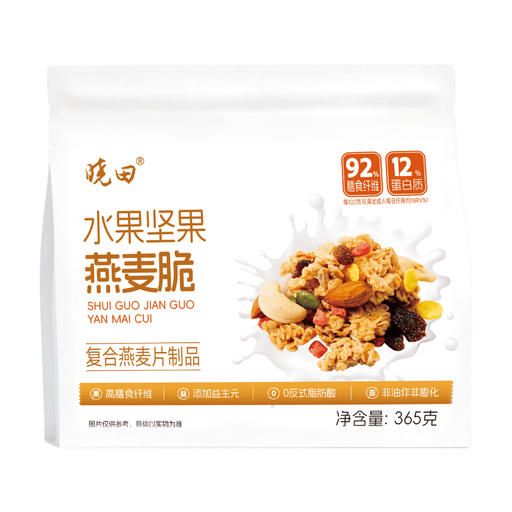
An oat cereal mix with fruit and nuts for anyone looking for this combination of ingredients. To compare it with other products, check the nutrition information per 100 g and, if needed, the allergen details on the pack.
 No image available
A crunchy oat muesli to compare for its ingredients and nutrition. Pay particular attention to the fibre and sugar figures per 100 g, as well as the allergen labelling.
 No image available
A fruit muesli to compare with crunchy varieties if you’re looking for this type of recipe. Despite the claim in the product name, check the sugar figure per 100 g and, if needed, read the ingredients and allergen information on the pack.
Under EU Regulation (EC) No 1924/2006, a product must contain at least 6 g of fibre per 100 g or 3 g per 100 kcal to make this claim. Check the nutrition information for the specific variety. A figure per portion alone is less useful for comparison.
No. A variety being listed doesn’t confirm that it can be delivered to your address. REWE says it shows delivery availability once you’ve entered your postcode. Then check which product is offered and whether there’s a suitable delivery slot.
Before eating the muesli, check the ingredients, highlighted allergens and any may-contain information on the pack you received. EDEKA notes that information on product pages may differ from the packaging.