Commuters looking for more fibre
If you’re short on time in the morning, you may want to eat your muesli dry or quickly mix it with yoghurt. To compare different varieties, start by checking the fibre content per 100 g.


For a quick breakfast on the go, the words ‘high in fibre’ are only part of the picture. Compare the fibre and sugar content per 100 g, as well as the ingredients in the specific variety. Ready-made crunchy muesli saves you preparation time, while a plain cereal base gives you more scope to add your own ingredients. Whether you eat your muesli dry or take it with milk or yoghurt will also affect which option works best.
If you’re short on time in the morning, you may want to eat your muesli dry or quickly mix it with yoghurt. To compare different varieties, start by checking the fibre content per 100 g.
Fruit flavour matters to them, but ‘no added sugar’ should not be confused with ‘sugar-free’. That’s why it’s important to check the stated sugar content as well as the ingredients list.
When choosing muesli to take on the go, they check the specific pack for cereals, nuts, sesame, milk and soya. The product category or brand alone is not enough.
First decide what matters most to you: the amount of fibre, control over sugar and ingredients, or a breakfast that needs no preparation. Then compare the nutritional information using the same reference amount, and consider how you’ll eat it while out and about.
| Criteria | What to check | Who it matters most to |
|---|---|---|
| Fibre content | Compare fibre per 100 g and relate it to the portion you’ll actually pack. | If fibre is my main priority for a quick breakfast, I want to be able to compare varieties even when their stated portion sizes differ. This is the main priority for around 42% of consumers. |
| Sugar and ingredients | Check the sugar per 100 g and the ingredients list; don’t assume ‘no added sugar’ means ‘sugar-free’. | When choosing fruit muesli, I want to know how much sugar the finished mix contains, rather than choosing based only on the claim on the front of the pack. Around 33% of consumers prioritise this. |
| Eating on the go | Decide in advance whether you’ll eat the product dry or combine it with milk or yoghurt carried separately. | When there’s little time between setting off and having breakfast, I need an option that suits my journey. This is the most important criterion for around 25% of consumers. |
A prominent fibre claim doesn’t also tell you about the sugar content or the overall ingredients. The Consumer Advice Centre recommends checking the nutrition table even when nutritional claims stand out on the pack.
Compare fibre and sugar per 100 g, then check the ingredients list.
Fruit muesli can still contain sugar from dried fruit, even if no sugar has been added. Kölln says its fruit and oat muesli with no added sugar contains dried fruit as part of the mix.
As well as checking the claim on the front, look at the sugar content per 100 g.
A crunchy mix that can be eaten dry has different practical requirements for your commute than muesli you plan to combine with milk or yoghurt.
Before choosing, decide whether you’ll eat it dry, take the ingredients separately or mix your breakfast when you arrive.
Milk or yoghurt may need a leakproof container, cutlery and, where necessary, refrigeration.
Ingredients and warnings about possible traces can vary between products from the same brand. If you have allergies, check the specific mix.
Check the current ingredients and allergen information on the pack every time you buy it.
Kölln offers oat mueslis in a range of mixes, including crunchy and fruit varieties.
Müsli Ballaststoff & Frucht combines cereal flakes and oat bran with fruit, seeds and almonds.
REWE stocks both ready-made muesli mixes and simpler cereal bases.
The Swiss brand familia offers a range of muesli lines, including organic options and mixes with less sugar.
Here you’ll find ready-made crunchy and fruit mueslis, as well as rolled oats for a simple base you can customise. Check the information on each pack before deciding based on fibre, sugar or ingredients.
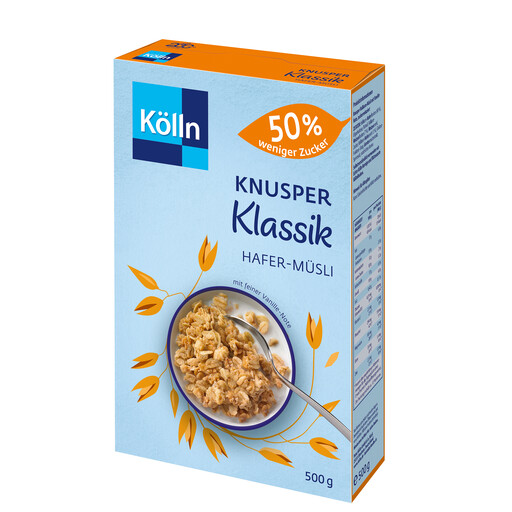 Image unavailable
A ready-made crunchy oat mix for anyone who doesn’t want to mix their own ingredients in the morning.
Pack size: 375 g. Compare the fibre and sugar content, as well as the ingredients on the pack, when making your choice.
 Image unavailable
A ready-made crunchy mix for when you want to take breakfast with you without putting the ingredients together yourself.
Pack size: 600 g. To compare it with other varieties, look at the specific nutritional information per 100 g, not just the variety name.
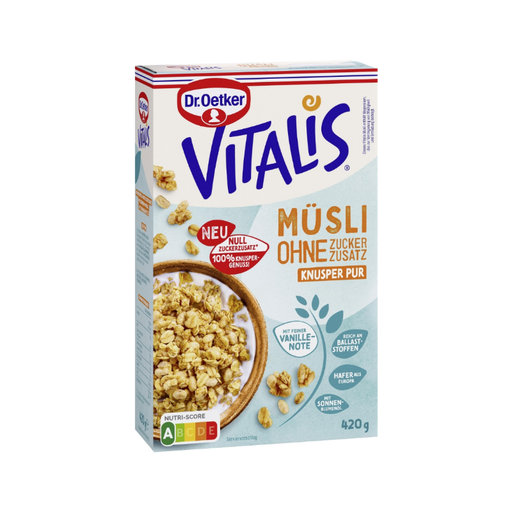 Image unavailable
A crunchy muesli option for anyone who wants to pay particular attention to claims about added sugar when choosing a quick breakfast.
Pack size: 420 g. Check the sugar content, ingredients and allergens on the specific pack; ‘No Added Sugar’ does not mean ‘sugar-free’.
 Image unavailable
A ready-made fruit muesli for anyone who doesn’t want to pack fruit ingredients separately for breakfast.
Pack size: 500 g. Despite the ‘No Added Sugar’ claim, compare the stated sugar content per 100 g.
 Image unavailable
Coarse rolled oats are a base for a breakfast you put together yourself, not a ready-made muesli.
Pack size: 500 g. If you plan to add fruit, yoghurt or other ingredients, remember to factor in preparation and transport.
No, the claim alone doesn’t give you enough information to make a full comparison. The Consumer Advice Centre recommends checking the nutrition table even when a product’s qualities are highlighted. Compare fibre and sugar per 100 g, and take your actual portion size into account.
No, ‘no added sugar’ does not mean ‘sugar-free’. Kölln lists dried fruit as an ingredient in its fruit and oat muesli with no added sugar, so check the sugar content for the specific variety too.
Some varieties are described as suitable to eat on their own: Kölln says this is an option for Knusper Klassik. If you prefer milk or yoghurt, plan to take a suitable container and, where necessary, keep it chilled.
No, the fibre content tells you nothing about allergens. The mixes mentioned may contain gluten-containing cereals, almonds, soya or sesame, among other ingredients; always check the information on the specific pack.