Keeping an eye on fibre
You want to compare muesli by its fibre content per 100 g, rather than relying solely on the wording on the front of the pack. The ingredients list also shows which grains and other ingredients the recipe contains.


To compare high-fibre muesli, start by checking the fibre content per 100 g. Under EU Regulation (EC) No 1924/2006, a product can be described as “high fibre” if it contains at least 6 g per 100 g or 3 g per 100 kcal. For your weekly shop, the pack size should also match how much you’ll use. Check the sugar content, ingredients and allergens separately for each variety.
You want to compare muesli by its fibre content per 100 g, rather than relying solely on the wording on the front of the pack. The ingredients list also shows which grains and other ingredients the recipe contains.
You’re planning several breakfasts in advance. The pack size should suit how much you’ll use, without overlooking the sugar content, allergens or ‘may contain’ warnings while shopping.
Alongside fibre, you compare the protein content or specifically look for a variety labelled vegan. If a recipe contains soya, grains or nuts, check the label on the specific pack.
For a like-for-like comparison, start with the fibre content per 100 g. Which pack is right for you then depends in particular on how much you’ll use each week, the sugar content and the ingredients.
| Criteria | What to check when buying | Who it matters to |
|---|---|---|
| Fibre | Compare the fibre content per 100 g. The EU criteria for the claim “high fibre” are at least 6 g per 100 g or 3 g per 100 kcal. | If fibre content matters most to me, I need a comparable figure rather than a marketing claim. Around 36% of consumers prioritise this. |
| Pack size | Check the pack weight against the breakfasts you have planned, and follow the storage instructions. | For several breakfasts, I want to choose a pack we can actually finish. This is the main consideration for around 29% of consumers. |
| Sugar and ingredients | Check the sugar content per 100 g and ingredients such as dried fruit, sugar or syrup. | With fruit or crunchy muesli, I want to know what’s behind the claim on the front of the pack. Around 21% of consumers prioritise this. |
| Allergens | Read the ingredients list, allergen information and ‘may contain’ warnings for the specific variety. | If I need to avoid certain ingredients, the label determines whether a variety is suitable for me. This is the top buying priority for around 14% of consumers. |
Muesli can still contain sugars from its ingredients, even with no added sugar. Kölln states that its Fruit Oat Muesli with No Added Sugar in the 1.200-g pack contains 22 g of sugar per 100 g.
As well as checking the claim on the front of the pack, read the sugar content per 100 g and the ingredients list.
Different serving sizes make per-serving figures impractical for a direct product comparison.
Start by comparing the figures per 100 g. Under EU Regulation (EC) No 1924/2006, the regulated claim “high fibre” requires at least 6 g per 100 g or 3 g per 100 kcal.
Muesli can contain different gluten-containing grains, soya or nuts. Even a pack that suits your weekly needs must be stored according to its instructions.
Check the allergen information for the variety you’ve chosen, and choose a pack size and storage approach that suit how much you’ll actually use and the manufacturer’s instructions.
Kölln makes oat, fruit and crunchy muesli. For your weekly shop, it’s worth comparing individual varieties and pack sizes.
The Seitenbacher range includes mueslis with stated fibre and protein content.
Alnatura offers both larger packs of muesli and smaller speciality recipes.
Brüggen makes muesli recipes for retailers’ own brands, among other products. The information therefore needs to match the specific brand and variety.
The Swiss brand familia offers Müesli ranges to suit different ingredient and nutrition preferences.
Here, REWE is relevant primarily as a retailer with its own-brand and other muesli brands, rather than as a single muesli recipe.
These packs include crunchy and fruit muesli in a range of sizes. To find the right one for you, compare the label for each variety with how much you’ll use in a week and your requirements for ingredients and allergens.
 No image available
If you’re buying crunchy muesli for several breakfasts, you can check whether the 600-g pack suits how much you plan to use.
Check the fibre and sugar content per 100 g, as well as the ingredients and allergens on the specific pack.
 No image available
The 750-g pack could suit your weekly shop if crunchy oat muesli is a regular part of your breakfast plans.
Before choosing, compare the fibre and sugar content per 100 g, and read the allergen information too.
 No image available
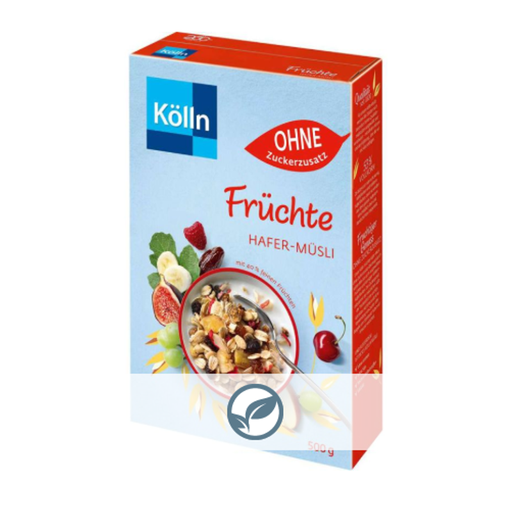
If you’re looking for fruit muesli in a 500-g pack, you can check whether this size suits how much you’ll use each week.
“No added sugar” doesn’t mean you can skip checking the sugar and fibre content per 100 g. Check the figures and ingredients on this pack rather than relying on information for another pack size.
Under EU Regulation (EC) No 1924/2006, a food must contain at least 6 g of fibre per 100 g or 3 g per 100 kcal to use this claim. When comparing two mueslis, the figure per 100 g gives you a consistent basis for comparison; assess other nutritional values and ingredients separately.
No. The German Nutrition Society recommends that adults consume at least 30 g of fibre a day. This applies to your overall diet, not to a single serving of muesli.
No, the claims don’t mean the same thing. Kölln states that its Fruit Oat Muesli with No Added Sugar in the 1.200-g pack contains 22 g of sugar per 100 g. Check the sugar content on the pack you’re actually planning to buy.