Families focused on fibre
When choosing muesli for a regular breakfast staple, they want to compare the stated fibre content per 100 g rather than relying on the product name alone.


When stocking up for the family, start by checking the fibre content per 100 g. Under EU rules on nutrition claims, at least 6 g per 100 g is one way for a food to qualify as “high in fibre”. The recipe matters next: plain muesli can be paired with different toppings, while crunchy or fruity blends are best compared separately for sugar, fat and ingredients. A larger pack is only practical if the mix suits everyone’s preferences and allergen requirements at home.
When choosing muesli for a regular breakfast staple, they want to compare the stated fibre content per 100 g rather than relying on the product name alone.
Plain muesli can be combined with different ingredients, such as yoghurt or fruit. What matters is whether one mix works for several people day to day.
They want a crunchy mix, but also compare sugar, fat and fibre per 100 g. A “reduced sugar” claim is no substitute for making that comparison.
Start by checking the fibre content and ingredients of each mix. For a cupboard staple, also consider pack size, sugar and fat, depending on what matters most to your household.
| Criterion | What to check | Most relevant for |
|---|---|---|
| Fibre | Compare fibre per 100 g. For solid foods, at least 6 g per 100 g is a permitted threshold for the “high in fibre” claim. | If fibre is my main buying priority, I want to be able to compare the amounts in different mixes directly. Around 36% of consumers put this evidence first. |
| Pack size | Check the net weight and storage instructions. With larger packs, also consider whether the mix will be eaten regularly. | For several breakfasts, I need a pack that my household can realistically finish. Around 29% of consumers prioritise how practical a store-cupboard staple is for everyday use. |
| Crunch and sugar | Compare sugar and fat per 100 g, and don’t assume that “less sugar” means “sugar-free”. | I want crunchy muesli, but I also want to compare its sugar content with other recipes before buying. This balance comes first for around 21% of consumers. |
| Ingredients and allergens | Check the ingredients list, highlighted allergens and any may-contain warnings on the actual pack. | If everyone at home can’t eat the same ingredients, the mix you share needs to suit their requirements. For around 14% of consumers, this is the most important buying condition. |
Wholegrain or bran ingredients on their own don’t prove that a mix meets the threshold for this nutrition claim.
Check the fibre content per 100 g in the nutrition table. EU rules set at least 6 g per 100 g as one permitted basis for the claim.
A sugar reduction is a comparative claim. On its own, it doesn’t tell you how much sugar or fat the mix contains per 100 g.
Compare the actual figures in the nutrition information when choosing between plain, fruit or crunchy muesli.
Mixes can vary in their cereals, soya, nuts and may-contain warnings. EDEKA also points out that online product information may differ from the packaging.
Check the labelling on the actual pack for everyone who will be eating the muesli.
If a larger pack doesn’t meet these requirements, it may end up going unused.
“High in fibre” describes a nutrient content, not a general effect. According to the Consumer Advice Centre, manufacturers had not substantiated claims that so-called prebiotic fibre has specific positive effects on gut flora.
Base your choice on the nutrition table, ingredients list and your household’s requirements, rather than a general promise of benefits.
These examples show how specific mueslis and shopping options can differ. The nutrition values for one product don’t automatically apply to other products from the same brand.
Fibre & Fruit Muesli is aimed at households looking for a mix with wholegrain flakes and bran.
The plain muesli makes a versatile base that you can pair with different ingredients at breakfast.
The range includes crunchy oat mueslis for households that care about texture.
REWE lists the Fruit Muesli in a 1 kg pack, which could make it worth considering for a cupboard top-up.
The high-fibre muesli category is a good starting point for finding different brands and recipes.
Bio 5-Grain Base Muesli is an example of an own-brand mix containing several types of grain and seeds.
This selection includes crunchy oat and fruit mueslis in packs for stocking up on breakfast essentials. Before choosing a mix, check the fibre, sugar and ingredients per 100 g on the specific pack.
 Image unavailable
For households looking for crunchy oat muesli to keep in the cupboard for breakfast. The pack contains 750 g; compare its nutrition information and ingredients with other mixes before buying.
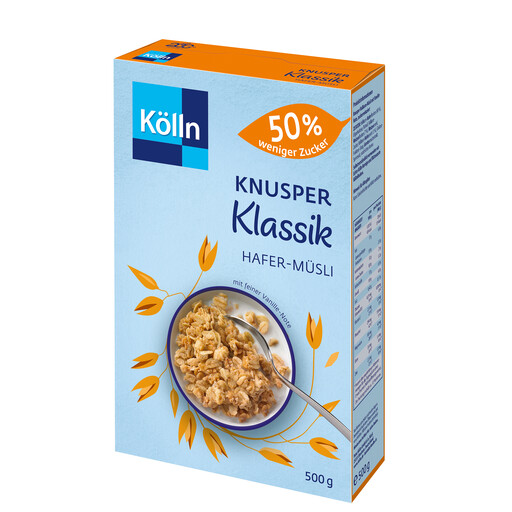 Image unavailable
For families looking for crunchy oat muesli. Compare the sugar and fat per 100 g, and check the net weight on the pack to help plan your cupboard stock.
 Image unavailable
A 600 g pack for households that prefer crunchy muesli. The nutrition information and allergen labelling on the pack will help you decide whether the recipe suits everyone at breakfast.
 Image unavailable
A 500 g pack for households considering fruit muesli. Even when a product says it has no added sugar, the total sugar per 100 g is what matters when comparing options.
Under the EU Regulation on nutrition and health claims, the claim is permitted, among other circumstances, when a solid food contains at least 6 g of fibre per 100 g. This means you can compare the per-100 g figures side by side when choosing between different mueslis.
No. The claim describes a reduction in sugar compared with a reference product; it doesn’t mean that there is no sugar. For example, Kölln Crunchy Klassik 50% Less Sugar is listed as containing 8 g of sugar per 100 g. Check the nutrition table for each product.
Seal the pack carefully after opening and follow its storage instructions. When stocking up for the family, it’s also important to choose a pack size that your household will use regularly.
No. The claim describes the fibre content. According to the Consumer Advice Centre, manufacturers had not substantiated claims that so-called prebiotic fibre has specific positive effects on gut flora. You can’t infer such an effect from the nutrition claim alone.
Use online information to help you shortlist products, then check the labelling on the actual pack. EDEKA specifically notes that the product information displayed online may differ from the packaging.