For a larger household, the fibre content per 100 g is only part of the picture. The pack size needs to suit how much you get through regularly, and the ingredients, sugar content and allergens need to work for everyone who eats it. A large pack is no use if nobody finishes that variety; and “no added sugar” doesn’t tell you how much sugar the muesli contains overall.
Who is this guide for?
Households focusing on fibre
If you’re making a point of including fibre at family breakfast, you can compare the nutritional information for different mueslis per 100 g. The ingredients matter too: wholegrain flakes, bran, fruit and nuts won’t suit everyone’s tastes or requirements.
Households that eat muesli regularly
When several people eat muesli regularly, pack size, storage after opening and whether everyone likes the variety become especially important. A carton of individually wrapped portions calls for a different approach to stocking up than one large pack.
Families with different ingredient requirements
If you need to avoid certain grains, soya, nuts or possible traces of other allergens, check the specific pack. Claims such as “vegan” or “no added sugar” don’t answer these questions on their own.
What should you look for when buying?
Start by comparing fibre and ingredients per 100 g. Then consider how much the household will actually get through and whether the mix is suitable for everyone who regularly eats it.
| Criteria |
What to check when buying |
Who it matters most to |
| Fibre and wholegrains |
Compare the fibre content per 100 g and the wholegrain ingredients listed. |
If fibre is a priority at breakfast, I want to be able to compare the figures for different mueslis directly. This is the main reason for buying for around 36% of consumers. |
| Pack size and consumption |
Check the net weight and storage instructions after opening against how much you regularly get through. |
If several people regularly eat the same variety, I need a stock-up quantity that we’ll actually finish. Around 29% of consumers put this first. |
| Ingredients and allergens |
Read the ingredients list, highlighted allergens and may-contain information for the specific variety. |
If not everyone in the household can eat the same ingredients, the chosen mix needs to suit everyone who’ll be eating it. This is a priority for around 21% of consumers. |
| Sugar and taste |
Check the “of which sugars” figure per 100 g, sweetening ingredients and whether everyone likes the variety. |
We want a fruity or crunchy mix that everyone will eat, but I don’t want to judge its sugar content from the front-of-pack claim alone. This balance is the main consideration for around 14% of consumers. |
Which buying mistakes can you avoid?
-
Assuming “no added sugar” means “low in sugar”
According to Kölln, Kölln Früchte Müsli ohne Zuckerzusatz contains 22 g of sugar per 100 g. So the no-added-sugar claim is no substitute for checking the nutritional information.
Compare the “of which sugars” figure per 100 g and read the ingredients list, especially for mueslis containing dried fruit.
-
Assuming a high-fibre mix is suitable for everyone
According to the manufacturer, Seitenbacher Müsli Ballaststoff & Frucht contains, among other ingredients, wheat, oats, spelt, barley, soya and almonds. The fibre content won’t tell you whether it’s suitable for anyone with an allergy.
Before buying in bulk, check the ingredients and allergen information for the variety you’ve chosen, rather than relying only on the brand or the claim on the front of the pack.
-
Buying a large quantity before settling on a variety
A bulk pack is only a good choice if the people who eat it regularly enjoy the taste and texture. Otherwise, you may end up with food left over.
If you haven’t tried a variety before, a smaller pack is a sensible way to see if you like it. For a tried-and-tested mix, separate individual packs can make it easier to plan your supplies.
Brands to consider
The examples below relate to specific muesli ranges and packs, not the suitability of every product from each brand.
Seitenbacher
Seitenbacher’s Müsli Ballaststoff & Frucht has a stated fibre content of 12 g per 100 g.
- Seitenbacher lists the ingredients and nutritional information for this mix. It’s also available in a carton containing nine separate 750-g packs.
- The mix contains, among other ingredients, gluten-containing cereals, soya and almonds. Before buying in bulk, check that it’s suitable for everyone who’ll be eating it.
Kölln
Kölln also sells its Früchte Hafer-Müsli ohne Zuckerzusatz in a 1.200-g pack.
- Kölln states that this pack contains 7,8 g of fibre per 100 g.
- According to Kölln, despite the “no added sugar” claim, the muesli contains 22 g of sugar per 100 g. It may also contain traces of nuts and milk.
Alnatura
Alnatura’s range includes a dark chocolate crunchy muesli made with wholegrain ingredients.
- Alnatura labels this particular variety as an organic product with a vegan recipe.
- The ingredients list includes raw cane sugar, rice syrup and sunflower oil. Check the may-contain information when choosing, too.
Brüggen
Brüggen also makes muesli for supermarket own-label ranges and bespoke product lines.
- The manufacturer describes a range that includes classic, crunchy and organic mueslis.
- When deciding what to buy, check the nutritional information, ingredients and allergens for the specific product.
Muesli selection at Joybuy
This selection includes two crunchy mueslis in different pack sizes and one fruit muesli. If you’re shopping for a larger household, it’s worth checking that the variety suits everyone’s tastes and ingredient requirements first.
 Image unavailable
Jeden Tag Less Sweet Crunchy Oat Muesli, 750 g
A crunchy muesli for households that regularly get through a 750-g pack. The “Less Sweet” name doesn’t replace checking the sugar content on the pack.
View at Joybuy
 Image unavailable
Dr. Oetker Vitalis Less Sweet Pure Crunchy Muesli, 600 g
The 600-g pack could suit a household that gets through this amount of crunchy muesli. If people have different ingredient requirements, everyone who’ll be eating it should check the information on the specific pack before you buy.
View at Joybuy
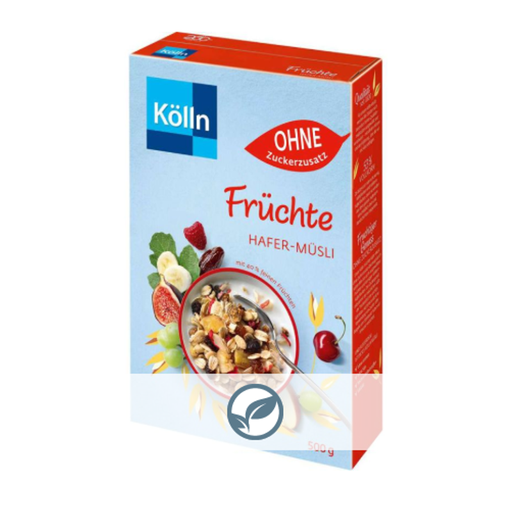 Image unavailable
Kölln 50 % Fruit Muesli No Added Sugar, 500 g
The 500-g pack is a good way to see whether everyone who regularly eats muesli likes a fruit variety before you choose a larger quantity. Despite the “No Added Sugar” name, compare the sugar content. The ingredients list on the pack is the best source for the exact recipe.
View at Joybuy
Frequently asked questions
What does “high fibre” mean for muesli?
EU Regulation (EC) No 1924/2006 sets the threshold for this nutrition claim at at least 6 g of fibre per 100 g or at least 3 g per 100 kcal. When choosing muesli for your household, you should also check the sugar content, ingredients and allergens of the specific product.
Does “no added sugar” also mean low in sugar?
No. Kölln states that its Früchte Hafer-Müsli ohne Zuckerzusatz contains 22 g of sugar per 100 g. Whatever the product name says, compare the “of which sugars” figure in the nutritional information.
How can you plan a larger supply of muesli?
Choose a quantity your household is likely to get through and follow the storage instructions on the pack. If you haven’t tried a variety before, a smaller pack can help you find out whether its taste and texture suit the people who’ll eat it regularly.
What should you bear in mind when making a significant switch to higher-fibre muesli?
According to Verbraucherzentrale, a sudden increase in high-fibre foods can initially cause bloating or a feeling of fullness. If you want to try a different amount, you can make the change gradually.


