Sweet-breakfast fans who prioritise fibre
You want a fruity or otherwise sweet breakfast and check the fibre content first. Compare the figures per 100 g with the amount you actually eat, rather than judging by the product name alone.


If fibre is your priority at breakfast, compare the nutrition information on the specific packs of muesli and cereal rather than relying on a wholegrain claim. Fruity and toasted mueslis, as well as cinnamon cereals, vary in their sugar content, ingredients and texture. So the right choice also depends on your taste and any dietary requirements.
You want a fruity or otherwise sweet breakfast and check the fibre content first. Compare the figures per 100 g with the amount you actually eat, rather than judging by the product name alone.
Cinnamon flavour and a crunchy texture matter most to you. It’s also worth checking the sugar and fibre content of the pack you choose: the figures differ between the mueslis and cinnamon cereals covered here.
You may need to avoid gluten-containing cereals, nuts or soya, or want a recipe without animal-derived ingredients. Check the ingredients list and allergen information on the individual pack; you can’t tell whether it’s suitable from the words ‘muesli’ or ‘cereal’ alone.
First decide what matters most to you: fibre, flavour or particular ingredients. Then compare the nutrition information per 100 g on the pack. Portion information can also help you work out how much you’ll actually eat.
| Criteria | What to check when buying | Who it matters most to |
|---|---|---|
| Fibre | Compare the fibre content per 100 g and per portion eaten. Under EU Regulation (EC) No 1924/2006, a product must contain at least 6 g of fibre per 100 g or 3 g per 100 kcal to make a ‘high fibre’ claim. | I want a sweet breakfast where fibre matters more than cinnamon flavour or maximum crunch. Around 50% of consumers put this first. |
| Flavour and sugar | Choose the ingredients and texture you want, then compare the sugar content per 100 g. Seitenbacher lists 9 g and 20 g of sugar per 100 g for two of its mueslis. | If I mainly want something fruity or cinnamon-flavoured with a bit of crunch in the morning, the sweetness needs to suit my taste. Around 30% of consumers put this first. |
| Ingredients and allergens | Read the ingredients list and allergen information on the specific pack, especially for cereal grains, nuts and soya, or if you need a vegan recipe. | I need to avoid certain ingredients, so I can’t choose based on fibre content alone. This is the top priority for around 20% of consumers. |
A wholegrain claim alone doesn’t prove that a product meets the requirements for a ‘high fibre’ claim. What matters is the fibre content of the specific food.
Compare the nutrition information on the pack. EU Regulation (EC) No 1924/2006 sets the minimum for this claim at 6 g of fibre per 100 g or 3 g per 100 kcal.
Even two mueslis with high fibre content can differ in sugar: Seitenbacher lists 9 g of sugar per 100 g for Müsli Ballaststoff & Frucht and 20 g per 100 g for Die geröstete Ballaststoffquelle #477.
Compare fibre and sugar using the same basis, and check the ingredients list if you view fruit, honey or other sweetening ingredients differently.
Nestlé Cereals Deutschland lists 6.4 g of fibre per 100 g for Cini Minis, while Müller Deutschland gives 5 g per 100 g for its listed product. Nestlé notes that when a recipe changes, packs with different recipes may be on sale at the same time.
Use online information to narrow down your options, then check the nutrition table and ingredients list on the specific pack before buying.
For its Müsli Ballaststoff & Frucht, Seitenbacher lists ingredients including wheat, oats, spelt, barley, soya and almonds. A fruity product name tells you nothing about whether these ingredients are included.
If you have allergies or other ingredient requirements, always check the current labelling, including the allergen information.
The mueslis covered here combine fruity or toasted ingredients with stated fibre values. Seitenbacher lists 12 g per 100 g for Müsli Ballaststoff & Frucht and 11 g per 100 g for Die geröstete Ballaststoffquelle #477.
Cini Minis are an option if cinnamon flavour and crunchy cereal are what you’re looking for. For the recipe currently shown, Nestlé Cereals Deutschland lists 6.4 g of fibre and 24 g of sugar per 100 g.
The bio-familia AG catalogue features various muesli ranges, including fruit, wholegrain and products in the ‘Lower sugar’ category. Its range can give you ideas if you’d like to compare other types of sweet muesli.
These two fruity mueslis offer different takes on a sweet breakfast. Before you decide, compare the fibre and sugar content, as well as the ingredients on each pack; the product name alone won’t answer these questions.
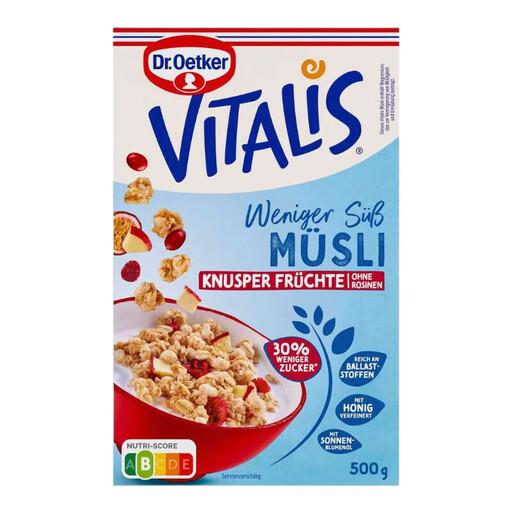 No image available
One to compare more closely if you’re looking for a fruity muesli with a crunchy texture. The pack contains 500 g; check the nutrition information and ingredients for the version on offer before deciding.
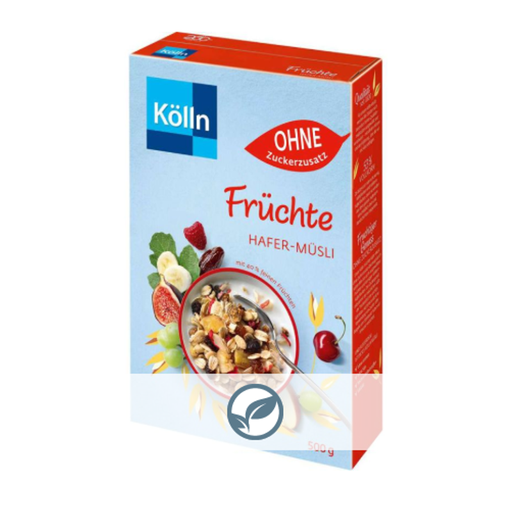 No image available
A fruity option to compare if the ingredients in your muesli matter to you. The product name states that it contains 50 % fruit, and the pack contains 500 g. Also check the ingredients list and the sugar and fibre content on the specific pack.
Under EU Regulation (EC) No 1924/2006, a food must contain at least 6 g of fibre per 100 g or at least 3 g per 100 kcal to make a ‘high fibre’ claim. A wholegrain claim alone doesn’t answer this question; compare the fibre content on the specific pack.
You can’t assume this applies to every pack based on online information alone. Nestlé Cereals Deutschland currently lists 6.4 g of fibre per 100 g, while Müller Deutschland lists 5 g per 100 g for one of its products. As Nestlé says that packs with different recipes may be on sale at the same time when a recipe changes, check the nutrition table on the pack you’re planning to buy.
Check the ingredients list and allergen information on the specific pack, especially for cereals, nuts and soya. For Müsli Ballaststoff & Frucht, Seitenbacher lists ingredients including wheat, oats, spelt, barley, soya and almonds. You can’t assume these ingredients are also in other fruit mueslis.
Compare the value per 100 g with the amount you actually eat. For Müsli Ballaststoff & Frucht, Seitenbacher gives 12 g of fibre per 100 g and 5 g for a stated 40 g portion. The German Nutrition Society recommends that adults get at least 30 g of fibre a day; a single portion is only part of that.