What should you look for when buying?
First, compare the amount you actually plan to eat. Then check the nutrition information and ingredients list to see whether the bar meets your other requirements too.
| Criteria |
What to check |
Who it matters to |
| Protein per bar |
Check the protein in g per 100 g and the pack weight for the same variety, then calculate the amount per bar you’ll eat. |
After a workout, I want to know how much protein is in my individual snack, rather than confusing a percentage with grams. For around 40% of consumers, this question of portion size is the main consideration. |
| Other nutrition information and ingredients |
Compare sugar, fat and energy per 100 g or per serving, as well as the ingredients list. |
If I’m also eating or drinking at the market, I don’t want to choose a bar based on its protein claim alone. Around 30% of consumers prioritise these other details. |
| Plant-based ingredients and allergens |
Check the current ingredients list, highlighted allergens and any precautionary ‘may contain’ statements for the variety you want. |
For my choice, I first need to know what ingredients the bar contains and which allergens are highlighted. This is the main concern for around 20% of consumers. |
| Availability before your visit |
Check whether your chosen store stocks the variety you want; if it’s a promotional item, plan an alternative. |
I want to buy my snack before visiting the market and avoid relying on a particular variety that may change. Around 10% of consumers put this kind of planning first. |
Brands to help you choose
These examples illustrate different types of bars and ranges. For a nutrition comparison, look at the specific product, not the brand as a whole.
ALDI SPORTS
ALDI Nord and ALDI SÜD stock different bars in the ALDI SPORTS range. Check which variety and pack size you have in front of you.
- For the 45 g pack of Filled Protein Riegel Strawberry Yogurt, ALDI SÜD lists 34 g of protein per 100 g; that works out to around 15.3 g per bar.
- The High-Protein-Riegel from ALDI Nord is a different product, listed as containing 31 g of protein per 100 g. Don’t apply its figures to the ALDI SÜD variety.
REWE PWR
REWE PWR is an own-brand range with several protein bars. When the range launched on 1 September 2026, REWE announced six bars.
- Several 45 g varieties give you a choice of bars within the same range.
- Numbers such as “30” or “50” in a product name don’t replace the protein per serving or the other nutrition information for that particular variety.
Corny
Corny may appeal to shoppers looking for a bar that combines cereal and protein. Check the product type for each variety individually.
- REWE includes Corny Nuts & Protein Chocolate in its protein bar range.
- The name alone doesn’t tell you how much protein is in the portion you’ll eat, or its sugar content or allergens; check the details on the specific pack.
KoRo
KoRo is one option if you’re looking for protein bars labelled as plant-based.
- Among the vegan-filtered protein bars it lists, REWE includes KoRo varieties, including a chocolate brownie bar in a 55 g pack.
- Being classified as vegan doesn’t mean that every variety has the same protein content or is free from allergens.
On-the-go bars on Joybuy
This selection includes portion-sized protein bars for on-the-go, including one variety with cereal ingredients and a bar labelled as vegan. Not every product is a granola bar, so compare the serving size, ingredients and nutrition information for each one.
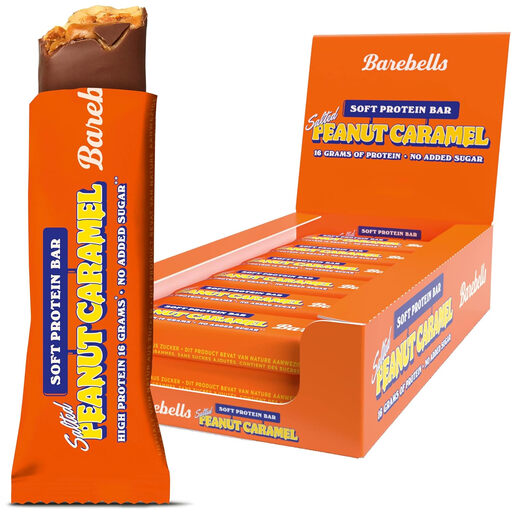 Image unavailable
Barebells Soft Protein Bar Salted Peanut Caramel, 12 × 55 g
An option if you’d like an individually portioned bar to enjoy after a workout or while you’re out and about.
A 55 g bar is listed as containing 16 g of protein and 2.1 g of sugar. The product information lists milk and peanuts, as well as the sweeteners maltitol, xylitol and sucralose; excessive consumption may have a laxative effect. If you have allergies, check the current packaging.
View on Joybuy
 Image unavailable
Power System Low Carb Cookies & Cream Protein Bar, 40 g
For a single 40 g snack, you can calculate the protein content from the figure per 100 g.
At 45 g of protein per 100 g, that works out to 18 g per bar; the listed sugar content is 2.5 g per 100 g. Check the current packaging for energy figures per 100 g and per bar. The product information lists milk and soya, as well as possible traces of other allergens; it also warns that excessive consumption may have a laxative effect.
View on Joybuy
 Image unavailable
Corny Protein Crunchy Vanilla & White Choc Flavour, 12 × 45 g
If you’re looking for a bar with oats and cereal crispies, this Corny variety offers a different option from a bar with no cereal ingredients listed.
At 30 g of protein per 100 g, a 45 g bar works out to 13.5 g; the listed sugar content is 3.2 g per 100 g. The product information is contradictory about ingredients containing gluten and a gluten-free claim. If you have a gluten intolerance, don’t rely on the claim; check the current packaging instead, and review the other allergen information too.
View on Joybuy
 Image unavailable
Barebells Vegan Protein Bar Peanut Caramel, 12 × 55 g
A bar labelled as vegan for shoppers looking for a portion-sized snack to take with them.
The protein figures for the 55 g bar don’t match: the description states 15 g, while the nutrition table gives 14.3 g. Check the figure on the current packaging. The listed ingredients include peanuts, wheat protein and soya protein; vegan doesn’t mean allergen-free.
View on Joybuy
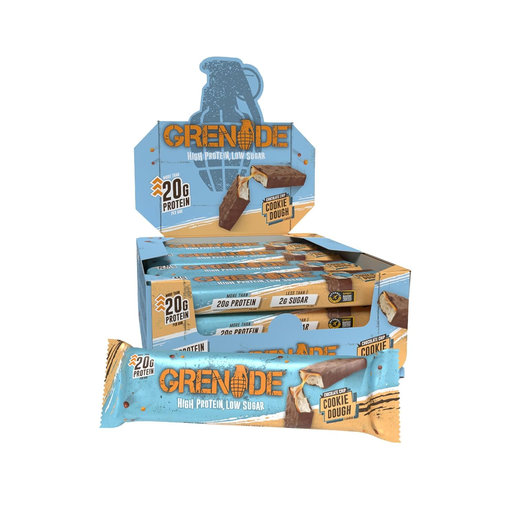 Image unavailable
Grenade Carb Killa Choc Chip Cookie Dough, 12 × 60 g
A portion-sized protein bar to enjoy on the go or after physical activity.
The product description lists 21 g of protein per 60 g bar. If you also want to compare sugar and other nutrients, check the full nutrition information on the current packaging. The product information lists milk and soya, and warns of a possible laxative effect from the polyols if consumed in excess.
View on Joybuy
Frequently asked questions
Should I compare protein percentages or grams?
To find out how much protein is in the bar you eat, compare grams of protein per serving. If the pack only gives the figure per 100 g, calculate it based on the bar’s weight. As the Verbraucherzentrale NRW explains, 20% protein in a 50 g bar isn’t the same as 20 g of protein per bar.
Is a protein bar automatically a better choice than a granola bar?
No, the name alone doesn’t determine that. If knowing how much protein you’re getting matters to you, compare the grams for the amount you’ll actually eat. For both types of bar, you should also consider sugar, fat, energy, ingredients and allergens. A bar won’t offset alcohol consumption.
Is “vegan” enough if I need to avoid allergens?
No. Check the highlighted allergens in the ingredients list for the specific variety, and look out for any precautionary ‘may contain’ statements. A recipe labelled as plant-based could, for example, contain peanuts, soya or wheat.
How should I take a bar with me to the Christmas market?
Keep it in its original packaging until you’re ready to eat it, and follow the storage instructions and best-before date on the pack. If you want to buy a particular variety before your visit, check what’s available at your chosen store too.


