
Lieferung heute & morgen

Qualitätsgarantie

Willkommens-Angebote freischalten: KOSTENLOSE Lieferung | Bis zu 80 % RABATT | Kostenlose 30-Tage-JoyPlus-Testphase
App herunterladen
Premium ambient lighting can transform a vehicle's interior, creating a modern, personalised atmosphere. But the market for retrofit kits is saturated and full of products whose marketing promises often fall short in practice. Many vehicle owners invest in systems that soon disappoint with uneven illumination, flickering lights, or a frustrating user experience.
Before you make a decision, it's crucial to understand the common pitfalls. This guide highlights the three most frequent flaws in retrofit kits and explains which technical features to look for to avoid a bad purchase and find a durable, visually appealing solution for your vehicle.
The disappointment after installation is often immense when the result doesn't meet expectations. Pay close attention to these three weaknesses found in many available kits:
To avoid the problems mentioned above, you should base your choice on objective technical parameters. These three criteria are crucial for the quality and longevity of your new car LED interior lighting.
The key to even, high-quality illumination lies in the type of light guide used. Instead of simple optical fibres, higher-quality systems rely on acrylic light guides.
Reliable app-controlled interior lighting is essential. Look for product descriptions that mention specific app names (e.g., "Lotus Lantern," "Magic Lantern"), as this indicates established software. Even more important is the hardware architecture:
The designation "10-in-1" or "18-in-1" indicates how many individual parts a kit contains. What matters is not just the number, but also the type of components and their flexibility.
Based on the criteria above, we have identified several products suitable for different user profiles and requirements.
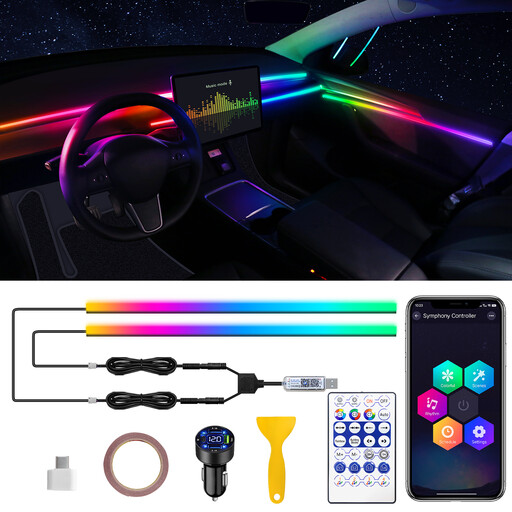
Why it's a match: Ideal for users who want a quick and easy dashboard upgrade without tapping into the vehicle's electronics. The USB or Type-C power supply makes installation extremely straightforward.
This kit completely bypasses the complex wiring pitfall. It simply plugs into an existing USB port, making installation a matter of minutes.
The acrylic light guides ensure even illumination. Control is flexible via app, remote control, or a touch button.

Why it's a match: For vehicle owners looking for a complete and integrated solution. The 18-in-1 kit covers the dashboard, all four doors, the footwell, and even the door storage bins for a professional, all-encompassing look.
The acrylic technology prevents hotspots and ensures a uniform line of light. The multi-controller system (1 main, 4 sub-controllers) significantly simplifies the wiring for such a comprehensive installation.
Offers dual-zone control, allowing different areas of the car to be lit independently. The extensive kit contents enable full customisation.
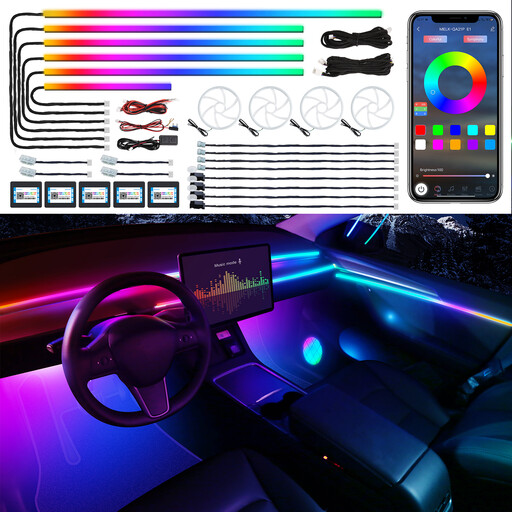
Why it's a match: For enthusiasts who don't want to compromise. This 22-in-1 kit offers the maximum scope, including rare components like lighting for the door speakers, for a unique show-car look.
Despite its enormous scope, the multi-controller system keeps the installation manageable. The high-quality acrylic light guides guarantee a premium and uniform lighting effect even with this level of complexity.
The largest kit available on the market, allowing for complete and detailed illumination of the entire interior, including the speaker grilles.
We have compiled a complete, up-to-date list of products that fully meet these strict selection criteria and all applicable regulations.
Yes, most universal retrofit kits are designed to be installed in virtually any vehicle model. The key is that the light strips are trimmable to fit the length of the dashboard and door panels. Power is typically supplied via the 12V socket (cigarette lighter) or by hardwiring to the fuse box, making them independent of the vehicle manufacturer.
The installation effort depends heavily on the scope of the kit. Simple systems that only light the dashboard and are powered by USB can often be installed in under 30 minutes. Comprehensive kits that also include doors and the footwell require more work, as this involves removing interior trim panels. Most kits include specialised pry tools for this purpose. However, systems with sub-controllers for each door can reduce the wiring effort, as not all cables need to be routed centrally to the front.
Modern LED technology is extremely energy-efficient. The power consumption of an ambient lighting system is minimal during operation and does not place a significant additional load on the alternator. Most systems are connected to ignition-switched power, so they turn off automatically when the engine is switched off. If connected to a constant power source, care should be taken to ensure the system is turned off completely, either manually or via the app, to prevent battery drain during long periods of non-use. Many control units feature an energy-saving standby mode.