
Lieferung heute & morgen

Qualitätsgarantie

Willkommens-Angebote freischalten: KOSTENLOSE Lieferung | Bis zu 80 % RABATT | Kostenlose 30-Tage-JoyPlus-Testphase
App herunterladen
A high-quality lined A5 notebook should be reliable in a school bag, rucksack or on your desk. Many shoppers initially focus on an attractive cover. For everyday use, however, other factors are more important: paper weight, binding, format, closure and the actual features included.
Whether you need it for taking notes, journalling, lists, creative ideas or as a gift for stationery lovers, the following selection criteria will help you assess marketing claims and avoid disappointing purchases.
A floral notebook or journal with a botanical design can look decorative. However, appearance alone says nothing about stability. A thin softcover can bend more quickly in a rucksack than a hardcover notebook. If you carry your notebook around frequently, check whether the binding is sufficiently sturdy and whether the book opens flat.
A fabric cover is not automatically hard-wearing either. Fabric, foil-stamped details and embossed elements should be protected from moisture and cleaned carefully. If you use your notebook every day while out and about, you should take this maintenance into account.
The term “premium paper” is not particularly informative without a technical specification. The key factor is paper weight, measured in g/m². An A5 notebook with 100 g/m² paper generally offers greater paper thickness than a model with 70 or 80 g/m². This can make a difference when writing with a ballpoint pen, gel pen or fountain pen.
Even so, show-through also depends on the ink and the line width. A paper weight of 100 g/m² is therefore a useful benchmark for comparison, but it is not a guarantee for every writing situation.
Product specifications often show “96 Sheets” and “192 Pages” alongside each other. In this case, that means 96 sheets or 192 writable pages. If you want to collect notes over a longer period, you should also pay attention to the ruling and the usable page area. An A5 journal with wide margins may offer less writing space despite having a high page count.
The A5 format measures approximately 14.8 × 21 cm. It provides enough room for lecture notes, minutes, longer diary entries and organised lists. This format is versatile enough for use at your desk, at university or in the office.
An A6 notebook, measuring approximately 10.5 × 14.8 cm, is considerably more compact. It fits more easily into smaller bags and is ideal for brief notes, shopping lists or spontaneous ideas. If you often write while out and about, you can use an A6 model alongside an A5 writing journal.
Look out for three specific details:
According to the respective product specifications, the A5 models presented here feature 100 g/m² offset or wood-free ivory paper. The Lamy A6 model is described as having 90 g/m² paper and 192 pages.
An integrated bookmark makes it easier to find the last page you used. An elastic band keeps the book closed and can prevent loose papers from falling out. A pen loop is useful if you want to keep your writing instrument with your notebook.
Not every feature is essential for every user. If you only write in the office, you may not need an elastic band. For commuters, students and journal fans, however, these details can make everyday use easier.
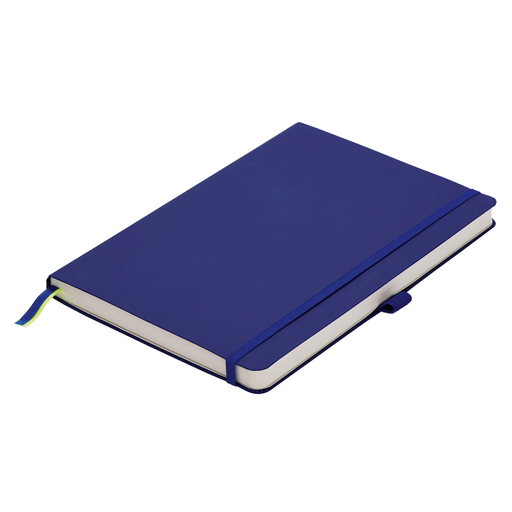
Why this product suits this profile: The compact A6 format is ideal for school pupils, students and professionals who want to jot down brief notes or sketches while out and about.
The specifications clearly state the format, paper weight and page count instead of relying only on vague quality claims.
192 ivory-coloured pages, 90 g/m² paper, pen loop, two ribbon bookmarks and a rear pocket.
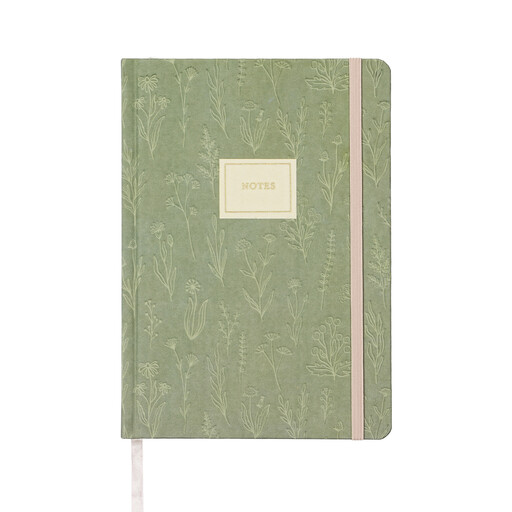
Why this product suits this profile: The A5 format, sturdy fabric cover and nature-inspired appearance are well suited to writing journals, diaries and a carefully organised workspace.
Rather than offering a purely decorative cover, it features a hardcover binding and clearly specified 96 sheets of 100 g/m² paper.
192 lined pages, fabric cover with decorative embossed or foil-stamped details, bookmark and elastic band.
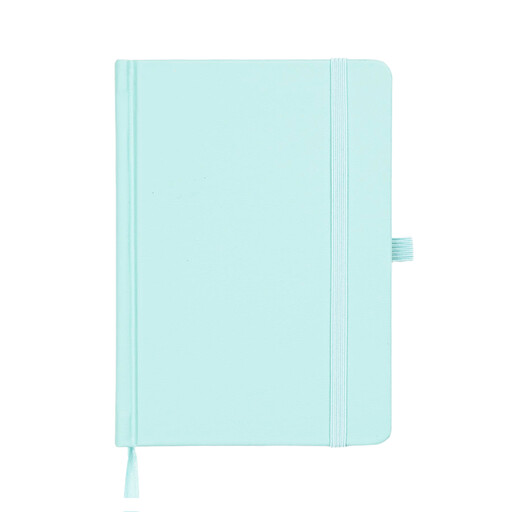
Why this product suits this profile: The handy format is suitable for commuters, frequent users and creative writers who prefer a complete writing set for use on the go.
The product description clearly specifies the PU leather cover, paper weight and integrated accessories. This makes it easier to check the features before buying.
160 pages across 80 sheets, 100 g/m² paper, bookmark, elastic band and notebook with pen loop.
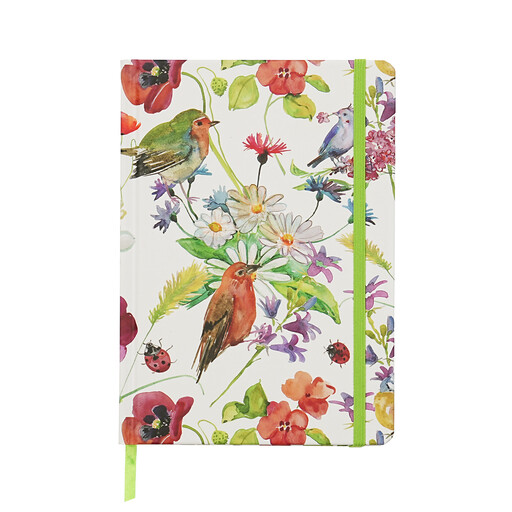
Why this product suits this profile: This floral notebook combines botanical design with clearly specified features and also makes a suitable gift for stationery lovers.
The decorative cover is supported by specific details about the format, paper, page count and accessories. The design therefore does not replace the functional specifications.
A5 format, 192 pages with 100 g/m² offset paper, botanical print, bookmark and elastic closure.
We have put together a complete, regularly updated list of products that fully meet these strict selection criteria and the safety regulations applicable in the EU.
Simple measures can help keep a notebook looking neat for longer:
Yes, the format provides enough writing space for taking notes, planning and journalling, while still being reasonably portable. An A6 notebook is more practical for very small bags.
100 g/m² paper is thicker than many standard notebook papers. However, whether it works well with a particular fountain pen or ink depends on the ink flow, nib width and writing pressure. For important applications, it is advisable to carry out your own writing test.
That depends on how you intend to use it. Around 190 pages is practical for a diary or regular study notes. A more compact book with fewer pages may be sufficient for short to-do lists or spontaneous ideas. The key is to compare the page count, sheet count and format correctly.