
Lieferung heute & morgen

Qualitätsgarantie

Willkommens-Angebote freischalten: KOSTENLOSE Lieferung | Bis zu 80 % RABATT | Kostenlose 30-Tage-JoyPlus-Testphase
App herunterladen
High-quality wooden toys for babies and children should be age-appropriate, safely made, and practical for everyday family life. However, product descriptions often use vague terms like “educationally valuable” without giving concrete details about materials, dimensions, or small parts. For parents, grandparents, and other family members, it’s worth taking a closer look at the actual product features.
A toy might appeal to toddlers but still contain small balls, magnets, or detachable pieces. One example is the MIMI Wooden Tabletop Balance Ball Game: the game board includes a small metal ball and, according to the product information, is not suitable for children under three years old. It should only be used under supervision.
The age rating is therefore not just a decorative note – it’s an important factor in your buying decision. For products aimed at babies and children from 1 year old, parents should pay particular attention to warnings about choking, inhalation, and unsupervised use.
The material name alone tells you little about how well the toy will hold up in daily use. Check whether the product is made from solid wood or engineered wood, whether the surfaces are smooth, and whether edges have been rounded. For toys intended for younger children, the stability of handles, push-fit connections, and moving parts is also important.
An FSC-certified wooden toy can additionally indicate that the wood used comes from certified, traceable sources. However, this certification does not replace the need to check the workmanship, age recommendation, and safety instructions.
A toy with lots of colours, sounds, and interchangeable elements isn’t automatically more versatile. For babies and toddlers, a clearly defined task – such as sorting, posting, or stacking – can be easier to understand. So look for a toy whose function matches your child’s developmental stage and attention span.
The manufacturer’s age recommendation should match the actual play situation. For children from 1 year old, for example, simple wooden puzzles with large handles, sorting toys, or sturdy stacking toys are suitable. Products with small balls, magnets, or detachable small parts should only be given to the intended age group.
Even with age-appropriate motor skills toys, regular checks are a good idea. Remove any parts that show cracks, splinters, loose connections, or visible damage straight away.
Look for:
A wooden baby play arch should only be used on a flat, stable surface. Before each use, check the fixings and components for damage. The play arch is not a climbing frame and must not be used unsupervised.
The dimensions determine whether a product can be used sensibly in a child’s bedroom, on the living room table, or on the go. A compact wooden puzzle, for example, fits into a shelf or a travel bag. A wooden rocking horse, on the other hand, needs plenty of clear floor space and a stable base.
Think before you buy about which skill the toy is designed to develop: a wooden posting toy trains shape matching, a sorting toy combines colours and categories, while a stacking toy also makes sequences and size differences visible. “Promotes fine motor skills” doesn’t mean every child has to complete the same task at the same speed. Free exploration and repetition are all part of play.
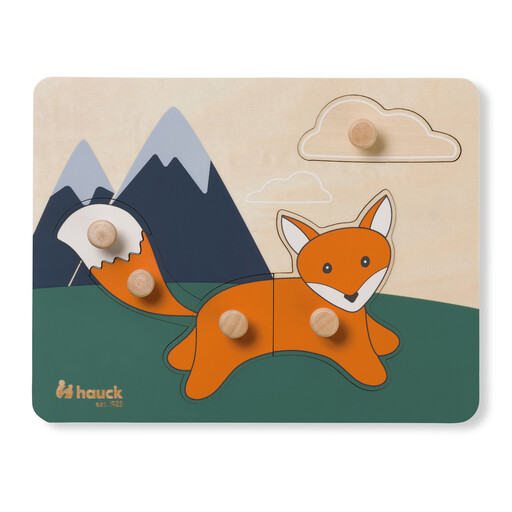
Why this product fits the profile: This wooden puzzle is designed for children from 12 months and offers a straightforward task with animal motifs and easy-to-grip wooden handles.
The clear puzzle function avoids an overload of features. Rounded edges and the stated suitability from 12 months make pre-selection easier.
FSC-certified wood according to the product information, dimensions of 22 × 17 × 2 cm, and wooden handles for lifting out the pieces.
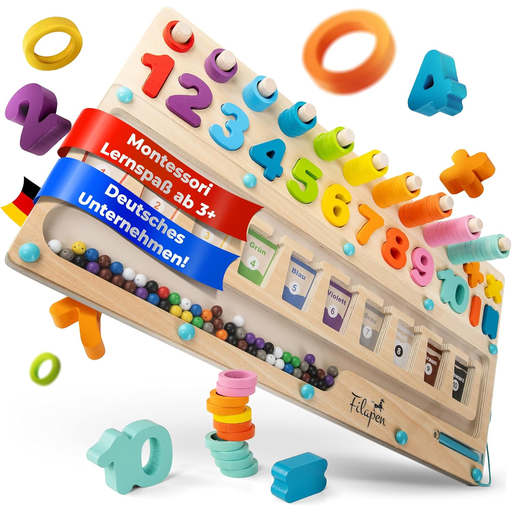
Why this product fits the profile: This magnetic maze combines colour sorting, numbers from 1 to 10, and a fine motor skills task on a compact wooden board.
The product information states the material, age recommendation, and specific play tasks. Because of the small parts, direct adult supervision is required.
Solid wood, no batteries required, and according to the manufacturer suitable for learning steps from colours and numbers through to simple counting.
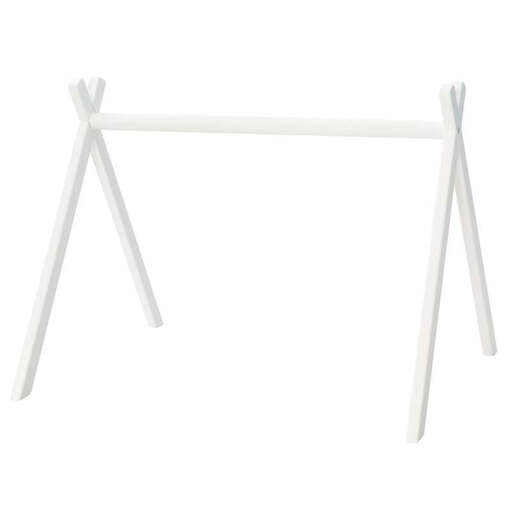
Why this product fits the profile: This play arch is aimed at families looking for a fixed activity for grasping, touching, and exploring in the baby area.
The product information states the dimensions of 52 × 70 × 50.5 cm, the need for a level surface, and the necessary supervision. This lets you check the space requirements before buying.
Varnished wooden surfaces are wipeable according to the product information; additional play sets are available separately.
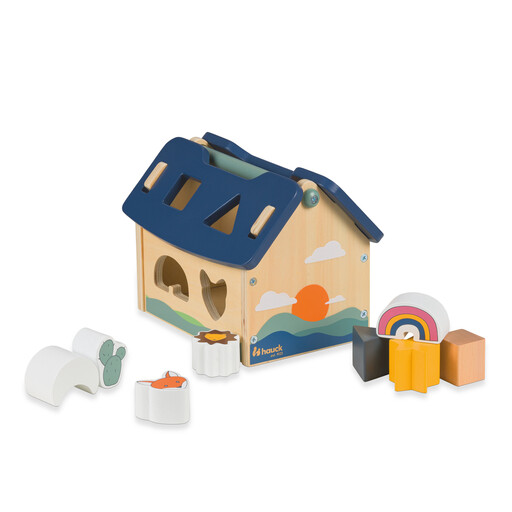
Why this product fits the profile: This wooden house combines shape posting, sorting, and storage. It’s suitable for families looking for a clear motor skills toy with several play variations.
The eight building blocks and the removable roof structure are described in detail. The pieces can be stored inside the house after play.
FSC-certified wood according to the product information, carrying handle, and intended use from 12 months.
We’ve put together a complete, regularly updated list of products that fully meet these strict selection criteria and the safety regulations in force in the EU.
For children from 12 months, depending on the manufacturer’s recommendation, simple wooden puzzles, posting toys, sorting toys, and stacking toys are suitable. What matters are large, easy-to-grip pieces, rounded edges, and a clear warning about small parts. The specific age rating of each product is the deciding factor.
The lifespan depends on the material, workmanship, use, and care. Store wooden toys in a dry place, clean them according to the manufacturer’s instructions, and regularly check edges, varnish, screws, and push-fit connections. Damaged or splintering parts should not be used any further.
No. “Montessori” in many product names describes a particular play concept or design, but it is not a safety guarantee on its own. You should also check the age rating, small parts, material information, workmanship, stability, and the instructions about supervision.