
Lieferung heute & morgen

Qualitätsgarantie

Willkommens-Angebote freischalten: KOSTENLOSE Lieferung | Bis zu 80 % RABATT | Kostenlose 30-Tage-JoyPlus-Testphase
App herunterladen
A highchair needs to do more than just bring your baby up to table height. It has to suit their age, their size, your dining area and your family's daily routine. With budget or heavily advertised models, it's easy to overlook important details: a non-adjustable footrest can restrict their sitting position, a difficult-to-clean cover creates extra work, and unclear age or weight guidance can quickly lead to the wrong choice.
This buying guide highlights the features that really matter before you purchase, and which models suit different needs.
Claims like "suitable up to adulthood" or a high weight capacity sound convincing at first. What really matters, however, is which configuration is intended for which age group. A highchair for babies from 6 months needs different safety features than a later child's or adult chair.
So check the following:
A highchair with a tray can make mealtimes and cleaning easier. However, the tray should never be used as a grab handle, a climbing aid or the sole safety restraint. Children can push against it or lean on it. A sturdy construction, a suitable 5-point harness or a correctly fitted restraint system, and a proper footrest remain essential.
Wooden surfaces can usually be wiped clean with a damp cloth, but shouldn't stay wet for long. Covers made from polyester or faux leather can be practical for spills, but differ in how they are washed and cared for. Look out for:
Many models are designed from 6 months, but only if your child can sit up unsupported. Age alone isn't a reliable guide. You also need to consider the maximum weight for each stage of use.
A classic baby highchair like the Chicco Polly Easy is, according to the product details, suitable for children from 6 months up to a maximum of 15 kg. A growing wooden highchair, on the other hand, can be designed to hold up to 70, 90 or 120 kg depending on the model. These figures don't automatically apply to the same seat configuration.
For small children, a correctly adjusted restraint system is especially important. A highchair with a 5-point harness distributes the restraint across the shoulders, hips and crotch. Models with a 3-point harness can also be suitable, but require careful attention to the manufacturer's instructions.
Also look for references to the EN 14988 standard. It describes safety requirements for highchairs, but doesn't replace correct assembly and use. Before every use, check the locks, screws, harness and the base. Never leave your child unattended in the chair.
A height-adjustable highchair isn't just practical for different table heights. Adjustable seat and foot positions allow you to adapt it to your child's height. Their feet should be able to rest firmly on a surface, rather than dangling freely.
A wooden highchair with multiple seat and footboard positions is often suitable for longer-term use. A foldable highchair with a limited seat height, on the other hand, can be a better choice if you have limited storage space or need to transport it regularly.
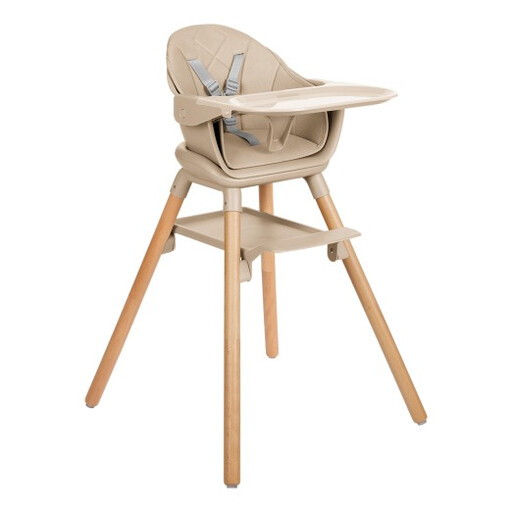
Why this product fits the profile: The 6-in-1 design covers several seating options and is suitable for children from around 6 months to 6 years.
The age and weight limits are separated by use: up to 15 kg in highchair mode and up to 25 kg as a junior chair. The 5-point harness is intended for the early stage.
Double, removable tray, adjustable footrest and wipe-clean cover. The feet are designed to be non-slip.
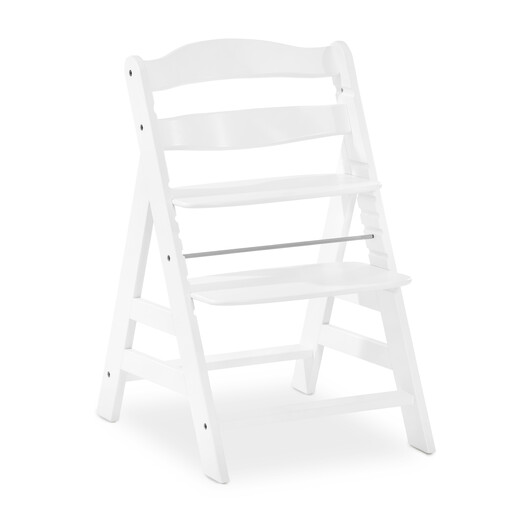
Why this product fits the profile: This wooden chair is designed for long-term use and offers adjustable seat and foot positions for different growth stages.
The product details state use from 6 months up to 12 years as a highchair, with a maximum load capacity of 90 kg. The 5-point harness is included.
European FSC-certified beech wood according to the product description, five seat heights and three footboard positions.

Why this product fits the profile: The foldable design is practical for small flats, visits to grandparents or frequent changes of location.
The construction is not only space-saving, but also states clear limits: suitable from 6 months up to 15 kg. The 5-point harness must be used every time.
Height-adjustable, removable XL tray, storage basket and a cover that can be washed at 40 °C according to the product details.
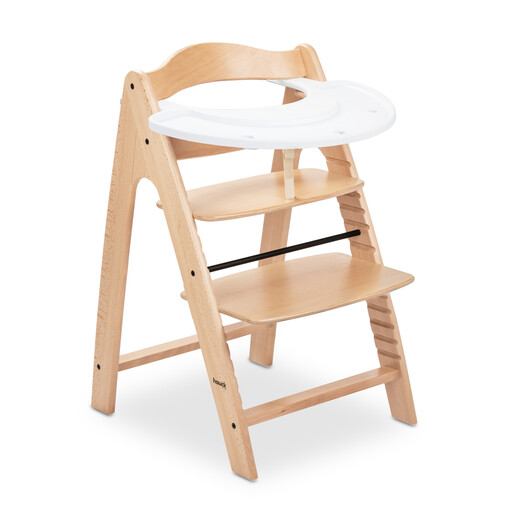
Why this product fits the profile: The combination of adjustable positions, a wooden frame and a play tray is aimed at families who want a versatile setup.
The seat and foot positions are adjustable in 13 stages. The scope of delivery includes a 5-point harness, a safety bar and a wipe-clean Click Tray.
FSC-certified beech wood according to the product description, GRS-certified recycled material for the play tray and a stated load capacity of up to 130 kg.
We've put together a complete, regularly updated list of products that fully meet these strict selection criteria and the safety regulations in force in the EU.
Before ordering a highchair, compare these points:
A highchair for babies from 6 months is often intended for children who can already sit up unsupported. Always follow the age and safety instructions from the specific manufacturer. A baby should not be placed in the chair just because they have reached a certain month of age.
That depends on the construction, weight capacity and accessories. Some models are designed as a child's chair up to adulthood, while compact baby highchairs are only intended for up to about 15 kg or three years. Check the limits for each individual stage of use.
A foldable highchair can be suitable for everyday life if the locking mechanism, stability and cleaning properties meet your needs. Before each use, the folding mechanism must be fully locked into place. For small spaces or transport, this design offers practical advantages; for long-term use, adjustable wooden models are often designed differently.